| Record Information |
|---|
| Version | 2.0 |
|---|
| Created at | 2022-03-17 21:09:39 UTC |
|---|
| Updated at | 2022-03-17 21:09:39 UTC |
|---|
| NP-MRD ID | NP0049262 |
|---|
| Secondary Accession Numbers | None |
|---|
| Natural Product Identification |
|---|
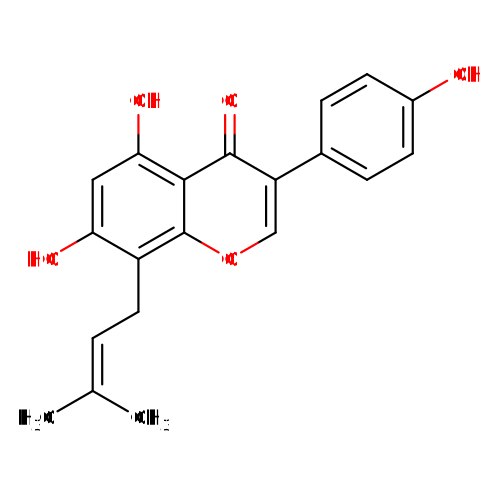
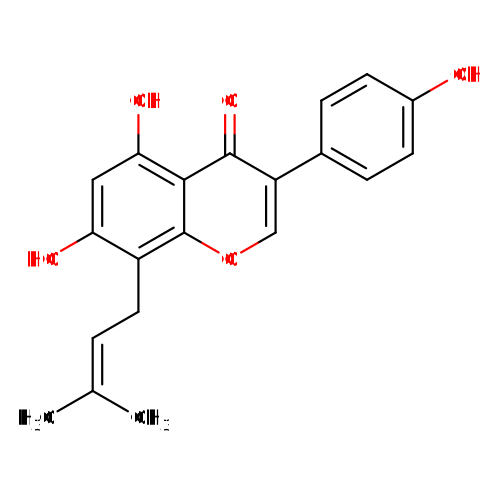
| Common Name | Lupiwighteone |
|---|
| Description | Lupiwighteone belongs to the class of organic compounds known as isoflavones. These are polycyclic compounds containing a 2-isoflavene skeleton which bears a ketone group at the C4 carbon atom. Thus, lupiwighteone is considered to be a flavonoid lipid molecule. Lupiwighteone is a very hydrophobic molecule, practically insoluble (in water), and relatively neutral. Outside of the human body, Lupiwighteone has been detected, but not quantified in, a few different foods, such as adzuki beans, herbs and spices, and pulses. Lupiwighteone is found in Anthyllis hermanniae, Bolusanthus speciosus, Curcuma mangga , Erythrina sigmoidea, Erythrina variegata L. , Glycyrrhiza glabra , Glycyrrhiza inflata , Glycyrrhiza uralensis , Lupinus albus, Lupinus luteus , Pueraria montana, Pueraria montana var. lobata and Derris scandens . This could make lupiwighteone a potential biomarker for the consumption of these foods. |
|---|
| Structure | CC(C)=CCC1=C2OC=C(C(=O)C2=C(O)C=C1O)C1=CC=C(O)C=C1 InChI=1S/C20H18O5/c1-11(2)3-8-14-16(22)9-17(23)18-19(24)15(10-25-20(14)18)12-4-6-13(21)7-5-12/h3-7,9-10,21-23H,8H2,1-2H3 |
|---|
| Synonyms | | Value | Source |
|---|
| 5,7,4'-Trihydroxy-8-prenylisoflavone | HMDB | | 5,7-Dihydroxy-3-(4-hydroxyphenyl)-8-(3-methyl-2-butenyl)-4H-1-benzopyran-4-one, 9ci | HMDB |
|
|---|
| Chemical Formula | C20H18O5 |
|---|
| Average Mass | 338.3539 Da |
|---|
| Monoisotopic Mass | 338.11542 Da |
|---|
| IUPAC Name | 5,7-dihydroxy-3-(4-hydroxyphenyl)-8-(3-methylbut-2-en-1-yl)-4H-chromen-4-one |
|---|
| Traditional Name | lupiwighteone |
|---|
| CAS Registry Number | 104691-86-3 |
|---|
| SMILES | CC(C)=CCC1=C2OC=C(C(=O)C2=C(O)C=C1O)C1=CC=C(O)C=C1 |
|---|
| InChI Identifier | InChI=1S/C20H18O5/c1-11(2)3-8-14-16(22)9-17(23)18-19(24)15(10-25-20(14)18)12-4-6-13(21)7-5-12/h3-7,9-10,21-23H,8H2,1-2H3 |
|---|
| InChI Key | YGCCASGFIOIXIN-UHFFFAOYSA-N |
|---|
| Experimental Spectra |
|---|
|
| Not Available | | Predicted Spectra |
|---|
|
| Not Available | | Chemical Shift Submissions |
|---|
|
| Not Available | | Species |
|---|
| Species of Origin | |
|---|
| Chemical Taxonomy |
|---|
| Description | Belongs to the class of organic compounds known as isoflavones. These are polycyclic compounds containing a 2-isoflavene skeleton which bears a ketone group at the C4 carbon atom. |
|---|
| Kingdom | Organic compounds |
|---|
| Super Class | Phenylpropanoids and polyketides |
|---|
| Class | Isoflavonoids |
|---|
| Sub Class | Isoflav-2-enes |
|---|
| Direct Parent | Isoflavones |
|---|
| Alternative Parents | |
|---|
| Substituents | - Hydroxyisoflavonoid
- Isoflavone
- Chromone
- Benzopyran
- 1-benzopyran
- 1-hydroxy-2-unsubstituted benzenoid
- Pyranone
- Phenol
- Monocyclic benzene moiety
- Benzenoid
- Pyran
- Heteroaromatic compound
- Vinylogous acid
- Oxacycle
- Organoheterocyclic compound
- Organic oxygen compound
- Organooxygen compound
- Hydrocarbon derivative
- Organic oxide
- Aromatic heteropolycyclic compound
|
|---|
| Molecular Framework | Aromatic heteropolycyclic compounds |
|---|
| External Descriptors | |
|---|
| Physical Properties |
|---|
| State | Not Available |
|---|
| Experimental Properties | | Property | Value | Reference |
|---|
| Melting Point | Not Available | Not Available | | Boiling Point | Not Available | Not Available | | Water Solubility | Not Available | Not Available | | LogP | Not Available | Not Available |
|
|---|
| Predicted Properties | |
|---|