| Record Information |
|---|
| Version | 2.0 |
|---|
| Created at | 2022-03-17 21:06:21 UTC |
|---|
| Updated at | 2022-03-17 21:06:22 UTC |
|---|
| NP-MRD ID | NP0049052 |
|---|
| Secondary Accession Numbers | None |
|---|
| Natural Product Identification |
|---|
| Common Name | alpha-Bisabolol oxide B |
|---|
| Description | Alpha-Bisabolol oxide B, also known as α-bisabolol oxide b, belongs to the class of organic compounds known as tetrahydrofurans. These are heterocyclic compounds containing a saturated, aliphatic, five-membered ring where a carbon is replaced by an oxygen. Alpha-Bisabolol oxide B is an extremely weak basic (essentially neutral) compound (based on its pKa). Outside of the human body, alpha-Bisabolol oxide B has been detected, but not quantified in, several different foods, such as fats and oils, german camomiles, herbs and spices, roman camomiles, and tea. alpha-Bisabolol oxide B is found in Chamaemalum nobile, Chamomilla rectita, Chamomilla recutina, Cinnamodendron corticosum, Ganoderma lucidum , Laggera pterodonta, Matricaria chamomilla , Melaleuca leucadendra L. , Saussurea involucrata and Stellaria pallida. This could make alpha-bisabolol oxide b a potential biomarker for the consumption of these foods. |
|---|
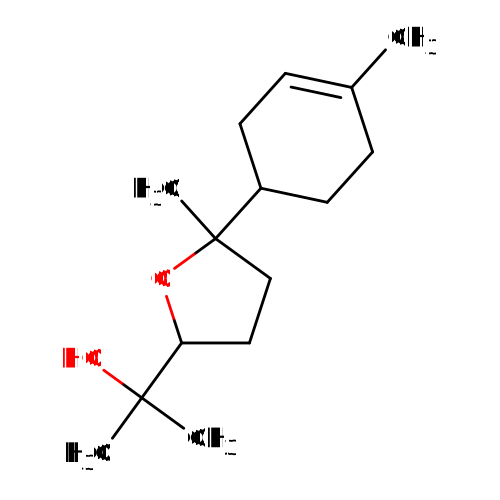
| Structure | CC1=CCC(CC1)C1(C)CCC(O1)C(C)(C)O InChI=1S/C15H26O2/c1-11-5-7-12(8-6-11)15(4)10-9-13(17-15)14(2,3)16/h5,12-13,16H,6-10H2,1-4H3 |
|---|
| Synonyms | | Value | Source |
|---|
| a-Bisabolol oxide b | Generator | | Α-bisabolol oxide b | Generator | | (-)-alpha-Bisabolol oxide b | HMDB | | (-)-Bisabolol oxide b | HMDB | | Bisabolol oxide b | HMDB | | Bisabolol oxide II | HMDB | | Bisabololoxide b | MeSH |
|
|---|
| Chemical Formula | C15H26O2 |
|---|
| Average Mass | 238.3657 Da |
|---|
| Monoisotopic Mass | 238.19328 Da |
|---|
| IUPAC Name | 2-[5-methyl-5-(4-methylcyclohex-3-en-1-yl)oxolan-2-yl]propan-2-ol |
|---|
| Traditional Name | 2-[5-methyl-5-(4-methylcyclohex-3-en-1-yl)oxolan-2-yl]propan-2-ol |
|---|
| CAS Registry Number | 26184-88-3 |
|---|
| SMILES | CC1=CCC(CC1)C1(C)CCC(O1)C(C)(C)O |
|---|
| InChI Identifier | InChI=1S/C15H26O2/c1-11-5-7-12(8-6-11)15(4)10-9-13(17-15)14(2,3)16/h5,12-13,16H,6-10H2,1-4H3 |
|---|
| InChI Key | RKBAYVATPNYHLW-UHFFFAOYSA-N |
|---|
| Experimental Spectra |
|---|
|
| Not Available | | Predicted Spectra |
|---|
|
| Not Available | | Chemical Shift Submissions |
|---|
|
| Not Available | | Species |
|---|
| Species of Origin | |
|---|
| Chemical Taxonomy |
|---|
| Description | Belongs to the class of organic compounds known as tetrahydrofurans. These are heterocyclic compounds containing a saturated, aliphatic, five-membered ring where a carbon is replaced by an oxygen. |
|---|
| Kingdom | Organic compounds |
|---|
| Super Class | Organoheterocyclic compounds |
|---|
| Class | Tetrahydrofurans |
|---|
| Sub Class | Not Available |
|---|
| Direct Parent | Tetrahydrofurans |
|---|
| Alternative Parents | |
|---|
| Substituents | - Tetrahydrofuran
- Tertiary alcohol
- Oxacycle
- Ether
- Dialkyl ether
- Organic oxygen compound
- Hydrocarbon derivative
- Organooxygen compound
- Alcohol
- Aliphatic heteromonocyclic compound
|
|---|
| Molecular Framework | Aliphatic heteromonocyclic compounds |
|---|
| External Descriptors | |
|---|
| Physical Properties |
|---|
| State | Not Available |
|---|
| Experimental Properties | | Property | Value | Reference |
|---|
| Melting Point | Not Available | Not Available | | Boiling Point | Not Available | Not Available | | Water Solubility | Not Available | Not Available | | LogP | Not Available | Not Available |
|
|---|
| Predicted Properties | |
|---|