| Record Information |
|---|
| Version | 2.0 |
|---|
| Created at | 2022-03-17 21:06:20 UTC |
|---|
| Updated at | 2022-03-17 21:06:20 UTC |
|---|
| NP-MRD ID | NP0049050 |
|---|
| Secondary Accession Numbers | None |
|---|
| Natural Product Identification |
|---|
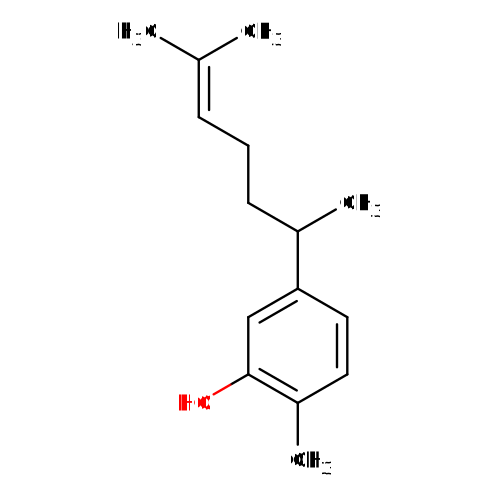
| Common Name | Xanthorrhizol |
|---|
| Description | Xanthorrhizol belongs to the class of organic compounds known as sesquiterpenoids. These are terpenes with three consecutive isoprene units. Xanthorrhizol is an extremely weak basic (essentially neutral) compound (based on its pKa). Outside of the human body, Xanthorrhizol is found, on average, in the highest concentration within gingers. Xanthorrhizol has also been detected, but not quantified in, a few different foods, such as beverages, herbs and spices, and root vegetables. Xanthorrhizol is found in Cinnamomum iners, Commiphora kua, Curcuma aromatica , Curcuma longa , Curcuma xanthorrhiza and Iostephane heterophylla. Xanthorrhizol was first documented in 2007 (PMID: 17465228). This could make xanthorrhizol a potential biomarker for the consumption of these foods (PMID: 21478819) (PMID: 18810881). |
|---|
| Structure | CC(CCC=C(C)C)C1=CC(O)=C(C)C=C1 InChI=1S/C15H22O/c1-11(2)6-5-7-12(3)14-9-8-13(4)15(16)10-14/h6,8-10,12,16H,5,7H2,1-4H3 |
|---|
| Synonyms | | Value | Source |
|---|
| (-)-5-(1,5-Dimethyl-4-hexenyl)-2-methylphenol | HMDB | | (R)-(-)-Xanthorrhizol | HMDB | | (R)-5-(1,5-Dimethyl-4-hexenyl)-O-cresol | HMDB | | (R)-5-(1-5-Dimethyl-4-hexenyl)-2-methylphenol | HMDB | | 5-(1,5-Dimethyl-4-hexenyl)-(-)-O-cresol | HMDB | | 5-(1,5-Dimethyl-4-hexenyl)-2-methyl-(-)-phenol | HMDB | | 5-(1,5-Dimethyl-4-hexenyl)-2-methylphenol | HMDB | | 5-(1,5-Dimethyl-4-hexenyl)-2-methylphenol, 9ci | HMDB | | 5-[(1R)-1,5-Dimethyl-4-hexenyl]-2-methyl-phenol | HMDB |
|
|---|
| Chemical Formula | C15H22O |
|---|
| Average Mass | 218.3346 Da |
|---|
| Monoisotopic Mass | 218.16707 Da |
|---|
| IUPAC Name | 2-methyl-5-(6-methylhept-5-en-2-yl)phenol |
|---|
| Traditional Name | 2-methyl-5-(6-methylhept-5-en-2-yl)phenol |
|---|
| CAS Registry Number | 30199-26-9 |
|---|
| SMILES | CC(CCC=C(C)C)C1=CC(O)=C(C)C=C1 |
|---|
| InChI Identifier | InChI=1S/C15H22O/c1-11(2)6-5-7-12(3)14-9-8-13(4)15(16)10-14/h6,8-10,12,16H,5,7H2,1-4H3 |
|---|
| InChI Key | FKWGCEDRLNNZOZ-UHFFFAOYSA-N |
|---|
| Experimental Spectra |
|---|
|
| Not Available | | Predicted Spectra |
|---|
|
| Not Available | | Chemical Shift Submissions |
|---|
|
| Not Available | | Species |
|---|
| Species of Origin | |
|---|
| Chemical Taxonomy |
|---|
| Description | Belongs to the class of organic compounds known as sesquiterpenoids. These are terpenes with three consecutive isoprene units. |
|---|
| Kingdom | Organic compounds |
|---|
| Super Class | Lipids and lipid-like molecules |
|---|
| Class | Prenol lipids |
|---|
| Sub Class | Sesquiterpenoids |
|---|
| Direct Parent | Sesquiterpenoids |
|---|
| Alternative Parents | |
|---|
| Substituents | - Bisabolane sesquiterpenoid
- Sesquiterpenoid
- P-cymene
- O-cresol
- 1-hydroxy-4-unsubstituted benzenoid
- 1-hydroxy-2-unsubstituted benzenoid
- Toluene
- Phenol
- Benzenoid
- Monocyclic benzene moiety
- Organic oxygen compound
- Hydrocarbon derivative
- Organooxygen compound
- Aromatic homomonocyclic compound
|
|---|
| Molecular Framework | Aromatic homomonocyclic compounds |
|---|
| External Descriptors | Not Available |
|---|
| Physical Properties |
|---|
| State | Not Available |
|---|
| Experimental Properties | | Property | Value | Reference |
|---|
| Melting Point | Not Available | Not Available | | Boiling Point | Not Available | Not Available | | Water Solubility | Not Available | Not Available | | LogP | Not Available | Not Available |
|
|---|
| Predicted Properties | |
|---|
| General References | - Mustaffa F, Indurkar J, Ismail S, Shah M, Mansor SM: An antimicrobial compound isolated from Cinnamomum iners leaves with activity against methicillin-resistant Staphylococcus aureus. Molecules. 2011 Apr 8;16(4):3037-47. doi: 10.3390/molecules16043037. [PubMed:21478819 ]
- Handayani T, Sakinah S, Nallappan M, Pihie AH: Regulation of p53-, Bcl-2- and caspase-dependent signaling pathway in xanthorrhizol-induced apoptosis of HepG2 hepatoma cells. Anticancer Res. 2007 Mar-Apr;27(2):965-71. [PubMed:17465228 ]
- Lee LY, Shim JS, Rukayadi Y, Hwang JK: Antibacterial activity of xanthorrhizol isolated from Curcuma xanthorrhiza Roxb. against foodborne pathogens. J Food Prot. 2008 Sep;71(9):1926-30. doi: 10.4315/0362-028x-71.9.1926. [PubMed:18810881 ]
|
|---|