Np mrd loader

Record Information
Version2.0
Created at2022-03-17 21:06:19 UTC
Updated at2022-03-17 21:06:19 UTC
NP-MRD IDNP0049049
Secondary Accession NumbersNone
Natural Product Identification
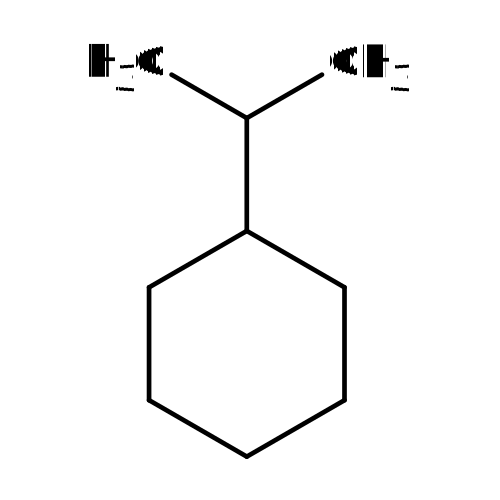
Common NameIsopropylcyclohexane
DescriptionIsopropylcyclohexane, also known as 2-cyclohexylpropane or hexahydrocumene, belongs to the class of organic compounds known as cycloalkanes. These are saturated monocyclic hydrocarbons (with or without side chains). Thus, isopropylcyclohexane is considered to be a hydrocarbon lipid molecule. Isopropylcyclohexane is a very hydrophobic molecule, practically insoluble (in water), and relatively neutral. Outside of the human body, Isopropylcyclohexane has been detected, but not quantified in, fruits and papaya. Isopropylcyclohexane is found in Artemisia monosperma. Isopropylcyclohexane was first documented in 1988 (PMID: 3373563). This could make isopropylcyclohexane a potential biomarker for the consumption of these foods (PMID: 19334733) (PMID: 22068299) (PMID: 20944862).
Structure
Thumb
Synonyms
ValueSource
(1-Methylethyl)-cyclohexaneHMDB
(1-Methylethyl)cyclohexane, 9ciHMDB
2-CyclohexylpropaneHMDB
Cyclohexane, isopropyl- (8ci)HMDB
HexahydrocumeneHMDB
Iso-propylcyclohexaneHMDB
Isopropyl-cyclohexaneHMDB
NormanthaneHMDB
(1-Methylethyl)cyclohexaneHMDB
IsopropylcyclohexaneMeSH
Chemical FormulaC9H18
Average Mass126.2392 Da
Monoisotopic Mass126.14085 Da
IUPAC Namepropan-2-ylcyclohexane
Traditional Nameisopropylcyclohexane
CAS Registry Number696-29-7
SMILES
CC(C)C1CCCCC1
InChI Identifier
InChI=1S/C9H18/c1-8(2)9-6-4-3-5-7-9/h8-9H,3-7H2,1-2H3
InChI KeyGWESVXSMPKAFAS-UHFFFAOYSA-N
Experimental Spectra
Not Available
Predicted Spectra
Not Available
Chemical Shift Submissions
Not Available
Species
Species of Origin
Species NameSourceReference
Artemisia monospermaLOTUS Database
Carica papaya L.FooDB
Chemical Taxonomy
Description Belongs to the class of organic compounds known as cycloalkanes. These are saturated monocyclic hydrocarbons (with or without side chains).
KingdomOrganic compounds
Super ClassHydrocarbons
ClassSaturated hydrocarbons
Sub ClassCycloalkanes
Direct ParentCycloalkanes
Alternative ParentsNot Available
Substituents
  • Cycloalkane
  • Aliphatic homomonocyclic compound
Molecular FrameworkAliphatic homomonocyclic compounds
External Descriptors
Physical Properties
StateNot Available
Experimental Properties
PropertyValueReference
Melting PointNot AvailableNot Available
Boiling PointNot AvailableNot Available
Water SolubilityNot AvailableNot Available
LogPNot AvailableNot Available
Predicted Properties
PropertyValueSource
logP4.5ALOGPS
logP3.69ChemAxon
logS-4.7ALOGPS
Physiological Charge0ChemAxon
Hydrogen Acceptor Count0ChemAxon
Hydrogen Donor Count0ChemAxon
Polar Surface Area0 ŲChemAxon
Rotatable Bond Count1ChemAxon
Refractivity41.3 m³·mol⁻¹ChemAxon
Polarizability16.88 ųChemAxon
Number of Rings1ChemAxon
BioavailabilityYesChemAxon
Rule of FiveYesChemAxon
Ghose FilterNoChemAxon
Veber's RuleYesChemAxon
MDDR-like RuleNoChemAxon
HMDB IDHMDB0038191
DrugBank IDNot Available
Phenol Explorer Compound IDNot Available
FoodDB IDFDB017430
KNApSAcK IDC00010859
Chemspider ID12239
KEGG Compound IDNot Available
BioCyc IDNot Available
BiGG IDNot Available
Wikipedia LinkNot Available
METLIN IDNot Available
PubChem Compound12763
PDB IDNot Available
ChEBI IDNot Available
Good Scents IDNot Available
References
General References
  1. Sprengnether MM, Demerjian KL, Dransfield TJ, Clarke JS, Anderson JG, Donahue NM: Rate constants of nine C6-C9 alkanes with OH from 230 to 379 K: chemical tracers for [OH]. J Phys Chem A. 2009 Apr 30;113(17):5030-8. doi: 10.1021/jp810412m. [PubMed:19334733 ]
  2. Kashida H, Sekiguchi K, Higashiyama N, Kato T, Asanuma H: Cyclohexyl "base pairs" stabilize duplexes and intensify pyrene fluorescence by shielding it from natural base pairs. Org Biomol Chem. 2011 Dec 21;9(24):8313-20. doi: 10.1039/c1ob06325a. Epub 2011 Nov 8. [PubMed:22068299 ]
  3. Nemkevich A, Burgi HB, Spackman MA, Corry B: Molecular dynamics simulations of structure and dynamics of organic molecular crystals. Phys Chem Chem Phys. 2010 Dec 7;12(45):14916-29. doi: 10.1039/c0cp01409e. Epub 2010 Oct 14. [PubMed:20944862 ]
  4. Henningsen GM, Salomon RA, Yu KO, Lopez I, Roberts J, Serve MP: Metabolism of nephrotoxic isopropylcyclohexane in male Fischer 344 rats. J Toxicol Environ Health. 1988;24(1):19-25. doi: 10.1080/15287398809531138. [PubMed:3373563 ]