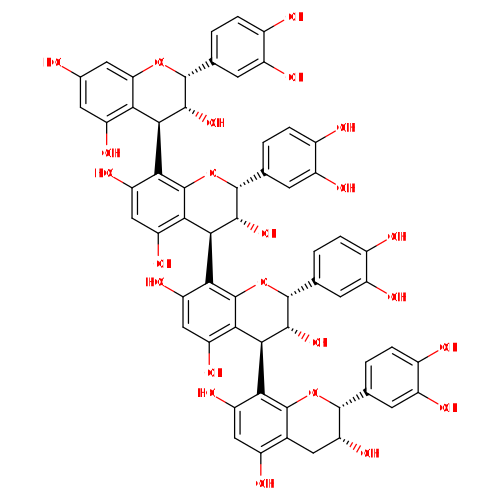
| Record Information |
|---|
| Version | 2.0 |
|---|
| Created at | 2022-03-17 21:03:29 UTC |
|---|
| Updated at | 2022-03-17 21:03:30 UTC |
|---|
| NP-MRD ID | NP0048870 |
|---|
| Secondary Accession Numbers | None |
|---|
| Natural Product Identification |
|---|
| Common Name | Cinnamtannin A2 |
|---|
| Description | Cinnamtannin A2 belongs to the class of organic compounds known as biflavonoids and polyflavonoids. These are organic compounds containing at least two flavan/flavone units. These units are usually linked through CC or C-O-C bonds. Some examples include C2-O-C3, C2-O-C4, C3'-C3''', and C6-C8''. Cinnamtannin A2 is an extremely weak basic (essentially neutral) compound (based on its pKa). Outside of the human body, Cinnamtannin A2 is found, on average, in the highest concentration within chocolates and cocoa powders. Cinnamtannin A2 has also been detected, but not quantified in, a few different foods, such as chinese cinnamons, cocoa beans, and herbs and spices. This could make cinnamtannin A2 a potential biomarker for the consumption of these foods. Cinnamtannin A2 is found in Areca catechu , Calluna vulgaris, Crataegus laevigata, Crataegus oxyacantha , Crataegus rhipidophylla, Crataegus sinaica, Dioscorea cirrhosa, Fallopia multiflora, Guazuma ulmifolia, Malus pumila, Pseudotsuga menziesii, Rhaphiolepis umbellata and Rumex acetosa. Cinnamtannin A2 was first documented in 2013 (PMID: 23563558). A proanthocyanidin isolated from Cinnamomum cassia. |
|---|
| Structure | O[C@@H]1CC2=C(O)C=C(O)C([C@@H]3[C@@H](O)[C@H](OC4=C([C@@H]5[C@@H](O)[C@H](OC6=C([C@@H]7[C@@H](O)[C@H](OC8=CC(O)=CC(O)=C78)C7=CC=C(O)C(O)=C7)C(O)=CC(O)=C56)C5=CC=C(O)C(O)=C5)C(O)=CC(O)=C34)C3=CC=C(O)C(O)=C3)=C2O[C@@H]1C1=CC=C(O)C(O)=C1 InChI=1S/C60H50O24/c61-23-13-34(71)42-41(14-23)81-55(20-2-6-26(63)31(68)10-20)51(78)48(42)44-36(73)17-38(75)46-50(53(80)57(83-59(44)46)22-4-8-28(65)33(70)12-22)47-39(76)18-37(74)45-49(52(79)56(84-60(45)47)21-3-7-27(64)32(69)11-21)43-35(72)16-29(66)24-15-40(77)54(82-58(24)43)19-1-5-25(62)30(67)9-19/h1-14,16-18,40,48-57,61-80H,15H2/t40-,48-,49+,50-,51-,52-,53-,54-,55-,56-,57-/m1/s1 |
|---|
| Synonyms | | Value | Source |
|---|
| Cinnamtannin I | HMDB | | Epicatechin tetramer | HMDB | | [Epicatechin(4b->8)]3-epicatechin | HMDB |
|
|---|
| Chemical Formula | C60H50O24 |
|---|
| Average Mass | 1155.0360 Da |
|---|
| Monoisotopic Mass | 1154.26920 Da |
|---|
| IUPAC Name | (2R,3R,4R)-2-(3,4-dihydroxyphenyl)-8-[(2R,3R,4R)-2-(3,4-dihydroxyphenyl)-3,5,7-trihydroxy-3,4-dihydro-2H-1-benzopyran-4-yl]-4-[(2R,3R,4S)-2-(3,4-dihydroxyphenyl)-4-[(2R,3R)-2-(3,4-dihydroxyphenyl)-3,5,7-trihydroxy-3,4-dihydro-2H-1-benzopyran-8-yl]-3,5,7-trihydroxy-3,4-dihydro-2H-1-benzopyran-8-yl]-3,4-dihydro-2H-1-benzopyran-3,5,7-triol |
|---|
| Traditional Name | (2R,3R,4R)-2-(3,4-dihydroxyphenyl)-8-[(2R,3R,4R)-2-(3,4-dihydroxyphenyl)-3,5,7-trihydroxy-3,4-dihydro-2H-1-benzopyran-4-yl]-4-[(2R,3R,4S)-2-(3,4-dihydroxyphenyl)-4-[(2R,3R)-2-(3,4-dihydroxyphenyl)-3,5,7-trihydroxy-3,4-dihydro-2H-1-benzopyran-8-yl]-3,5,7-trihydroxy-3,4-dihydro-2H-1-benzopyran-8-yl]-3,4-dihydro-2H-1-benzopyran-3,5,7-triol |
|---|
| CAS Registry Number | 86631-38-1 |
|---|
| SMILES | O[C@@H]1CC2=C(O)C=C(O)C([C@@H]3[C@@H](O)[C@H](OC4=C([C@@H]5[C@@H](O)[C@H](OC6=C([C@@H]7[C@@H](O)[C@H](OC8=CC(O)=CC(O)=C78)C7=CC=C(O)C(O)=C7)C(O)=CC(O)=C56)C5=CC=C(O)C(O)=C5)C(O)=CC(O)=C34)C3=CC=C(O)C(O)=C3)=C2O[C@@H]1C1=CC=C(O)C(O)=C1 |
|---|
| InChI Identifier | InChI=1S/C60H50O24/c61-23-13-34(71)42-41(14-23)81-55(20-2-6-26(63)31(68)10-20)51(78)48(42)44-36(73)17-38(75)46-50(53(80)57(83-59(44)46)22-4-8-28(65)33(70)12-22)47-39(76)18-37(74)45-49(52(79)56(84-60(45)47)21-3-7-27(64)32(69)11-21)43-35(72)16-29(66)24-15-40(77)54(82-58(24)43)19-1-5-25(62)30(67)9-19/h1-14,16-18,40,48-57,61-80H,15H2/t40-,48-,49+,50-,51-,52-,53-,54-,55-,56-,57-/m1/s1 |
|---|
| InChI Key | QFLMUASKTWGRQE-JNIIMKSASA-N |
|---|
| Experimental Spectra |
|---|
|
| Not Available | | Predicted Spectra |
|---|
|
| Not Available | | Chemical Shift Submissions |
|---|
|
| Not Available | | Species |
|---|
| Species of Origin | |
|---|
| Chemical Taxonomy |
|---|
| Description | Belongs to the class of organic compounds known as biflavonoids and polyflavonoids. These are organic compounds containing at least two flavan/flavone units. These units are usually linked through CC or C-O-C bonds. Some examples include C2-O-C3, C2-O-C4, C3'-C3''', and C6-C8''. |
|---|
| Kingdom | Organic compounds |
|---|
| Super Class | Phenylpropanoids and polyketides |
|---|
| Class | Flavonoids |
|---|
| Sub Class | Biflavonoids and polyflavonoids |
|---|
| Direct Parent | Biflavonoids and polyflavonoids |
|---|
| Alternative Parents | |
|---|
| Substituents | - C-type proanthocyanidin
- B-type proanthocyanidin
- Bi- and polyflavonoid skeleton
- Proanthocyanidin
- Catechin
- Flavan-3-ol
- Hydroxyflavonoid
- 3'-hydroxyflavonoid
- 7-hydroxyflavonoid
- 5-hydroxyflavonoid
- 4'-hydroxyflavonoid
- 3-hydroxyflavonoid
- Flavan
- Chromane
- 1-benzopyran
- Benzopyran
- Catechol
- Phenol
- 1-hydroxy-2-unsubstituted benzenoid
- Alkyl aryl ether
- 1-hydroxy-4-unsubstituted benzenoid
- Benzenoid
- Monocyclic benzene moiety
- Secondary alcohol
- Polyol
- Organoheterocyclic compound
- Oxacycle
- Ether
- Hydrocarbon derivative
- Alcohol
- Organic oxygen compound
- Organooxygen compound
- Aromatic heteropolycyclic compound
|
|---|
| Molecular Framework | Aromatic heteropolycyclic compounds |
|---|
| External Descriptors | |
|---|
| Physical Properties |
|---|
| State | Not Available |
|---|
| Experimental Properties | | Property | Value | Reference |
|---|
| Melting Point | Not Available | Not Available | | Boiling Point | Not Available | Not Available | | Water Solubility | Not Available | Not Available | | LogP | Not Available | Not Available |
|
|---|
| Predicted Properties | |
|---|