Np mrd loader

Record Information
Version2.0
Created at2022-03-17 21:03:17 UTC
Updated at2022-03-17 21:03:17 UTC
NP-MRD IDNP0048857
Secondary Accession NumbersNone
Natural Product Identification
Common NameXanthomicrol
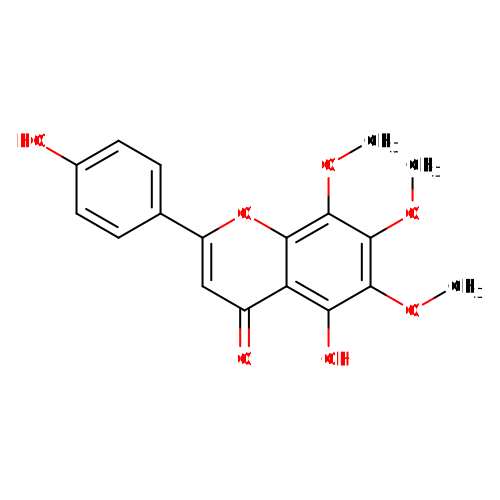
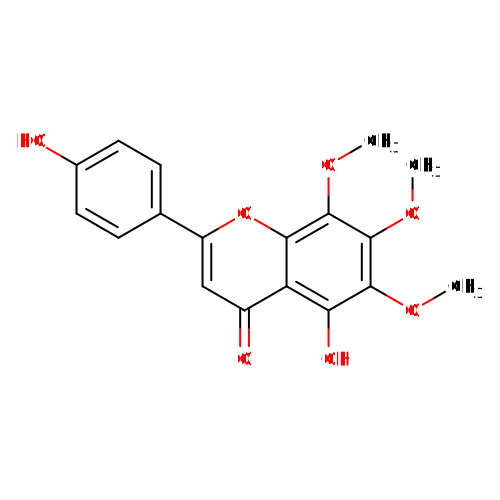
DescriptionXanthomicrol belongs to the class of organic compounds known as 8-o-methylated flavonoids. These are flavonoids with methoxy groups attached to the C8 atom of the flavonoid backbone. Thus, xanthomicrol is considered to be a flavonoid lipid molecule. Xanthomicrol is a very hydrophobic molecule, practically insoluble (in water), and relatively neutral. Outside of the human body, Xanthomicrol is found, on average, in the highest concentration within sweet basils. Xanthomicrol has also been detected, but not quantified in, several different foods, such as citrus, herbs and spices, peppermints, and winter savories. This could make xanthomicrol a potential biomarker for the consumption of these foods. Xanthomicrol is found in Ambrosia deltoidea, Baccharis patens, Baccharis quitensis, Baccharis tucumanensis, Bellardia trixago, Bombax ceiba, Bracteantha viscosa, Brickellia paniculata, Cheilanthes argentea, Citrus medica, Citrus sudachi , Citrus sudachii, Clinopodium douglasii, Cunila angustifolia, Cunila incana, Dracocephalum kotschyi, Dracocephalum multicaule, Ficus lyrata, Helichrysum spp., Hymenoxys scaposa, Lavandula mairei, Lavandula pubescens, Mentha piperita, Nepeta spp., Ocimum americanum, Ocimum americanum L.var.americanum , Ocimum gratissimum , Olearia heterocarpa, Ononis natrix , Origanum calcaratum, Origanum dictamnus , Origanum floribundum, Origanum dubium, Origanum microphyllum, Origanum onites , Origanum syriacum , Origanum vulgare subsp. Glandulosum , Origanum vulgare subsp. Hirtum , Phytolacca americana , Satureja cuneifolia, Satureja douglasii, Sideritis dasygnaphala, Sideritis leucantha, Sideritis spp., Stachys aegyptiaca, Stachys chrysantha, Stachys schtschegleevii, Thymus herba-barona , Thymus saturejoides, Thymus spp., Thymus vulgaris, Varthemia iphionoides and Wilkesia hobdyi. Xanthomicrol was first documented in 2005 (PMID: 15949825). A trimethoxyflavone that is flavone substituted by methoxy groups at positions 6, 7 and 8 and hydroxy groups at positions 5 and 4' (PMID: 23768339) (PMID: 24895220) (PMID: 25138085).
Structure
Thumb
Synonyms
ValueSource
4',5-Dihydroxy-6,7,8-trimethoxyflavoneChEBI
5-Hydroxy-2-(4-hydroxyphenyl)-6,7,8-trimethoxy-4H-1-benzopyran-4-oneHMDB
Chemical FormulaC18H16O7
Average Mass344.3154 Da
Monoisotopic Mass344.08960 Da
IUPAC Name5-hydroxy-2-(4-hydroxyphenyl)-6,7,8-trimethoxy-4H-chromen-4-one
Traditional Namexanthomicrol
CAS Registry Number16545-23-6
SMILES
COC1=C(OC)C(OC)=C2OC(=CC(=O)C2=C1O)C1=CC=C(O)C=C1
InChI Identifier
InChI=1S/C18H16O7/c1-22-16-14(21)13-11(20)8-12(9-4-6-10(19)7-5-9)25-15(13)17(23-2)18(16)24-3/h4-8,19,21H,1-3H3
InChI KeySAMBWAJRKKEEOR-UHFFFAOYSA-N
Experimental Spectra
Not Available
Predicted Spectra
Not Available
Chemical Shift Submissions
Not Available
Species
Species of Origin
Species NameSourceReference
Ambrosia deltoideaPlant
Baccharis patensPlant
Baccharis quitensisLOTUS Database
Baccharis tucumanensisLOTUS Database
Bartsia trixagoLOTUS Database
Bombax ceibaLOTUS Database
Bracteantha viscosaPlant
Brickellia paniculataLOTUS Database
Cheilanthes argenteaPlant
Citrus medicaLOTUS Database
Citrus sudachiPlant
Citrus sudachiiPlant
Clinopodium douglasiiLOTUS Database
Cunila angustifoliaPlant
Cunila incanaPlant
Dracocephalum kotschyiLOTUS Database
Dracocephalum multicauleLOTUS Database
Ficus lyrataLOTUS Database
Helichrysum spp.Plant
Hymenoxys scaposaPlant
Lavandula mairei var. maireiLOTUS Database
Lavandula pubescensLOTUS Database
Mentha piperitaLOTUS Database
Mentha x piperitaFooDB
Nepeta spp.Plant
Ocimum americanumLOTUS Database
Ocimum americanum L.var.americanumPlant
Ocimum basilicumFooDB
Ocimum gratissimumPlant
Olearia heterocarpaLOTUS Database
Ononis natrixPlant
Origanum calcaratumPlant
Origanum dictamnusPlant
Origanum floribundumPlant
Origanum majoranaPlant
Origanum microphyllumPlant
Origanum onitesPlant
Origanum syriacumPlant
Origanum vulgare subsp. GlandulosumPlant
Origanum vulgare subsp. HirtumPlant
Phytolacca americanaPlant
Satureja cuneifoliaLOTUS Database
Satureja douglasiiPlant
Satureja montanaFooDB
Sideritis dasygnaphalaPlant
Sideritis leucanthaLOTUS Database
Sideritis spp.Plant
Stachys aegyptiacaLOTUS Database
Stachys chrysanthaLOTUS Database
Stachys schtschegleeviiLOTUS Database
Thymus herba-baronaPlant
Thymus satureioidesLOTUS Database
Thymus spp.Plant
Thymus vulgarisLOTUS Database
Varthemia iphionoidesPlant
Wilkesia hobdyiLOTUS Database
Chemical Taxonomy
Description Belongs to the class of organic compounds known as 8-o-methylated flavonoids. These are flavonoids with methoxy groups attached to the C8 atom of the flavonoid backbone.
KingdomOrganic compounds
Super ClassPhenylpropanoids and polyketides
ClassFlavonoids
Sub ClassO-methylated flavonoids
Direct Parent8-O-methylated flavonoids
Alternative Parents
Substituents
  • 6-methoxyflavonoid-skeleton
  • 8-methoxyflavonoid-skeleton
  • 7-methoxyflavonoid-skeleton
  • 4'-hydroxyflavonoid
  • 5-hydroxyflavonoid
  • Flavone
  • Hydroxyflavonoid
  • Chromone
  • Benzopyran
  • 1-benzopyran
  • Anisole
  • Alkyl aryl ether
  • 1-hydroxy-2-unsubstituted benzenoid
  • Phenol
  • Pyranone
  • Benzenoid
  • Pyran
  • Monocyclic benzene moiety
  • Vinylogous acid
  • Heteroaromatic compound
  • Ether
  • Organoheterocyclic compound
  • Oxacycle
  • Organic oxygen compound
  • Organooxygen compound
  • Hydrocarbon derivative
  • Organic oxide
  • Aromatic heteropolycyclic compound
Molecular FrameworkAromatic heteropolycyclic compounds
External Descriptors
Physical Properties
StateNot Available
Experimental Properties
PropertyValueReference
Melting PointNot AvailableNot Available
Boiling PointNot AvailableNot Available
Water SolubilityNot AvailableNot Available
LogPNot AvailableNot Available
Predicted Properties
PropertyValueSource
logP2.89ALOGPS
logP2.54ChemAxon
logS-3.9ALOGPS
pKa (Strongest Acidic)8.67ChemAxon
pKa (Strongest Basic)-4.3ChemAxon
Physiological Charge0ChemAxon
Hydrogen Acceptor Count7ChemAxon
Hydrogen Donor Count2ChemAxon
Polar Surface Area94.45 ŲChemAxon
Rotatable Bond Count4ChemAxon
Refractivity90.32 m³·mol⁻¹ChemAxon
Polarizability34.64 ųChemAxon
Number of Rings3ChemAxon
BioavailabilityYesChemAxon
Rule of FiveYesChemAxon
Ghose FilterYesChemAxon
Veber's RuleNoChemAxon
MDDR-like RuleNoChemAxon
HMDB IDHMDB0037600
DrugBank IDNot Available
Phenol Explorer Compound IDNot Available
FoodDB IDFDB016712
KNApSAcK IDC00003879
Chemspider ID65965
KEGG Compound IDC14476
BioCyc IDNot Available
BiGG IDNot Available
Wikipedia LinkNot Available
METLIN IDNot Available
PubChem Compound73207
PDB IDNot Available
ChEBI ID35047
Good Scents IDNot Available
References
General References
  1. Jahaniani F, Ebrahimi SA, Rahbar-Roshandel N, Mahmoudian M: Xanthomicrol is the main cytotoxic component of Dracocephalum kotschyii and a potential anti-cancer agent. Phytochemistry. 2005 Jul;66(13):1581-92. doi: 10.1016/j.phytochem.2005.04.035. [PubMed:15949825 ]
  2. Fattahi M, Nazeri V, Torras-Claveria L, Sefidkon F, Cusido RM, Zamani Z, Palazon J: Identification and quantification of leaf surface flavonoids in wild-growing populations of Dracocephalum kotschyi by LC-DAD-ESI-MS. Food Chem. 2013 Nov 1;141(1):139-46. doi: 10.1016/j.foodchem.2013.03.019. Epub 2013 Mar 13. [PubMed:23768339 ]
  3. Abbaszadeh H, Ebrahimi SA, Akhavan MM: Antiangiogenic activity of xanthomicrol and calycopterin, two polymethoxylated hydroxyflavones in both in vitro and ex vivo models. Phytother Res. 2014 Nov;28(11):1661-70. doi: 10.1002/ptr.5179. Epub 2014 Jun 3. [PubMed:24895220 ]
  4. Fattahi M, Cusido RM, Khojasteh A, Bonfill M, Palazon J: Xanthomicrol: a comprehensive review of its chemistry, distribution, biosynthesis and pharmacological activity. Mini Rev Med Chem. 2014;14(9):725-33. doi: 10.2174/1389557514666140820122818. [PubMed:25138085 ]