| Record Information |
|---|
| Version | 2.0 |
|---|
| Created at | 2022-03-17 21:01:24 UTC |
|---|
| Updated at | 2022-03-17 21:01:24 UTC |
|---|
| NP-MRD ID | NP0048738 |
|---|
| Secondary Accession Numbers | None |
|---|
| Natural Product Identification |
|---|
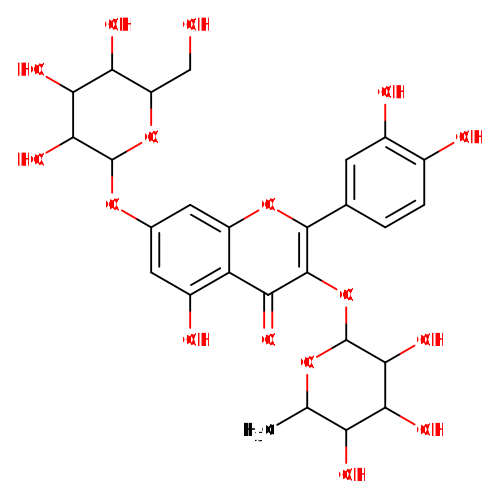
| Common Name | Quercetin 3-rhamnoside 7-glucoside |
|---|
| Description | 2-(3,4-Dihydroxyphenyl)-5-hydroxy-7-{[3,4,5-trihydroxy-6-(hydroxymethyl)oxan-2-yl]oxy}-3-[(3,4,5-trihydroxy-6-methyloxan-2-yl)oxy]-4H-chromen-4-one belongs to the class of organic compounds known as coumestans. These are polycyclic aromatic compounds containing a coumestan moiety, which consists of a benzoxole fused to a chromen-2-one to form 1-Benzoxolo[3,2-c]chromen-6-one. They are oxidation products of pterocarpan. 2-(3,4-Dihydroxyphenyl)-5-hydroxy-7-{[3,4,5-trihydroxy-6-(hydroxymethyl)oxan-2-yl]oxy}-3-[(3,4,5-trihydroxy-6-methyloxan-2-yl)oxy]-4H-chromen-4-one is an extremely weak basic (essentially neutral) compound (based on its pKa). Outside of the human body, 2-(3,4-dihydroxyphenyl)-5-hydroxy-7-{[3,4,5-trihydroxy-6-(hydroxymethyl)oxan-2-yl]oxy}-3-[(3,4,5-trihydroxy-6-methyloxan-2-yl)oxy]-4H-chromen-4-one has been detected, but not quantified in, several different foods, such as orange bell peppers, green bell peppers, italian sweet red peppers, yellow bell peppers, and pepper (c. Annuum). Quercetin 3-rhamnoside 7-glucoside is found in Actinidia deliciosa , Celastrus hypoglaucus, Erythroxylum vacciniifolium, Euonymus europaea , Euonymus maackii, Ilex hainanensis, Lithophragma bolanderi, Lotus corniculatus and Sedum alfredi. This could make 2-(3,4-dihydroxyphenyl)-5-hydroxy-7-{[3,4,5-trihydroxy-6-(hydroxymethyl)oxan-2-yl]oxy}-3-[(3,4,5-trihydroxy-6-methyloxan-2-yl)oxy]-4H-chromen-4-one a potential biomarker for the consumption of these foods. |
|---|
| Structure | CC1OC(OC2=C(OC3=CC(OC4OC(CO)C(O)C(O)C4O)=CC(O)=C3C2=O)C2=CC(O)=C(O)C=C2)C(O)C(O)C1O InChI=1S/C27H30O16/c1-8-17(32)20(35)22(37)26(39-8)43-25-19(34)16-13(31)5-10(40-27-23(38)21(36)18(33)15(7-28)42-27)6-14(16)41-24(25)9-2-3-11(29)12(30)4-9/h2-6,8,15,17-18,20-23,26-33,35-38H,7H2,1H3 |
|---|
| Synonyms | Not Available |
|---|
| Chemical Formula | C27H30O16 |
|---|
| Average Mass | 610.5175 Da |
|---|
| Monoisotopic Mass | 610.15338 Da |
|---|
| IUPAC Name | 2-(3,4-dihydroxyphenyl)-5-hydroxy-7-{[3,4,5-trihydroxy-6-(hydroxymethyl)oxan-2-yl]oxy}-3-[(3,4,5-trihydroxy-6-methyloxan-2-yl)oxy]-4H-chromen-4-one |
|---|
| Traditional Name | 2-(3,4-dihydroxyphenyl)-5-hydroxy-7-{[3,4,5-trihydroxy-6-(hydroxymethyl)oxan-2-yl]oxy}-3-[(3,4,5-trihydroxy-6-methyloxan-2-yl)oxy]chromen-4-one |
|---|
| CAS Registry Number | 17306-45-5 |
|---|
| SMILES | CC1OC(OC2=C(OC3=CC(OC4OC(CO)C(O)C(O)C4O)=CC(O)=C3C2=O)C2=CC(O)=C(O)C=C2)C(O)C(O)C1O |
|---|
| InChI Identifier | InChI=1S/C27H30O16/c1-8-17(32)20(35)22(37)26(39-8)43-25-19(34)16-13(31)5-10(40-27-23(38)21(36)18(33)15(7-28)42-27)6-14(16)41-24(25)9-2-3-11(29)12(30)4-9/h2-6,8,15,17-18,20-23,26-33,35-38H,7H2,1H3 |
|---|
| InChI Key | MCTZMXCUYPDYNE-UHFFFAOYSA-N |
|---|
| Experimental Spectra |
|---|
|
| Not Available | | Predicted Spectra |
|---|
|
| Not Available | | Chemical Shift Submissions |
|---|
|
| Not Available | | Species |
|---|
| Species of Origin | |
|---|
| Chemical Taxonomy |
|---|
| Description | Belongs to the class of organic compounds known as coumestans. These are polycyclic aromatic compounds containing a coumestan moiety, which consists of a benzoxole fused to a chromen-2-one to form 1-Benzoxolo[3,2-c]chromen-6-one. They are oxidation products of pterocarpan. |
|---|
| Kingdom | Organic compounds |
|---|
| Super Class | Phenylpropanoids and polyketides |
|---|
| Class | Isoflavonoids |
|---|
| Sub Class | Coumestans |
|---|
| Direct Parent | Coumestans |
|---|
| Alternative Parents | |
|---|
| Substituents | - Coumestan
- Angular furanocoumarin
- Furanocoumarin
- Coumarin
- Benzopyran
- 1-benzopyran
- Benzofuran
- Furopyran
- Anisole
- 1-hydroxy-4-unsubstituted benzenoid
- 1-hydroxy-2-unsubstituted benzenoid
- Alkyl aryl ether
- Pyranone
- Benzenoid
- Pyran
- Furan
- Heteroaromatic compound
- Lactone
- Oxacycle
- Organoheterocyclic compound
- Ether
- Organic oxygen compound
- Organic oxide
- Organooxygen compound
- Hydrocarbon derivative
- Aromatic heteropolycyclic compound
|
|---|
| Molecular Framework | Aromatic heteropolycyclic compounds |
|---|
| External Descriptors | |
|---|
| Physical Properties |
|---|
| State | Not Available |
|---|
| Experimental Properties | | Property | Value | Reference |
|---|
| Melting Point | Not Available | Not Available | | Boiling Point | Not Available | Not Available | | Water Solubility | Not Available | Not Available | | LogP | Not Available | Not Available |
|
|---|
| Predicted Properties | |
|---|