| Record Information |
|---|
| Version | 2.0 |
|---|
| Created at | 2022-03-17 20:59:21 UTC |
|---|
| Updated at | 2022-03-17 20:59:21 UTC |
|---|
| NP-MRD ID | NP0048619 |
|---|
| Secondary Accession Numbers | None |
|---|
| Natural Product Identification |
|---|
| Common Name | Alloxanthin |
|---|
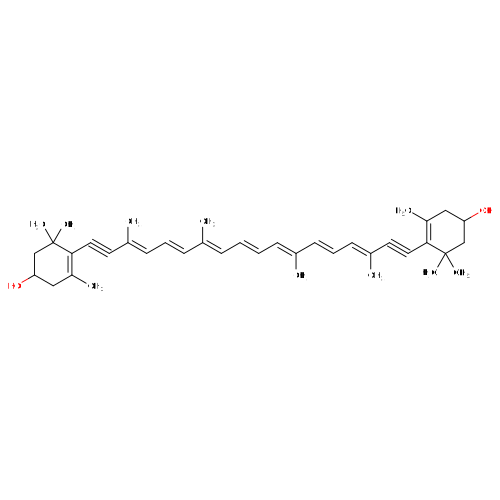
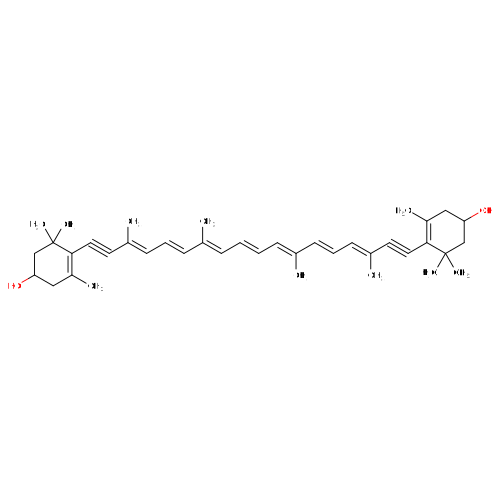
| Description | Alloxanthin, also known as cryptomonaxanthin or manixanthin, belongs to the class of organic compounds known as diterpenoids. These are terpene compounds formed by four isoprene units. Alloxanthin is an extremely weak basic (essentially neutral) compound (based on its pKa). Outside of the human body, Alloxanthin has been detected, but not quantified in, channel catfish and mollusks. Alloxanthin is found in Aplidium pliciferum, Asterias amurensis, Branchiostegus japonicus, Corbicula japonica , Corbicula sandai , Corydoras melanistius, Crassostrea gigas, Cryptomonas ovata, Gelliodes callista, Halocynthia roretzi, Hemiselmis virescens, Liobagrus reinii, Malapterurus electricus, Mytilus coruscus, Mytilus edulis , Paralithodes brevipes, Pecten jacobaeus, Pecten maximus , Pelteobagrus nudiceps , Plotosus lineatus , Rhinogobius brunneus, Silurus asotus , Silurus biwaensis , Silurus lithophilus and Silurus microdorsalis. This could make alloxanthin a potential biomarker for the consumption of these foods. |
|---|
| Structure | C\C(\C=C\C=C(/C)C#CC1=C(C)CC(O)CC1(C)C)=C/C=C/C=C(\C)/C=C/C=C(\C)C#CC1=C(C)CC(O)CC1(C)C InChI=1S/C40H52O2/c1-29(17-13-19-31(3)21-23-37-33(5)25-35(41)27-39(37,7)8)15-11-12-16-30(2)18-14-20-32(4)22-24-38-34(6)26-36(42)28-40(38,9)10/h11-20,35-36,41-42H,25-28H2,1-10H3/b12-11+,17-13+,18-14+,29-15+,30-16+,31-19+,32-20+ |
|---|
| Synonyms | | Value | Source |
|---|
| 7,7',8,8'-Tetradehydro-b,b-carotene-3,3'-diol | HMDB | | Cryptomonaxanthin | HMDB | | Manixanthin | HMDB | | Pectenoxanthin | HMDB | | Alloxanthin | MeSH |
|
|---|
| Chemical Formula | C40H52O2 |
|---|
| Average Mass | 564.8397 Da |
|---|
| Monoisotopic Mass | 564.39673 Da |
|---|
| IUPAC Name | 4-[(3E,5E,7E,9E,11E,13E,15E)-18-(4-hydroxy-2,6,6-trimethylcyclohex-1-en-1-yl)-3,7,12,16-tetramethyloctadeca-3,5,7,9,11,13,15-heptaen-1,17-diyn-1-yl]-3,5,5-trimethylcyclohex-3-en-1-ol |
|---|
| Traditional Name | 4-[(3E,5E,7E,9E,11E,13E,15E)-18-(4-hydroxy-2,6,6-trimethylcyclohex-1-en-1-yl)-3,7,12,16-tetramethyloctadeca-3,5,7,9,11,13,15-heptaen-1,17-diyn-1-yl]-3,5,5-trimethylcyclohex-3-en-1-ol |
|---|
| CAS Registry Number | 28380-31-6 |
|---|
| SMILES | C\C(\C=C\C=C(/C)C#CC1=C(C)CC(O)CC1(C)C)=C/C=C/C=C(\C)/C=C/C=C(\C)C#CC1=C(C)CC(O)CC1(C)C |
|---|
| InChI Identifier | InChI=1S/C40H52O2/c1-29(17-13-19-31(3)21-23-37-33(5)25-35(41)27-39(37,7)8)15-11-12-16-30(2)18-14-20-32(4)22-24-38-34(6)26-36(42)28-40(38,9)10/h11-20,35-36,41-42H,25-28H2,1-10H3/b12-11+,17-13+,18-14+,29-15+,30-16+,31-19+,32-20+ |
|---|
| InChI Key | DVICWXUADSCSLL-PJQROKOUSA-N |
|---|
| Experimental Spectra |
|---|
|
| Not Available | | Predicted Spectra |
|---|
|
| Not Available | | Chemical Shift Submissions |
|---|
|
| Not Available | | Species |
|---|
| Species of Origin | |
|---|
| Chemical Taxonomy |
|---|
| Description | Belongs to the class of organic compounds known as diterpenoids. These are terpene compounds formed by four isoprene units. |
|---|
| Kingdom | Organic compounds |
|---|
| Super Class | Lipids and lipid-like molecules |
|---|
| Class | Prenol lipids |
|---|
| Sub Class | Diterpenoids |
|---|
| Direct Parent | Diterpenoids |
|---|
| Alternative Parents | |
|---|
| Substituents | - Diterpenoid
- Secondary alcohol
- Organic oxygen compound
- Hydrocarbon derivative
- Organooxygen compound
- Alcohol
- Aliphatic homomonocyclic compound
|
|---|
| Molecular Framework | Aliphatic homomonocyclic compounds |
|---|
| External Descriptors | Not Available |
|---|
| Physical Properties |
|---|
| State | Not Available |
|---|
| Experimental Properties | | Property | Value | Reference |
|---|
| Melting Point | Not Available | Not Available | | Boiling Point | Not Available | Not Available | | Water Solubility | Not Available | Not Available | | LogP | Not Available | Not Available |
|
|---|
| Predicted Properties | |
|---|