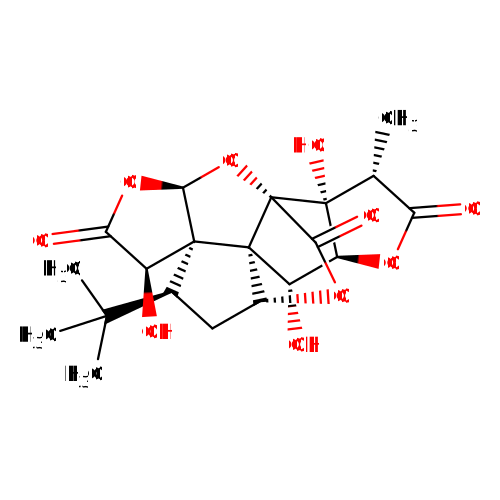
| Record Information |
|---|
| Version | 2.0 |
|---|
| Created at | 2022-03-17 20:59:12 UTC |
|---|
| Updated at | 2022-03-17 20:59:12 UTC |
|---|
| NP-MRD ID | NP0048610 |
|---|
| Secondary Accession Numbers | None |
|---|
| Natural Product Identification |
|---|
| Common Name | Ginkgolide B |
|---|
| Description | Ginkgolide-B belongs to the class of organic compounds known as ginkgolides and bilobalides. These are diterpene lactones with a structure based either on the gingkolide or the bilobalide skeleton. The ginkgolide skeleton is a very rigid structure consisting of hexacyclic C20 trilactone. The cis-fused F/A/D/C ring junction forms an empty semi-ball hole, the D ring contains a cage form tetrahydrofuran ring which occupies the center of the empty hole, and the oxygen atoms of the D,C and F ring and 10-hydroxyl group consist of an analogous crown ether structure. Ginkgolide B is found in Machilus wangchiana. Ginkgolide-B is an extremely weak basic (essentially neutral) compound (based on its pKa). |
|---|
| Structure | [H][C@@]1(C)C(=O)O[C@@]2([H])[C@]([H])(O)[C@@]34[C@@]5([H])C[C@@]([H])(C(C)(C)C)[C@@]33[C@@]([H])(O)C(=O)O[C@@]3([H])O[C@@]4(C(=O)O5)[C@@]12O InChI=1S/C20H24O10/c1-6-12(23)28-11-9(21)18-8-5-7(16(2,3)4)17(18)10(22)13(24)29-15(17)30-20(18,14(25)27-8)19(6,11)26/h6-11,15,21-22,26H,5H2,1-4H3/t6-,7+,8-,9+,10+,11+,15+,17+,18+,19-,20-/m1/s1 |
|---|
| Synonyms | | Value | Source |
|---|
| Ginkolide b | MeSH | | Ginkgolide b, (1beta)-isomer | MeSH |
|
|---|
| Chemical Formula | C20H24O10 |
|---|
| Average Mass | 424.3986 Da |
|---|
| Monoisotopic Mass | 424.13695 Da |
|---|
| IUPAC Name | (1R,3R,6R,7S,8S,10R,11R,12R,13S,16S,17R)-8-tert-butyl-6,12,17-trihydroxy-16-methyl-2,4,14,19-tetraoxahexacyclo[8.7.2.0^{1,11}.0^{3,7}.0^{7,11}.0^{13,17}]nonadecane-5,15,18-trione |
|---|
| Traditional Name | (1R,3R,6R,7S,8S,10R,11R,12R,13S,16S,17R)-8-tert-butyl-6,12,17-trihydroxy-16-methyl-2,4,14,19-tetraoxahexacyclo[8.7.2.0^{1,11}.0^{3,7}.0^{7,11}.0^{13,17}]nonadecane-5,15,18-trione |
|---|
| CAS Registry Number | 15291-77-7 |
|---|
| SMILES | [H][C@@]1(C)C(=O)O[C@@]2([H])[C@]([H])(O)[C@@]34[C@@]5([H])C[C@@]([H])(C(C)(C)C)[C@@]33[C@@]([H])(O)C(=O)O[C@@]3([H])O[C@@]4(C(=O)O5)[C@@]12O |
|---|
| InChI Identifier | InChI=1S/C20H24O10/c1-6-12(23)28-11-9(21)18-8-5-7(16(2,3)4)17(18)10(22)13(24)29-15(17)30-20(18,14(25)27-8)19(6,11)26/h6-11,15,21-22,26H,5H2,1-4H3/t6-,7+,8-,9+,10+,11+,15+,17+,18+,19-,20-/m1/s1 |
|---|
| InChI Key | SQOJOAFXDQDRGF-MMQTXUMRSA-N |
|---|
| Experimental Spectra |
|---|
|
| Not Available | | Predicted Spectra |
|---|
|
| Not Available | | Chemical Shift Submissions |
|---|
|
| Not Available | | Species |
|---|
| Species of Origin | |
|---|
| Chemical Taxonomy |
|---|
| Description | Belongs to the class of organic compounds known as ginkgolides and bilobalides. These are diterpene lactones with a structure based either on the gingkolide or the bilobalide skeleton. The ginkgolide skeleton is a very rigid structure consisting of hexacyclic C20 trilactone. The cis-fused F/A/D/C ring junction forms an empty semi-ball hole, the D ring contains a cage form tetrahydrofuran ring which occupies the center of the empty hole, and the oxygen atoms of the D,C and F ring and 10-hydroxyl group consist of an analogous crown ether structure. |
|---|
| Kingdom | Organic compounds |
|---|
| Super Class | Lipids and lipid-like molecules |
|---|
| Class | Prenol lipids |
|---|
| Sub Class | Terpene lactones |
|---|
| Direct Parent | Ginkgolides and bilobalides |
|---|
| Alternative Parents | |
|---|
| Substituents | - Ginkgolide-skeleton
- Diterpenoid
- Tricarboxylic acid or derivatives
- Furofuran
- Gamma butyrolactone
- Cyclic alcohol
- Tetrahydrofuran
- Tertiary alcohol
- Carboxylic acid ester
- Lactone
- Secondary alcohol
- Organoheterocyclic compound
- Oxacycle
- Acetal
- Carboxylic acid derivative
- Polyol
- Alcohol
- Hydrocarbon derivative
- Organic oxide
- Organic oxygen compound
- Carbonyl group
- Organooxygen compound
- Aliphatic heteropolycyclic compound
|
|---|
| Molecular Framework | Aliphatic heteropolycyclic compounds |
|---|
| External Descriptors | Not Available |
|---|
| Physical Properties |
|---|
| State | Not Available |
|---|
| Experimental Properties | | Property | Value | Reference |
|---|
| Melting Point | Not Available | Not Available | | Boiling Point | Not Available | Not Available | | Water Solubility | Not Available | Not Available | | LogP | Not Available | Not Available |
|
|---|
| Predicted Properties | |
|---|