| Record Information |
|---|
| Version | 2.0 |
|---|
| Created at | 2022-03-17 20:57:40 UTC |
|---|
| Updated at | 2022-03-17 20:57:40 UTC |
|---|
| NP-MRD ID | NP0048515 |
|---|
| Secondary Accession Numbers | None |
|---|
| Natural Product Identification |
|---|
| Common Name | Geosmin |
|---|
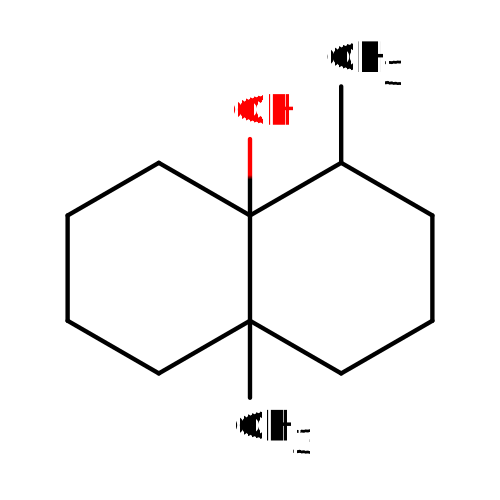
| Description | Geosmin belongs to the class of organic compounds known as tertiary alcohols. Tertiary alcohols are compounds in which a hydroxy group, -OH, is attached to a saturated carbon atom R3COH (R not H ). Geosmin is an extremely weak basic (essentially neutral) compound (based on its pKa). Geosmin is a beet, earthy, and fresh tasting compound. Outside of the human body, Geosmin is found, on average, in the highest concentration within corns. Geosmin has also been detected, but not quantified in, common beets. This could make geosmin a potential biomarker for the consumption of these foods. Under acidic conditions, geosmin decomposes into odorless substances. Besides the production of volatile geosmin, it also produces many other complex molecules of pharmacological interest; its genome sequence is available at the Sanger Institute. Geosmin is also an issue for saltwater fish grown in recirculating aquaculture systems, such as Atlantic salmon. These systems rely on biological filtration using cultured microbial communities to process the nitrogenous waste from the fish (ammonia) into less harmful compounds (nitrite and nitrate) that can be tolerated at higher concentrations. The human nose is extremely sensitive to geosmin and is able to detect it at concentrations as low as 5 parts per trillion. Geosmin is produced by the gram-positive bacteria Streptomyces and various cyanobacteria, and released when these microorganisms die. Geosmin is an organic compound with a distinct earthy flavor and aroma produced by certain bacteria, and is responsible for the earthy taste of beetroots and a contributor to the strong scent (petrichor) that occurs in the air when rain falls after a dry spell of weather or when soil is disturbed. Geosmin is found in Basella alba, Beta vulgaris, Coffea arabica, Cystoderma carcharias, Kitasatospora aureofaciens, Oscillatoria brevis, Phaseolus vulgaris, Physarum polycephalum, Streptomyces albidoflavus, Streptomyces alboflavus, Streptomyces avermitilis, Streptomyces coelicolor, Streptomyces fradiae, Streptomyces odorifer, Streptomyces rimosus, Streptomyces spp., Streptomyces tendae, Streptomyces thermocarboxydus, Symphyogyna brongniartii and Zea mays. Geosmin breaks down in acid conditions; hence, vinegar and other acidic ingredients are used in fish recipes to reduce the muddy flavor. |
|---|
| Structure | InChI=1S/C12H22O/c1-10-6-5-8-11(2)7-3-4-9-12(10,11)13/h10,13H,3-9H2,1-2H3 |
|---|
| Synonyms | | Value | Source |
|---|
| 1,10-Dimethyl-9-decalol | HMDB | | 11,12,13-Trinor-5-eudesmanol | HMDB | | 4,8a-Dimethyloctahydro-4a(2H)-naphthalenol | HMDB | | 4,8alpha-Dimethyl-octahydro-naphthalen-4alpha-ol | HMDB | | Octahydro-4,8a-dimethyl-4a(2H)-naphthalenol, 9ci | HMDB |
|
|---|
| Chemical Formula | C12H22O |
|---|
| Average Mass | 182.3025 Da |
|---|
| Monoisotopic Mass | 182.16707 Da |
|---|
| IUPAC Name | 4,8a-dimethyl-decahydronaphthalen-4a-ol |
|---|
| Traditional Name | geosmin |
|---|
| CAS Registry Number | 19700-21-1 |
|---|
| SMILES | CC1CCCC2(C)CCCCC12O |
|---|
| InChI Identifier | InChI=1S/C12H22O/c1-10-6-5-8-11(2)7-3-4-9-12(10,11)13/h10,13H,3-9H2,1-2H3 |
|---|
| InChI Key | JLPUXFOGCDVKGO-UHFFFAOYSA-N |
|---|
| Experimental Spectra |
|---|
|
| Not Available | | Predicted Spectra |
|---|
|
| Not Available | | Chemical Shift Submissions |
|---|
|
| Not Available | | Species |
|---|
| Species of Origin | |
|---|
| Chemical Taxonomy |
|---|
| Description | Belongs to the class of organic compounds known as tertiary alcohols. Tertiary alcohols are compounds in which a hydroxy group, -OH, is attached to a saturated carbon atom R3COH (R not H ). |
|---|
| Kingdom | Organic compounds |
|---|
| Super Class | Organic oxygen compounds |
|---|
| Class | Organooxygen compounds |
|---|
| Sub Class | Alcohols and polyols |
|---|
| Direct Parent | Tertiary alcohols |
|---|
| Alternative Parents | |
|---|
| Substituents | - Tertiary alcohol
- Cyclic alcohol
- Hydrocarbon derivative
- Aliphatic homopolycyclic compound
|
|---|
| Molecular Framework | Aliphatic homopolycyclic compounds |
|---|
| External Descriptors | |
|---|
| Physical Properties |
|---|
| State | Not Available |
|---|
| Experimental Properties | | Property | Value | Reference |
|---|
| Melting Point | Not Available | Not Available | | Boiling Point | Not Available | Not Available | | Water Solubility | Not Available | Not Available | | LogP | Not Available | Not Available |
|
|---|
| Predicted Properties | |
|---|