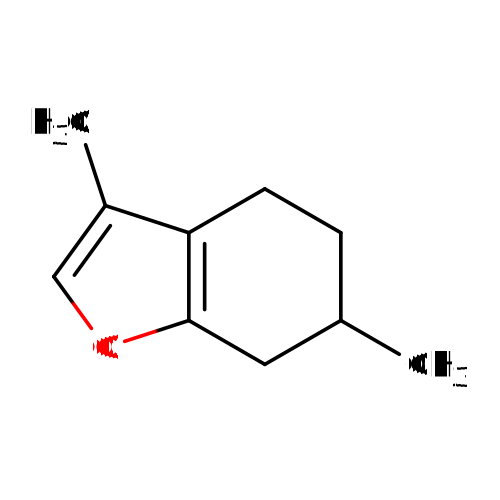
| Record Information |
|---|
| Version | 2.0 |
|---|
| Created at | 2022-03-17 20:56:38 UTC |
|---|
| Updated at | 2022-03-17 20:56:38 UTC |
|---|
| NP-MRD ID | NP0048448 |
|---|
| Secondary Accession Numbers | None |
|---|
| Natural Product Identification |
|---|
| Common Name | Menthofuran |
|---|
| Description | (R)-Menthofuran belongs to the class of organic compounds known as aromatic monoterpenoids. These are monoterpenoids containing at least one aromatic ring (R)-Menthofuran is an extremely weak basic (essentially neutral) compound (based on its pKa) (R)-Menthofuran is a coffee, earthy, and musty tasting compound. Outside of the human body, (R)-Menthofuran has been detected, but not quantified in, a few different foods, such as herbs and spices, mentha (mint), and orange mints. This could make (R)-menthofuran a potential biomarker for the consumption of these foods. Menthofuran is found in Agathosma betulina, Clinopodium ashei, Clinopodium serpyllifolium, Cunila microcephala, Curcuma longa, Euodia hortensis, Mentha longifolia, Mentha piperita, Mentha piperita L. , Mentha pulegium, Mentha spp. , Mentha verticillata, Methanothermobacter thermautotrophicus, Minthostachys andina and Pycnanthemum floridanum. Menthofuran was first documented in 1988 (PMID: 3252034). A monoterpenoid that is 4,5,6,7-tetrahydro-1-benzofuran substituted by methyl groups at positions 3 and 6 (PMID: 18044925) (PMID: 23199997) (PMID: 24050256) (PMID: 22054099). |
|---|
| Structure | InChI=1S/C10H14O/c1-7-3-4-9-8(2)6-11-10(9)5-7/h6-7H,3-5H2,1-2H3 |
|---|
| Synonyms | | Value | Source |
|---|
| 3,9-Epoxy-p-mentha-3,8-diene | ChEBI | | 4,5,6,7-Tetrahydro-3,6-dimethylbenzofuran | ChEBI | | 4,5,6,7-Tetrahydro-3,6-dimethylcoumarone | ChEBI | | (+)-3,9-Epoxy-p-mentha-3,8-diene | HMDB | | (+)-Menthofuran | HMDB | | (6R)-3,6-Dimethyl-4,5,6,7-tetrahydro-1-benzofuran | HMDB | | (R)-(+)-Menthofuran | HMDB | | (R)-4,5,6,7-Tetrahydro-3,6-dimethylbenzofuran | HMDB | | 3,6-Dimethyl-4,5,6,7-tetrahydro-1-benzofuran | HMDB | | 3,9-Epoxy-(+)-p-mentha-3,8-diene | HMDB | | 4,5,6,7-Tetrahydro-3,6-dimethyl-(R)-benzofuran | HMDB | | 4,5,6,7-Tetrahydro-3,6-dimethyl-benzofuran | HMDB | | Menthofuran | HMDB | | Menthofuran, (R)-isomer | HMDB |
|
|---|
| Chemical Formula | C10H14O |
|---|
| Average Mass | 150.2176 Da |
|---|
| Monoisotopic Mass | 150.10447 Da |
|---|
| IUPAC Name | 3,6-dimethyl-4,5,6,7-tetrahydro-1-benzofuran |
|---|
| Traditional Name | 3,9-epoxy-p-mentha-3,8-diene |
|---|
| CAS Registry Number | 494-90-6 |
|---|
| SMILES | CC1CCC2=C(C1)OC=C2C |
|---|
| InChI Identifier | InChI=1S/C10H14O/c1-7-3-4-9-8(2)6-11-10(9)5-7/h6-7H,3-5H2,1-2H3 |
|---|
| InChI Key | YGWKXXYGDYYFJU-UHFFFAOYSA-N |
|---|
| Experimental Spectra |
|---|
|
| Not Available | | Predicted Spectra |
|---|
|
| Not Available | | Chemical Shift Submissions |
|---|
|
| Not Available | | Species |
|---|
| Species of Origin | |
|---|
| Chemical Taxonomy |
|---|
| Description | Belongs to the class of organic compounds known as aromatic monoterpenoids. These are monoterpenoids containing at least one aromatic ring. |
|---|
| Kingdom | Organic compounds |
|---|
| Super Class | Lipids and lipid-like molecules |
|---|
| Class | Prenol lipids |
|---|
| Sub Class | Monoterpenoids |
|---|
| Direct Parent | Aromatic monoterpenoids |
|---|
| Alternative Parents | |
|---|
| Substituents | - Menthofuran monoterpenoid
- Bicyclic monoterpenoid
- Aromatic monoterpenoid
- Benzofuran
- Heteroaromatic compound
- Furan
- Oxacycle
- Organoheterocyclic compound
- Organic oxygen compound
- Hydrocarbon derivative
- Organooxygen compound
- Aromatic heteropolycyclic compound
|
|---|
| Molecular Framework | Aromatic heteropolycyclic compounds |
|---|
| External Descriptors | |
|---|
| Physical Properties |
|---|
| State | Not Available |
|---|
| Experimental Properties | | Property | Value | Reference |
|---|
| Melting Point | Not Available | Not Available | | Boiling Point | Not Available | Not Available | | Water Solubility | Not Available | Not Available | | LogP | Not Available | Not Available |
|
|---|
| Predicted Properties | |
|---|
| General References | - De Lucia M, Mainieri F, Verotta L, Maffei M, Panzella L, Crescenzi O, Napolitano A, Barone V, Appendino G, d'Ischia M: Nitration versus nitrosation chemistry of menthofuran: remarkable fragmentation and dimerization pathways and expeditious entry into dehydromenthofurolactone. J Org Chem. 2007 Dec 21;72(26):10123-9. doi: 10.1021/jo701992r. Epub 2007 Nov 29. [PubMed:18044925 ]
- Tyagi AK, Gottardi D, Malik A, Guerzoni ME: Anti-yeast activity of mentha oil and vapours through in vitro and in vivo (real fruit juices) assays. Food Chem. 2013 Apr 15;137(1-4):108-14. doi: 10.1016/j.foodchem.2012.10.015. Epub 2012 Oct 26. [PubMed:23199997 ]
- Caboni P, Saba M, Tocco G, Casu L, Murgia A, Maxia A, Menkissoglu-Spiroudi U, Ntalli N: Nematicidal activity of mint aqueous extracts against the root-knot nematode Meloidogyne incognita. J Agric Food Chem. 2013 Oct 16;61(41):9784-8. doi: 10.1021/jf403684h. Epub 2013 Oct 3. [PubMed:24050256 ]
- Miyazawa M, Haigou R: Determination of cytochrome P450 enzymes involved in the metabolism of (-)-terpinen-4-ol by human liver microsomes. Xenobiotica. 2011 Dec;41(12):1056-62. doi: 10.3109/00498254.2011.596230. [PubMed:22054099 ]
- Thomassen D, Slattery JT, Nelson SD: Contribution of menthofuran to the hepatotoxicity of pulegone: assessment based on matched area under the curve and on matched time course. J Pharmacol Exp Ther. 1988 Mar;244(3):825-9. [PubMed:3252034 ]
|
|---|