| Record Information |
|---|
| Version | 2.0 |
|---|
| Created at | 2022-03-17 20:56:34 UTC |
|---|
| Updated at | 2022-03-17 20:56:34 UTC |
|---|
| NP-MRD ID | NP0048444 |
|---|
| Secondary Accession Numbers | None |
|---|
| Natural Product Identification |
|---|
| Common Name | Limonexic acid |
|---|
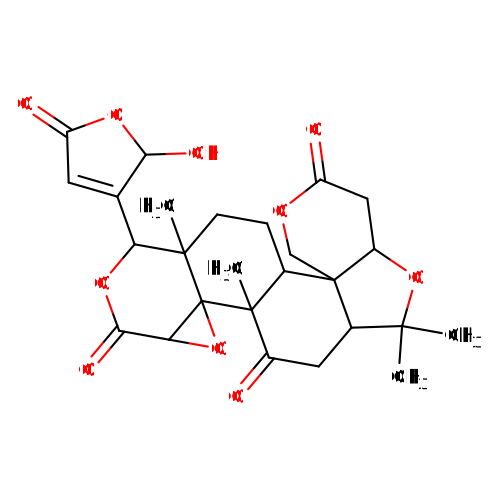
| Description | Limonexic acid, also known as limonexate or limonexin, belongs to the class of organic compounds known as limonoids. These are highly oxygenated, modified terpenoids with a prototypical structure either containing or derived from a precursor with a 4,4,8-trimethyl-17-furanylsteroid skeleton. All naturally occurring citrus limonoids contain a furan ring attached to the D-ring, at C-17, as well as oxygen containing functional groups at C-3, C-4, C-7, C-16 and C-17. Limonexic acid is an extremely weak basic (essentially neutral) compound (based on its pKa). Outside of the human body, limonexic acid has been detected, but not quantified in, citrus and sweet oranges. Limonexic acid is found in Citrus aurantium, Citrus spp. and Dictamnus angustifolius. This could make limonexic acid a potential biomarker for the consumption of these foods. |
|---|
| Structure | CC1(C)OC2CC(=O)OCC22C1CC(=O)C1(C)C2CCC2(C)C(OC(=O)C3OC123)C1=CC(=O)OC1O InChI=1S/C26H30O10/c1-22(2)13-8-14(27)24(4)12(25(13)10-32-16(28)9-15(25)35-22)5-6-23(3)18(11-7-17(29)33-20(11)30)34-21(31)19-26(23,24)36-19/h7,12-13,15,18-20,30H,5-6,8-10H2,1-4H3 |
|---|
| Synonyms | | Value | Source |
|---|
| Limonexate | Generator | | Limonexin | HMDB | | Shihulimonin a | HMDB |
|
|---|
| Chemical Formula | C26H30O10 |
|---|
| Average Mass | 502.5104 Da |
|---|
| Monoisotopic Mass | 502.18390 Da |
|---|
| IUPAC Name | 19-(2-hydroxy-5-oxo-2,5-dihydrofuran-3-yl)-9,9,13,20-tetramethyl-4,8,15,18-tetraoxahexacyclo[11.9.0.0²,⁷.0²,¹⁰.0¹⁴,¹⁶.0¹⁴,²⁰]docosane-5,12,17-trione |
|---|
| Traditional Name | 19-(2-hydroxy-5-oxo-2H-furan-3-yl)-9,9,13,20-tetramethyl-4,8,15,18-tetraoxahexacyclo[11.9.0.0²,⁷.0²,¹⁰.0¹⁴,¹⁶.0¹⁴,²⁰]docosane-5,12,17-trione |
|---|
| CAS Registry Number | 99026-99-0 |
|---|
| SMILES | CC1(C)OC2CC(=O)OCC22C1CC(=O)C1(C)C2CCC2(C)C(OC(=O)C3OC123)C1=CC(=O)OC1O |
|---|
| InChI Identifier | InChI=1S/C26H30O10/c1-22(2)13-8-14(27)24(4)12(25(13)10-32-16(28)9-15(25)35-22)5-6-23(3)18(11-7-17(29)33-20(11)30)34-21(31)19-26(23,24)36-19/h7,12-13,15,18-20,30H,5-6,8-10H2,1-4H3 |
|---|
| InChI Key | RTPPVNISJHFPFX-UHFFFAOYSA-N |
|---|
| Experimental Spectra |
|---|
|
| Not Available | | Predicted Spectra |
|---|
|
| Not Available | | Chemical Shift Submissions |
|---|
|
| Not Available | | Species |
|---|
| Species of Origin | |
|---|
| Chemical Taxonomy |
|---|
| Description | Belongs to the class of organic compounds known as limonoids. These are highly oxygenated, modified terpenoids with a prototypical structure either containing or derived from a precursor with a 4,4,8-trimethyl-17-furanylsteroid skeleton. All naturally occurring citrus limonoids contain a furan ring attached to the D-ring, at C-17, as well as oxygen containing functional groups at C-3, C-4, C-7, C-16 and C-17. |
|---|
| Kingdom | Organic compounds |
|---|
| Super Class | Lipids and lipid-like molecules |
|---|
| Class | Prenol lipids |
|---|
| Sub Class | Triterpenoids |
|---|
| Direct Parent | Limonoids |
|---|
| Alternative Parents | |
|---|
| Substituents | - Limonoid skeleton
- Steroid lactone
- 11-oxosteroid
- Oxosteroid
- 2-oxosteroid
- Steroid
- Naphthopyran
- Naphthalene
- Tricarboxylic acid or derivatives
- 1,4-dioxepane
- Delta valerolactone
- Dioxepane
- Delta_valerolactone
- Oxane
- Pyran
- 2-furanone
- Tetrahydrofuran
- Enoate ester
- Alpha,beta-unsaturated carboxylic ester
- Dihydrofuran
- Carboxylic acid ester
- Lactone
- Ketone
- Hemiacetal
- Organoheterocyclic compound
- Oxacycle
- Carboxylic acid derivative
- Dialkyl ether
- Oxirane
- Ether
- Hydrocarbon derivative
- Organic oxygen compound
- Carbonyl group
- Organooxygen compound
- Organic oxide
- Aliphatic heteropolycyclic compound
|
|---|
| Molecular Framework | Aliphatic heteropolycyclic compounds |
|---|
| External Descriptors | Not Available |
|---|
| Physical Properties |
|---|
| State | Not Available |
|---|
| Experimental Properties | | Property | Value | Reference |
|---|
| Melting Point | Not Available | Not Available | | Boiling Point | Not Available | Not Available | | Water Solubility | Not Available | Not Available | | LogP | Not Available | Not Available |
|
|---|
| Predicted Properties | |
|---|