| Record Information |
|---|
| Version | 2.0 |
|---|
| Created at | 2022-03-17 20:55:35 UTC |
|---|
| Updated at | 2024-09-03 04:19:12 UTC |
|---|
| NP-MRD ID | NP0048381 |
|---|
| Natural Product DOI | https://doi.org/10.57994/1670 |
|---|
| Secondary Accession Numbers | None |
|---|
| Natural Product Identification |
|---|
| Common Name | Limonin |
|---|
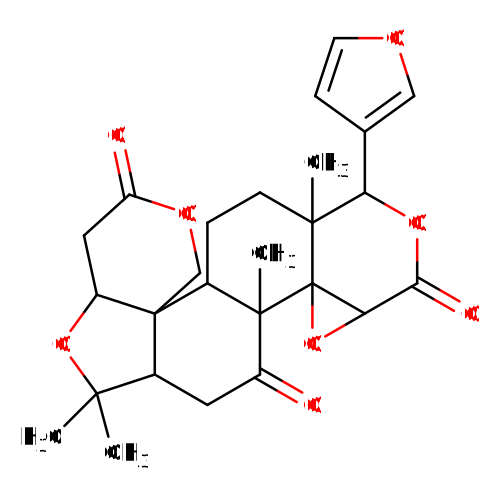
| Description | Limonin, also known as evodin or citrolimonin, belongs to the class of organic compounds known as limonoids. These are highly oxygenated, modified terpenoids with a prototypical structure either containing or derived from a precursor with a 4,4,8-trimethyl-17-furanylsteroid skeleton. All naturally occurring citrus limonoids contain a furan ring attached to the D-ring, at C-17, as well as oxygen containing functional groups at C-3, C-4, C-7, C-16 and C-17. Limonin and other limonoid compounds contribute to the bitter taste of some citrus food products. Limonin is an extremely weak basic (essentially neutral) compound (based on its pKa). Limonin is a bitter tasting compound. Outside of the human body, Limonin has been detected, but not quantified in, several different foods, such as citrus, lemons, mandarin orange (clementine, tangerine), and sweet oranges. This could make limonin a potential biomarker for the consumption of these foods. Limonin is enriched in citrus fruits and is often found at higher concentrations in seeds, for example orange and lemon seeds. Limonin reduces proliferation of colon cancer cells and has been tested as an anti-obesity agent in mice. Chemically, it is a member of the class of compounds known as furanolactones. Ongoing research programs are examining the effects of limonin in human diseases. Limonin is present in plants such as those of the Dictamnus genus. Neuroprotective effects of limonin have also been described. Limonin is found in Citrus aurantium, Citrus hanaju, Citrus junos, Citrus maxima, Citrus medica, Citrus sinensis, Citrus sudachi, Citrus trifoliata, Dictamnus albus, Dictamnus dasycarpus, Tetradium glabrifolium, Flacourtia jangomas, Glycosmis parva, Phellodendron amurense, Samadera bidwillii and Vepris louisii. Limonin was first documented in 1998 (PMID: 9619117). Citrus seed extracts reportedly have antiviral properties, inhibiting replication of retroviruses like HIV-1 and HTLV-I. |
|---|
| Structure | CC1(C)OC2CC(=O)OCC22C1CC(=O)C1(C)C2CCC2(C)C(OC(=O)C3OC123)C1=COC=C1 InChI=1S/C26H30O8/c1-22(2)15-9-16(27)24(4)14(25(15)12-31-18(28)10-17(25)33-22)5-7-23(3)19(13-6-8-30-11-13)32-21(29)20-26(23,24)34-20/h6,8,11,14-15,17,19-20H,5,7,9-10,12H2,1-4H3 |
|---|
| Synonyms | | Value | Source |
|---|
| 7,16-Dioxo-7,16-dideoxylimondiol | HMDB | | Citrolimonin | HMDB | | Dictamnolactone | HMDB | | Evodia fruit | HMDB | | Evodia fruit (JP15) | HMDB | | Evodin | HMDB | | Evodine? | HMDB | | Limone? | HMDB | | Limonoate D-ring-lactone | HMDB | | Limonoic acid 3,19:16,17-dilactone | HMDB | | Limonoic acid, di-delta-lactone | HMDB | | Obaculactone | HMDB |
|
|---|
| Chemical Formula | C26H30O8 |
|---|
| Average Mass | 470.5116 Da |
|---|
| Monoisotopic Mass | 470.19407 Da |
|---|
| IUPAC Name | 19-(furan-3-yl)-9,9,13,20-tetramethyl-4,8,15,18-tetraoxahexacyclo[11.9.0.0²,⁷.0²,¹⁰.0¹⁴,¹⁶.0¹⁴,²⁰]docosane-5,12,17-trione |
|---|
| Traditional Name | limonin |
|---|
| CAS Registry Number | 1180-71-8 |
|---|
| SMILES | CC1(C)OC2CC(=O)OCC22C1CC(=O)C1(C)C2CCC2(C)C(OC(=O)C3OC123)C1=COC=C1 |
|---|
| InChI Identifier | InChI=1S/C26H30O8/c1-22(2)15-9-16(27)24(4)14(25(15)12-31-18(28)10-17(25)33-22)5-7-23(3)19(13-6-8-30-11-13)32-21(29)20-26(23,24)34-20/h6,8,11,14-15,17,19-20H,5,7,9-10,12H2,1-4H3 |
|---|
| InChI Key | KBDSLGBFQAGHBE-UHFFFAOYSA-N |
|---|
| Experimental Spectra |
|---|
|
| | Spectrum Type | Description | Depositor Email | Depositor Organization | Depositor | Deposition Date | View |
|---|
| HSQC NMR | [1H, 13C] NMR Spectrum (2D, 600 MHz, C2D6OS, experimental) | [email protected] | MU Metabolomics Center, University of Missouri, Columbia. MO, USA | Dr. Bharat Goel | 2024-01-25 | View Spectrum | | HMBC NMR | [1H, 13C] NMR Spectrum (2D, 600 MHz, C2D6OS, experimental) | [email protected] | MU Metabolomics Center, University of Missouri, Columbia. MO, USA | Dr. Bharat Goel | 2024-01-25 | View Spectrum | | COSY NMR | [1H, 1H] NMR Spectrum (2D, 600 MHz, C2D6OS, experimental) | [email protected] | MU Metabolomics Center, University of Missouri, Columbia. MO, USA | Dr. Bharat Goel | 2024-01-25 | View Spectrum | | 1D NMR | 13C NMR Spectrum (1D, 201 MHz, C2D6OS, experimental) | [email protected] | MU Metabolomics Center, University of Missouri, Columbia. MO, USA | Dr. Bharat Goel | 2024-01-25 | View Spectrum | | 1D NMR | 1H NMR Spectrum (1D, 600 MHz, C2D6OS, experimental) | [email protected] | MU Metabolomics Center, University of Missouri, Columbia. MO, USA | Dr. Bharat Goel | 2024-01-25 | View Spectrum |
| | Predicted Spectra |
|---|
|
| | Spectrum Type | Description | Depositor ID | Depositor Organization | Depositor | Deposition Date | View |
|---|
| | Chemical Shift Submissions |
|---|
|
| Not Available | | Species |
|---|
| Species of Origin | |
|---|
| Chemical Taxonomy |
|---|
| Description | Belongs to the class of organic compounds known as limonoids. These are highly oxygenated, modified terpenoids with a prototypical structure either containing or derived from a precursor with a 4,4,8-trimethyl-17-furanylsteroid skeleton. All naturally occurring citrus limonoids contain a furan ring attached to the D-ring, at C-17, as well as oxygen containing functional groups at C-3, C-4, C-7, C-16 and C-17. |
|---|
| Kingdom | Organic compounds |
|---|
| Super Class | Lipids and lipid-like molecules |
|---|
| Class | Prenol lipids |
|---|
| Sub Class | Triterpenoids |
|---|
| Direct Parent | Limonoids |
|---|
| Alternative Parents | |
|---|
| Substituents | - Limonoid skeleton
- Steroid lactone
- 11-oxosteroid
- Oxosteroid
- 2-oxosteroid
- Steroid
- Naphthopyran
- Naphthalene
- Delta valerolactone
- Dioxepane
- 1,4-dioxepane
- Delta_valerolactone
- Pyran
- Oxane
- Dicarboxylic acid or derivatives
- Tetrahydrofuran
- Heteroaromatic compound
- Furan
- Carboxylic acid ester
- Lactone
- Ketone
- Organoheterocyclic compound
- Carboxylic acid derivative
- Oxacycle
- Dialkyl ether
- Oxirane
- Ether
- Organooxygen compound
- Organic oxide
- Carbonyl group
- Hydrocarbon derivative
- Organic oxygen compound
- Aromatic heteropolycyclic compound
|
|---|
| Molecular Framework | Aromatic heteropolycyclic compounds |
|---|
| External Descriptors | |
|---|
| Physical Properties |
|---|
| State | Not Available |
|---|
| Experimental Properties | | Property | Value | Reference |
|---|
| Melting Point | Not Available | Not Available | | Boiling Point | Not Available | Not Available | | Water Solubility | Not Available | Not Available | | LogP | Not Available | Not Available |
|
|---|
| Predicted Properties | |
|---|