| Record Information |
|---|
| Version | 2.0 |
|---|
| Created at | 2022-03-17 20:55:03 UTC |
|---|
| Updated at | 2022-03-17 20:55:03 UTC |
|---|
| NP-MRD ID | NP0048349 |
|---|
| Secondary Accession Numbers | None |
|---|
| Natural Product Identification |
|---|
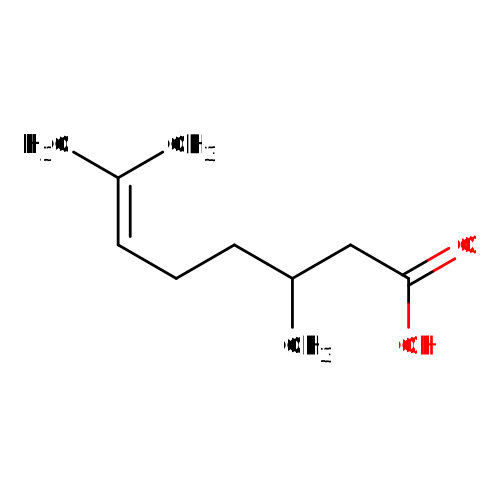
| Common Name | Citronellic acid |
|---|
| Description | Citronellic acid, also known as rhodinic acid or citronellate, belongs to the class of organic compounds known as acyclic monoterpenoids. These are monoterpenes that do not contain a cycle. Citronellic acid is a very hydrophobic molecule, practically insoluble (in water), and relatively neutral. Citronellic acid exists in all living organisms, ranging from bacteria to humans. Citronellic acid is a fatty, floral, and grassy tasting compound. Outside of the human body, Citronellic acid is found, on average, in the highest concentration within lemon balms and peppermints. Citronellic acid has also been detected, but not quantified in, a few different foods, such as cardamoms, lemon grass, and mandarin orange (clementine, tangerine). This could make citronellic acid a potential biomarker for the consumption of these foods. Citronellic acid is found in Callitris glauca, Callitris intratropica, Chamaecyparis obtusa, Daphne papyracea, Eucalyptus albens, Eucalyptus tereticornis, Juniperus spp., Pelargonium graveolens, Pelargonium vitifolium and Thujopsis dolabrata. Citronellic acid was first documented in 1990 (PMID: 2265211). A monounsaturated fatty acid that is oct-6-enoic acid carrying methyl groups at positions 3 and 7 (PMID: 18605213) (PMID: 20429462) (PMID: 20568624) (PMID: 29393872). |
|---|
| Structure | InChI=1S/C10H18O2/c1-8(2)5-4-6-9(3)7-10(11)12/h5,9H,4,6-7H2,1-3H3,(H,11,12) |
|---|
| Synonyms | | Value | Source |
|---|
| 3,7-Dimethyl-6-octenoic acid | ChEBI | | Rhodinic acid | ChEBI | | Rhodinolic acid | ChEBI | | 3,7-Dimethyl-6-octenoate | Generator | | Rhodinate | Generator | | Rhodinolate | Generator | | Citronellate | Generator | | Callitrol | HMDB | | FEMA 3142 | HMDB |
|
|---|
| Chemical Formula | C10H18O2 |
|---|
| Average Mass | 170.2487 Da |
|---|
| Monoisotopic Mass | 170.13068 Da |
|---|
| IUPAC Name | 3,7-dimethyloct-6-enoic acid |
|---|
| Traditional Name | citronellic acid |
|---|
| CAS Registry Number | 502-47-6 |
|---|
| SMILES | CC(CCC=C(C)C)CC(O)=O |
|---|
| InChI Identifier | InChI=1S/C10H18O2/c1-8(2)5-4-6-9(3)7-10(11)12/h5,9H,4,6-7H2,1-3H3,(H,11,12) |
|---|
| InChI Key | GJWSUKYXUMVMGX-UHFFFAOYSA-N |
|---|
| Experimental Spectra |
|---|
|
| Not Available | | Predicted Spectra |
|---|
|
| Not Available | | Chemical Shift Submissions |
|---|
|
| Not Available | | Species |
|---|
| Species of Origin | |
|---|
| Chemical Taxonomy |
|---|
| Description | Belongs to the class of organic compounds known as acyclic monoterpenoids. These are monoterpenes that do not contain a cycle. |
|---|
| Kingdom | Organic compounds |
|---|
| Super Class | Lipids and lipid-like molecules |
|---|
| Class | Prenol lipids |
|---|
| Sub Class | Monoterpenoids |
|---|
| Direct Parent | Acyclic monoterpenoids |
|---|
| Alternative Parents | |
|---|
| Substituents | - Acyclic monoterpenoid
- Medium-chain fatty acid
- Branched fatty acid
- Methyl-branched fatty acid
- Unsaturated fatty acid
- Fatty acyl
- Fatty acid
- Monocarboxylic acid or derivatives
- Carboxylic acid
- Carboxylic acid derivative
- Organic oxygen compound
- Organooxygen compound
- Carbonyl group
- Hydrocarbon derivative
- Organic oxide
- Aliphatic acyclic compound
|
|---|
| Molecular Framework | Aliphatic acyclic compounds |
|---|
| External Descriptors | |
|---|
| Physical Properties |
|---|
| State | Not Available |
|---|
| Experimental Properties | | Property | Value | Reference |
|---|
| Melting Point | Not Available | Not Available | | Boiling Point | Not Available | Not Available | | Water Solubility | Not Available | Not Available | | LogP | Not Available | Not Available |
|
|---|
| Predicted Properties | |
|---|
| General References | - Martin A, Armbruster U, Decker D, Gedig T, Kockritz A: Oxidation of citronellal to citronellic acid by molecular oxygen using supported gold catalysts. ChemSusChem. 2008;1(3):242-8. doi: 10.1002/cssc.200700140. [PubMed:18605213 ]
- Phillips AK, Appel AG, Sims SR: Topical toxicity of essential oils to the German cockroach (Dictyoptera: Blattellidae). J Econ Entomol. 2010 Apr;103(2):448-59. doi: 10.1603/EC09192. [PubMed:20429462 ]
- Phillips AK, Appel AG: Fumigant toxicity of essential oils to the German cockroach (Dictyoptera: Blattellidae). J Econ Entomol. 2010 Jun;103(3):781-90. doi: 10.1603/ec09358. [PubMed:20568624 ]
- Berger RG, Akkan Z, Drawert F: Catabolism of geraniol by cell suspension cultures of Citrus limon. Biochim Biophys Acta. 1990 Dec 10;1055(3):234-9. doi: 10.1016/0167-4889(90)90038-f. [PubMed:2265211 ]
- Rychlicka M, Niezgoda N, Gliszczynska A: Lipase-Catalyzed Acidolysis of Egg-Yolk Phosphatidylcholine with Citronellic Acid. New Insight into Synthesis of Isoprenoid-Phospholipids. Molecules. 2018 Feb 2;23(2). pii: molecules23020314. doi: 10.3390/molecules23020314. [PubMed:29393872 ]
|
|---|