| Record Information |
|---|
| Version | 2.0 |
|---|
| Created at | 2022-03-17 20:53:57 UTC |
|---|
| Updated at | 2022-03-17 20:53:57 UTC |
|---|
| NP-MRD ID | NP0048280 |
|---|
| Secondary Accession Numbers | None |
|---|
| Natural Product Identification |
|---|
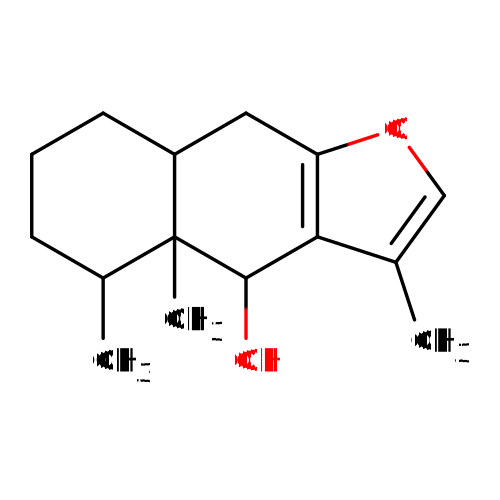
| Common Name | Petasalbin |
|---|
| Description | Petasalbin, also known as ligularol, belongs to the class of organic compounds known as eremophilane, 8,9-secoeremophilane and furoeremophilane sesquiterpenoids. These are sesquiterpenoids with a structure based either on the eremophilane skeleton, its 8,9-seco derivative, or the furoeremophilane skeleton. Eremophilanes have been shown to be derived from eudesmanes by migration of the methyl group at C-10 to C-5. Petasalbin is an extremely weak basic (essentially neutral) compound (based on its pKa). Outside of the human body, Petasalbin has been detected, but not quantified in, a few different foods, such as giant butterburs, green vegetables, and tea. Petasalbin is found in Ligularia fischeri, Ligularia kanaitzensis, Ligularia lamarum, Ligularia sibirica, Ligularia subspicata, Ligularia vellerea, Ligularia virgaurea and Petasites albus. This could make petasalbin a potential biomarker for the consumption of these foods. |
|---|
| Structure | CC1CCCC2CC3=C(C(O)C12C)C(C)=CO3 InChI=1S/C15H22O2/c1-9-8-17-12-7-11-6-4-5-10(2)15(11,3)14(16)13(9)12/h8,10-11,14,16H,4-7H2,1-3H3 |
|---|
| Synonyms | | Value | Source |
|---|
| 6-Hydroxyfuranoeremophilane | HMDB | | Ligularol | HMDB | | Methyl 2-oxoheptanoate | HMDB |
|
|---|
| Chemical Formula | C15H22O2 |
|---|
| Average Mass | 234.3340 Da |
|---|
| Monoisotopic Mass | 234.16198 Da |
|---|
| IUPAC Name | 3,4a,5-trimethyl-4H,4aH,5H,6H,7H,8H,8aH,9H-naphtho[2,3-b]furan-4-ol |
|---|
| Traditional Name | 3,4a,5-trimethyl-4H,5H,6H,7H,8H,8aH,9H-naphtho[2,3-b]furan-4-ol |
|---|
| CAS Registry Number | 4176-11-8 |
|---|
| SMILES | CC1CCCC2CC3=C(C(O)C12C)C(C)=CO3 |
|---|
| InChI Identifier | InChI=1S/C15H22O2/c1-9-8-17-12-7-11-6-4-5-10(2)15(11,3)14(16)13(9)12/h8,10-11,14,16H,4-7H2,1-3H3 |
|---|
| InChI Key | ANKFPIBCTISOBX-UHFFFAOYSA-N |
|---|
| Experimental Spectra |
|---|
|
| Not Available | | Predicted Spectra |
|---|
|
| Not Available | | Chemical Shift Submissions |
|---|
|
| Not Available | | Species |
|---|
| Species of Origin | |
|---|
| Chemical Taxonomy |
|---|
| Description | Belongs to the class of organic compounds known as eremophilane, 8,9-secoeremophilane and furoeremophilane sesquiterpenoids. These are sesquiterpenoids with a structure based either on the eremophilane skeleton, its 8,9-seco derivative, or the furoeremophilane skeleton. Eremophilanes have been shown to be derived from eudesmanes by migration of the methyl group at C-10 to C-5. |
|---|
| Kingdom | Organic compounds |
|---|
| Super Class | Lipids and lipid-like molecules |
|---|
| Class | Prenol lipids |
|---|
| Sub Class | Sesquiterpenoids |
|---|
| Direct Parent | Eremophilane, 8,9-secoeremophilane and furoeremophilane sesquiterpenoids |
|---|
| Alternative Parents | |
|---|
| Substituents | - Furoeremophilane sesquiterpenoid
- Naphthofuran
- Benzofuran
- Heteroaromatic compound
- Furan
- Secondary alcohol
- Oxacycle
- Organoheterocyclic compound
- Organic oxygen compound
- Hydrocarbon derivative
- Organooxygen compound
- Alcohol
- Aromatic heteropolycyclic compound
|
|---|
| Molecular Framework | Aromatic heteropolycyclic compounds |
|---|
| External Descriptors | Not Available |
|---|
| Physical Properties |
|---|
| State | Not Available |
|---|
| Experimental Properties | | Property | Value | Reference |
|---|
| Melting Point | Not Available | Not Available | | Boiling Point | Not Available | Not Available | | Water Solubility | Not Available | Not Available | | LogP | Not Available | Not Available |
|
|---|
| Predicted Properties | |
|---|