| Record Information |
|---|
| Version | 2.0 |
|---|
| Created at | 2022-03-17 20:53:38 UTC |
|---|
| Updated at | 2022-03-17 20:53:38 UTC |
|---|
| NP-MRD ID | NP0048259 |
|---|
| Secondary Accession Numbers | None |
|---|
| Natural Product Identification |
|---|
| Common Name | Rishitin |
|---|
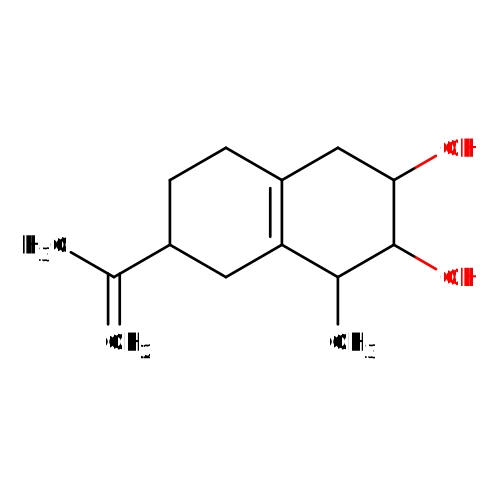
| Description | Rishitin belongs to the class of organic compounds known as 1,2-diols. These are polyols containing an alcohol group at two adjacent positions. Studies using radioisotope labeled compounds, revealed however that solavetivone, 15-hydroxysolavetivone, lubimin and 3-hydroxylubimin are precursors of rishitin. Rishitin is an extremely weak basic (essentially neutral) compound (based on its pKa). Outside of the human body, Rishitin has been detected, but not quantified in, several different foods, such as potato, pepper (c. Annuum), orange bell peppers, red bell peppers, and green bell peppers. This could make rishitin a potential biomarker for the consumption of these foods. Same as the phytoalexin capsidiol, it belongs to the group of sesquiterpenes and is as such a FPP derivative. The biosynthetic pathway of rishitin has not yet been fully elucidated, and is still an active topic of research. Currently, the enzymes responsible for the synthesis of rishitin have not yet been discovered. Rishitin was named after the potato cultivar Rishiri, where it was first discovered in 1968. Rishitin belongs to a heterogeneous group of anti-microbial plant defense compounds termed phytoalexins and is produced upon pathogen attack. Rishitin is found in Nicotiana tabacum , Boeremia exigua, Phytophthora infestans, Solanum demissum, Solanum spp and Solanum spp.. Rishitin is a terpenoid compound, produced by some plants belonging to the Solanum family, including potato and tomato. |
|---|
| Structure | CC1C(O)C(O)CC2=C1CC(CC2)C(C)=C InChI=1S/C14H22O2/c1-8(2)10-4-5-11-7-13(15)14(16)9(3)12(11)6-10/h9-10,13-16H,1,4-7H2,2-3H3 |
|---|
| Synonyms | Not Available |
|---|
| Chemical Formula | C14H22O2 |
|---|
| Average Mass | 222.3233 Da |
|---|
| Monoisotopic Mass | 222.16198 Da |
|---|
| IUPAC Name | 1-methyl-7-(prop-1-en-2-yl)-1,2,3,4,5,6,7,8-octahydronaphthalene-2,3-diol |
|---|
| Traditional Name | 1-methyl-7-(prop-1-en-2-yl)-1,2,3,4,5,6,7,8-octahydronaphthalene-2,3-diol |
|---|
| CAS Registry Number | 18178-54-6 |
|---|
| SMILES | CC1C(O)C(O)CC2=C1CC(CC2)C(C)=C |
|---|
| InChI Identifier | InChI=1S/C14H22O2/c1-8(2)10-4-5-11-7-13(15)14(16)9(3)12(11)6-10/h9-10,13-16H,1,4-7H2,2-3H3 |
|---|
| InChI Key | XSCYYIVXGBKTOC-UHFFFAOYSA-N |
|---|
| Experimental Spectra |
|---|
|
| Not Available | | Predicted Spectra |
|---|
|
| Not Available | | Chemical Shift Submissions |
|---|
|
| Not Available | | Species |
|---|
| Species of Origin | |
|---|
| Chemical Taxonomy |
|---|
| Description | Belongs to the class of organic compounds known as 1,2-diols. These are polyols containing an alcohol group at two adjacent positions. |
|---|
| Kingdom | Organic compounds |
|---|
| Super Class | Organic oxygen compounds |
|---|
| Class | Organooxygen compounds |
|---|
| Sub Class | Alcohols and polyols |
|---|
| Direct Parent | 1,2-diols |
|---|
| Alternative Parents | |
|---|
| Substituents | - Secondary alcohol
- 1,2-diol
- Hydrocarbon derivative
- Aliphatic homopolycyclic compound
|
|---|
| Molecular Framework | Aliphatic homopolycyclic compounds |
|---|
| External Descriptors | |
|---|
| Physical Properties |
|---|
| State | Not Available |
|---|
| Experimental Properties | | Property | Value | Reference |
|---|
| Melting Point | Not Available | Not Available | | Boiling Point | Not Available | Not Available | | Water Solubility | Not Available | Not Available | | LogP | Not Available | Not Available |
|
|---|
| Predicted Properties | |
|---|