| Record Information |
|---|
| Version | 2.0 |
|---|
| Created at | 2022-03-17 20:52:44 UTC |
|---|
| Updated at | 2022-03-17 20:52:44 UTC |
|---|
| NP-MRD ID | NP0048201 |
|---|
| Secondary Accession Numbers | None |
|---|
| Natural Product Identification |
|---|
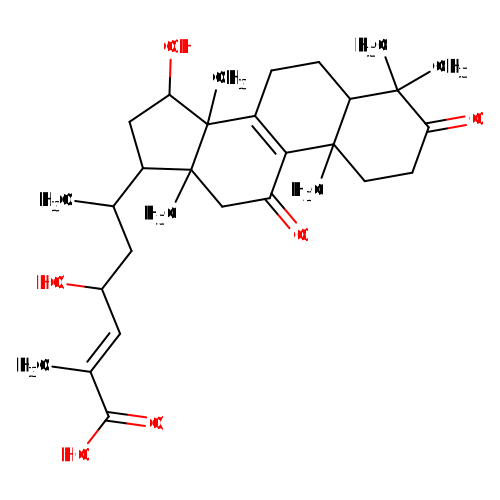
| Common Name | Ganolucidic acid D |
|---|
| Description | Theaflavin 3,3'-digallate belongs to the class of organic compounds known as imidolactams. These are cyclic organooxygen compounds containing the structure RC(=N)N where the central carbon atom and one of the linked nitrogen atoms are part of the same ring( R here is an organyl group). They can also be viewed as analogs of lactams where the oxygen atom is replaced by a nitrogen atom. Theaflavin 3,3'-digallate is an extremely weak basic (essentially neutral) compound (based on its pKa). Outside of the human body, Theaflavin 3,3'-digallate is found, on average, in the highest concentration within tea. Theaflavin 3,3'-digallate has also been detected, but not quantified in, german camomiles and peppermints. Ganolucidic acid D is found in Ganoderma lucidum . This could make theaflavin 3,3'-digallate a potential biomarker for the consumption of these foods. |
|---|
| Structure | CC(CC(O)\C=C(/C)C(O)=O)C1CC(O)C2(C)C3=C(C(=O)CC12C)C1(C)CCC(=O)C(C)(C)C1CC3 InChI=1S/C30H44O6/c1-16(12-18(31)13-17(2)26(35)36)20-14-24(34)30(7)19-8-9-22-27(3,4)23(33)10-11-28(22,5)25(19)21(32)15-29(20,30)6/h13,16,18,20,22,24,31,34H,8-12,14-15H2,1-7H3,(H,35,36)/b17-13+ |
|---|
| Synonyms | | Value | Source |
|---|
| Theaflavin 3,3'-digallic acid | Generator | | Theaflavin 3,3'-di-O-gallate | HMDB | | (+)-Ganolucidic acid D | HMDB | | 15alpha,23-Dihydroxy-3,11-dioxo-5alpha-lanosta-8,24E-dien-26-Oic acid | HMDB | | (2E)-4-Hydroxy-6-{12-hydroxy-2,6,6,11,15-pentamethyl-5,17-dioxotetracyclo[8.7.0.0²,⁷.0¹¹,¹⁵]heptadec-1(10)-en-14-yl}-2-methylhept-2-enoate | Generator | | Ganolucidate D | Generator |
|
|---|
| Chemical Formula | C30H44O6 |
|---|
| Average Mass | 500.6668 Da |
|---|
| Monoisotopic Mass | 500.31379 Da |
|---|
| IUPAC Name | (2E)-4-hydroxy-6-{12-hydroxy-2,6,6,11,15-pentamethyl-5,17-dioxotetracyclo[8.7.0.0²,⁷.0¹¹,¹⁵]heptadec-1(10)-en-14-yl}-2-methylhept-2-enoic acid |
|---|
| Traditional Name | (2E)-4-hydroxy-6-{12-hydroxy-2,6,6,11,15-pentamethyl-5,17-dioxotetracyclo[8.7.0.0²,⁷.0¹¹,¹⁵]heptadec-1(10)-en-14-yl}-2-methylhept-2-enoic acid |
|---|
| CAS Registry Number | 102607-22-7 |
|---|
| SMILES | CC(CC(O)\C=C(/C)C(O)=O)C1CC(O)C2(C)C3=C(C(=O)CC12C)C1(C)CCC(=O)C(C)(C)C1CC3 |
|---|
| InChI Identifier | InChI=1S/C30H44O6/c1-16(12-18(31)13-17(2)26(35)36)20-14-24(34)30(7)19-8-9-22-27(3,4)23(33)10-11-28(22,5)25(19)21(32)15-29(20,30)6/h13,16,18,20,22,24,31,34H,8-12,14-15H2,1-7H3,(H,35,36)/b17-13+ |
|---|
| InChI Key | AUAXRALNWSHMRJ-GHRIWEEISA-N |
|---|
| Experimental Spectra |
|---|
|
| Not Available | | Predicted Spectra |
|---|
|
| Not Available | | Chemical Shift Submissions |
|---|
|
| Not Available | | Species |
|---|
| Species of Origin | | Species Name | Source | Reference |
|---|
| Agaricus bisporus | FooDB | - Shmuel Yannai Dictionary of Food Compounds with CD-ROM: Additives, Flavors, and Ingredients. Chap...
| | Ganoderma lucidum | Fungi | | | Pleurotus ostreatus | FooDB | - Shmuel Yannai Dictionary of Food Compounds with CD-ROM: Additives, Flavors, and Ingredients. Chap...
|
|
|---|
| Chemical Taxonomy |
|---|
| Description | Belongs to the class of organic compounds known as imidolactams. These are cyclic organooxygen compounds containing the structure RC(=N)N where the central carbon atom and one of the linked nitrogen atoms are part of the same ring( R here is an organyl group). They can also be viewed as analogs of lactams where the oxygen atom is replaced by a nitrogen atom. |
|---|
| Kingdom | Organic compounds |
|---|
| Super Class | Organoheterocyclic compounds |
|---|
| Class | Imidolactams |
|---|
| Sub Class | Not Available |
|---|
| Direct Parent | Imidolactams |
|---|
| Alternative Parents | |
|---|
| Substituents | - Imidolactam
- 2-imidazoline
- Azacycle
- Organic 1,3-dipolar compound
- Propargyl-type 1,3-dipolar organic compound
- Carboximidamide
- Carboxylic acid amidine
- Amidine
- Organic nitrogen compound
- Organopnictogen compound
- Hydrocarbon derivative
- Organonitrogen compound
- Aliphatic heteromonocyclic compound
|
|---|
| Molecular Framework | Aliphatic heteromonocyclic compounds |
|---|
| External Descriptors | Not Available |
|---|
| Physical Properties |
|---|
| State | Not Available |
|---|
| Experimental Properties | | Property | Value | Reference |
|---|
| Melting Point | Not Available | Not Available | | Boiling Point | Not Available | Not Available | | Water Solubility | Not Available | Not Available | | LogP | Not Available | Not Available |
|
|---|
| Predicted Properties | |
|---|