Np mrd loader

Record Information
Version2.0
Created at2022-03-17 20:52:29 UTC
Updated at2022-03-17 20:52:29 UTC
NP-MRD IDNP0048185
Secondary Accession NumbersNone
Natural Product Identification
Common NameHydroxypropanedioic acid
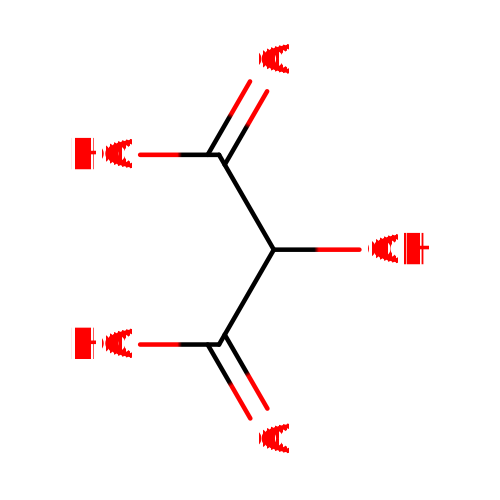
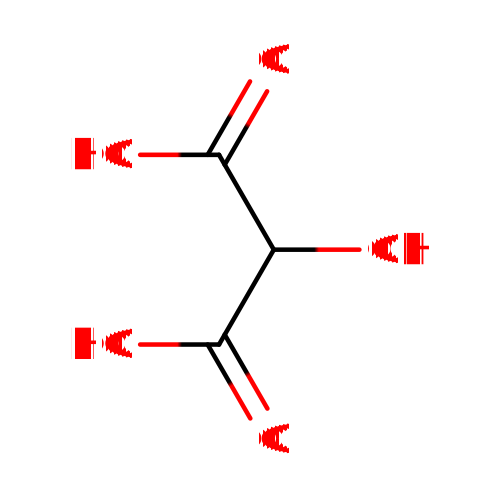
DescriptionHydroxypropanedioic acid, also known as 2-tartronic acid or 2-hydroxymalonate, belongs to the class of organic compounds known as dicarboxylic acids and derivatives. These are organic compounds containing exactly two carboxylic acid groups. Hydroxypropanedioic acid is an extremely weak basic (essentially neutral) compound (based on its pKa). Outside of the human body, Hydroxypropanedioic acid has been detected, but not quantified in, potato. This could make hydroxypropanedioic acid a potential biomarker for the consumption of these foods. Hydroxypropanedioic acid is found in Apis cerana and Pogostemon cablin. Hydroxypropanedioic acid was first documented in 1962 (PMID: 14039995). A dicarboxylic acid that is malonic acid substituted by a hydroxy group at position 2 (PMID: 17889996) (PMID: 11731084) (PMID: 4803853) (PMID: 22360688).
Structure
Thumb
Synonyms
ValueSource
2-HydroxymalonateChEBI
2-Hydroxymalonic acidChEBI
2-Hydroxypropanedioic acidChEBI
2-Tartronic acidChEBI
Tartronic acidChEBI
Hydroxymalonic acidKegg
2-HydroxypropanedioateGenerator
2-TartronateGenerator
TartronateGenerator
HydroxymalonateGenerator
HydroxypropanedioateGenerator
Hydroxy-malonic acidHMDB
Propanedioic acid, hydroxy- (9ci)HMDB
Tartronic acid, 8ciHMDB
Chemical FormulaC3H4O5
Average Mass120.0609 Da
Monoisotopic Mass120.00587 Da
IUPAC Name2-hydroxypropanedioic acid
Traditional Nametartronic acid
CAS Registry Number80-69-3
SMILES
OC(C(O)=O)C(O)=O
InChI Identifier
InChI=1S/C3H4O5/c4-1(2(5)6)3(7)8/h1,4H,(H,5,6)(H,7,8)
InChI KeyROBFUDYVXSDBQM-UHFFFAOYSA-N
Experimental Spectra
Not Available
Predicted Spectra
Not Available
Chemical Shift Submissions
Not Available
Species
Species of Origin
Species NameSourceReference
Apis ceranaLOTUS Database
Pogostemon cablinLOTUS Database
Solanum tuberosumFooDB
Chemical Taxonomy
Description Belongs to the class of organic compounds known as dicarboxylic acids and derivatives. These are organic compounds containing exactly two carboxylic acid groups.
KingdomOrganic compounds
Super ClassOrganic acids and derivatives
ClassCarboxylic acids and derivatives
Sub ClassDicarboxylic acids and derivatives
Direct ParentDicarboxylic acids and derivatives
Alternative Parents
Substituents
  • 1,3-dicarbonyl compound
  • Monosaccharide
  • Hydroxy acid
  • Dicarboxylic acid or derivatives
  • Alpha-hydroxy acid
  • Secondary alcohol
  • Carboxylic acid
  • Organic oxygen compound
  • Organic oxide
  • Hydrocarbon derivative
  • Organooxygen compound
  • Carbonyl group
  • Alcohol
  • Aliphatic acyclic compound
Molecular FrameworkAliphatic acyclic compounds
External Descriptors
Physical Properties
StateNot Available
Experimental Properties
PropertyValueReference
Melting PointNot AvailableNot Available
Boiling PointNot AvailableNot Available
Water SolubilityNot AvailableNot Available
LogPNot AvailableNot Available
Predicted Properties
PropertyValueSource
logP-1ALOGPS
logP-1ChemAxon
logS0.18ALOGPS
pKa (Strongest Acidic)2.16ChemAxon
pKa (Strongest Basic)-4.9ChemAxon
Physiological Charge-2ChemAxon
Hydrogen Acceptor Count5ChemAxon
Hydrogen Donor Count3ChemAxon
Polar Surface Area94.83 ŲChemAxon
Rotatable Bond Count2ChemAxon
Refractivity20.33 m³·mol⁻¹ChemAxon
Polarizability8.96 ųChemAxon
Number of Rings0ChemAxon
BioavailabilityYesChemAxon
Rule of FiveYesChemAxon
Ghose FilterNoChemAxon
Veber's RuleNoChemAxon
MDDR-like RuleNoChemAxon
HMDB IDHMDB0035227
DrugBank IDNot Available
Phenol Explorer Compound IDNot Available
FoodDB IDFDB013880
KNApSAcK IDNot Available
Chemspider ID44
KEGG Compound IDC02287
BioCyc IDNot Available
BiGG IDNot Available
Wikipedia LinkHydroxymalonic_acid
METLIN IDNot Available
PubChem Compound45
PDB IDNot Available
ChEBI ID16513
Good Scents IDNot Available
References
General References
  1. VEITCH FP, BRIERLEY GP: The quantitative determination of tartronic acid (hydroxymalonic acid) in urine and tissues. Biochim Biophys Acta. 1962 Apr 23;58:567-73. doi: 10.1016/0006-3002(62)90057-4. [PubMed:14039995 ]
  2. Shen JM, Chen ZL, Xu ZZ, Li XY, Xu BB, Qi F: Kinetics and mechanism of degradation of p-chloronitrobenzene in water by ozonation. J Hazard Mater. 2008 Apr 15;152(3):1325-31. doi: 10.1016/j.jhazmat.2007.08.009. Epub 2007 Aug 8. [PubMed:17889996 ]
  3. Guerranti R, Pagani R, Neri S, Errico SV, Leoncini R, Marinello E: Inhibition and regulation of rat liver L-threonine dehydrogenase by different fatty acids and their derivatives. Biochim Biophys Acta. 2001 Nov 7;1568(1):45-52. doi: 10.1016/s0304-4165(01)00197-0. [PubMed:11731084 ]
  4. Jacob J, Grimmer G: [Occurrence of alkyl-hydroxymalonic acids in uropygial gland secretions of birds (author's transl)]. Hoppe Seylers Z Physiol Chem. 1973 Dec;354(12):1648-50. [PubMed:4803853 ]
  5. Knope KE, Kimura H, Yasaka Y, Nakahara M, Andrews MB, Cahill CL: Investigation of in situ oxalate formation from 2,3-pyrazinedicarboxylate under hydrothermal conditions using nuclear magnetic resonance spectroscopy. Inorg Chem. 2012 Mar 19;51(6):3883-90. doi: 10.1021/ic3000944. Epub 2012 Feb 24. [PubMed:22360688 ]