| Record Information |
|---|
| Version | 2.0 |
|---|
| Created at | 2022-03-17 20:50:00 UTC |
|---|
| Updated at | 2022-03-17 20:50:00 UTC |
|---|
| NP-MRD ID | NP0048033 |
|---|
| Secondary Accession Numbers | None |
|---|
| Natural Product Identification |
|---|
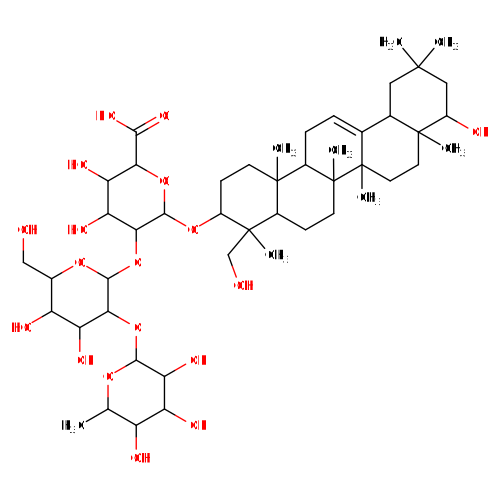
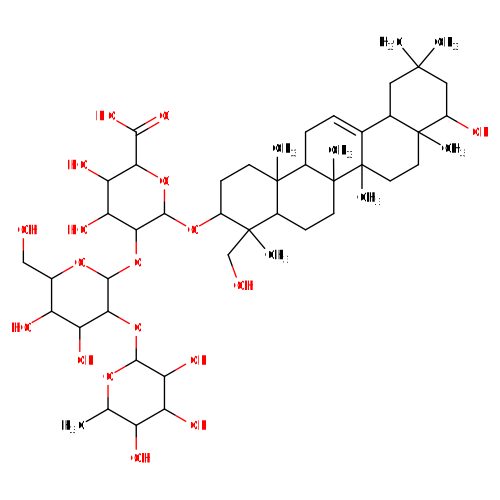
| Common Name | Soyasaponin I |
|---|
| Description | Soyasaponin I, also known as SCM 3B, belongs to the class of organic compounds known as triterpene saponins. These are glycosylated derivatives of triterpene sapogenins. The sapogenin moiety backbone is usually based on the oleanane, ursane, taraxastane, bauerane, lanostane, lupeol, lupane, dammarane, cycloartane, friedelane, hopane, 9b,19-cyclo-lanostane, cycloartane, or cycloartanol skeleton. Soyasaponin I is an extremely weak basic (essentially neutral) compound (based on its pKa). Outside of the human body, Soyasaponin I is found, on average, in the highest concentration within soy beans. Soyasaponin I has also been detected, but not quantified in, several different foods, such as chickpea, common pea, lentils, and pulses. Soyasaponin I is found in Abrus fruticulosus, Abrus pulchellus, Arachis hypogaea, Astragalus icmadophilus, Astragalus membranaceus, Astragalus shikokianus, Astragalus sikokianus, Crotalaria albida, Sophora koreensis, Glycyrrhiza glabra, Gueldenstaedtia multiflora , Gueldenstaedtia verna, Hedysarum polybotrys, Impatiens siculifer, Lupinus angustifolius, Lupinus oreophilus, Lupinus polyphyllus, Medicago arabica, Medicago arborea, Medicago citrina, Medicago polymorpha, Medicago sativa , Medicago truncatula, Melilotus messanensis, Melilotus officinalis, Phaseolus spp., Pueraria montana, Rothia indica, Sophora flavescens , Sophora tonkinensis, Sorbus cuspidata, Styphnolobium japonicum, Trifolium alexandrinum, Trifolium argutum, Trifolium pratense, Trifolium repens , Trifolium resupinatum, Vigna angularis , Vigna mungo and Wisteria brachybotrys. This could make soyasaponin I a potential biomarker for the consumption of these foods. |
|---|
| Structure | CC1OC(OC2C(O)C(O)C(CO)OC2OC2C(O)C(O)C(OC2OC2CCC3(C)C(CCC4(C)C3CC=C3C5CC(C)(C)CC(O)C5(C)CCC43C)C2(C)CO)C(O)=O)C(O)C(O)C1O InChI=1S/C48H78O18/c1-21-29(52)31(54)35(58)40(61-21)65-37-32(55)30(53)24(19-49)62-41(37)66-38-34(57)33(56)36(39(59)60)64-42(38)63-28-12-13-45(5)25(46(28,6)20-50)11-14-48(8)26(45)10-9-22-23-17-43(2,3)18-27(51)44(23,4)15-16-47(22,48)7/h9,21,23-38,40-42,49-58H,10-20H2,1-8H3,(H,59,60) |
|---|
| Synonyms | | Value | Source |
|---|
| Oleanane, b-D-glucopyranosiduronic acid deriv. | HMDB | | SCM 3b | HMDB | | Soyasaponin BB | HMDB | | Soybean saponin fraction b1 | HMDB | | 5-{[4,5-dihydroxy-6-(hydroxymethyl)-3-[(3,4,5-trihydroxy-6-methyloxan-2-yl)oxy]oxan-2-yl]oxy}-3,4-dihydroxy-6-{[9-hydroxy-4-(hydroxymethyl)-4,6a,6b,8a,11,11,14b-heptamethyl-1,2,3,4,4a,5,6,6a,6b,7,8,8a,9,10,11,12,12a,14,14a,14b-icosahydropicen-3-yl]oxy}oxane-2-carboxylate | Generator |
|
|---|
| Chemical Formula | C48H78O18 |
|---|
| Average Mass | 943.1221 Da |
|---|
| Monoisotopic Mass | 942.51882 Da |
|---|
| IUPAC Name | 5-{[4,5-dihydroxy-6-(hydroxymethyl)-3-[(3,4,5-trihydroxy-6-methyloxan-2-yl)oxy]oxan-2-yl]oxy}-3,4-dihydroxy-6-{[9-hydroxy-4-(hydroxymethyl)-4,6a,6b,8a,11,11,14b-heptamethyl-1,2,3,4,4a,5,6,6a,6b,7,8,8a,9,10,11,12,12a,14,14a,14b-icosahydropicen-3-yl]oxy}oxane-2-carboxylic acid |
|---|
| Traditional Name | 5-{[4,5-dihydroxy-6-(hydroxymethyl)-3-[(3,4,5-trihydroxy-6-methyloxan-2-yl)oxy]oxan-2-yl]oxy}-3,4-dihydroxy-6-{[9-hydroxy-4-(hydroxymethyl)-4,6a,6b,8a,11,11,14b-heptamethyl-1,2,3,4a,5,6,7,8,9,10,12,12a,14,14a-tetradecahydropicen-3-yl]oxy}oxane-2-carboxylic acid |
|---|
| CAS Registry Number | 51330-27-9 |
|---|
| SMILES | CC1OC(OC2C(O)C(O)C(CO)OC2OC2C(O)C(O)C(OC2OC2CCC3(C)C(CCC4(C)C3CC=C3C5CC(C)(C)CC(O)C5(C)CCC43C)C2(C)CO)C(O)=O)C(O)C(O)C1O |
|---|
| InChI Identifier | InChI=1S/C48H78O18/c1-21-29(52)31(54)35(58)40(61-21)65-37-32(55)30(53)24(19-49)62-41(37)66-38-34(57)33(56)36(39(59)60)64-42(38)63-28-12-13-45(5)25(46(28,6)20-50)11-14-48(8)26(45)10-9-22-23-17-43(2,3)18-27(51)44(23,4)15-16-47(22,48)7/h9,21,23-38,40-42,49-58H,10-20H2,1-8H3,(H,59,60) |
|---|
| InChI Key | PTDAHAWQAGSZDD-UHFFFAOYSA-N |
|---|
| Experimental Spectra |
|---|
|
| Not Available | | Predicted Spectra |
|---|
|
| Not Available | | Chemical Shift Submissions |
|---|
|
| Not Available | | Species |
|---|
| Species of Origin | |
|---|
| Chemical Taxonomy |
|---|
| Description | Belongs to the class of organic compounds known as triterpene saponins. These are glycosylated derivatives of triterpene sapogenins. The sapogenin moiety backbone is usually based on the oleanane, ursane, taraxastane, bauerane, lanostane, lupeol, lupane, dammarane, cycloartane, friedelane, hopane, 9b,19-cyclo-lanostane, cycloartane, or cycloartanol skeleton. |
|---|
| Kingdom | Organic compounds |
|---|
| Super Class | Lipids and lipid-like molecules |
|---|
| Class | Prenol lipids |
|---|
| Sub Class | Terpene glycosides |
|---|
| Direct Parent | Triterpene saponins |
|---|
| Alternative Parents | |
|---|
| Substituents | - Triterpene saponin
- Triterpenoid
- Oligosaccharide
- Steroid
- Fatty acyl glycoside
- 1-o-glucuronide
- O-glucuronide
- Glucuronic acid or derivatives
- Glycosyl compound
- O-glycosyl compound
- Beta-hydroxy acid
- Fatty acyl
- Hydroxy acid
- Pyran
- Oxane
- Cyclic alcohol
- Secondary alcohol
- Acetal
- Polyol
- Oxacycle
- Monocarboxylic acid or derivatives
- Carboxylic acid derivative
- Carboxylic acid
- Organoheterocyclic compound
- Primary alcohol
- Hydrocarbon derivative
- Organic oxide
- Alcohol
- Carbonyl group
- Organooxygen compound
- Organic oxygen compound
- Aliphatic heteropolycyclic compound
|
|---|
| Molecular Framework | Aliphatic heteropolycyclic compounds |
|---|
| External Descriptors | Not Available |
|---|
| Physical Properties |
|---|
| State | Not Available |
|---|
| Experimental Properties | | Property | Value | Reference |
|---|
| Melting Point | Not Available | Not Available | | Boiling Point | Not Available | Not Available | | Water Solubility | Not Available | Not Available | | LogP | Not Available | Not Available |
|
|---|
| Predicted Properties | |
|---|