| Record Information |
|---|
| Version | 2.0 |
|---|
| Created at | 2022-03-17 20:49:23 UTC |
|---|
| Updated at | 2022-03-17 20:49:23 UTC |
|---|
| NP-MRD ID | NP0047996 |
|---|
| Secondary Accession Numbers | None |
|---|
| Natural Product Identification |
|---|
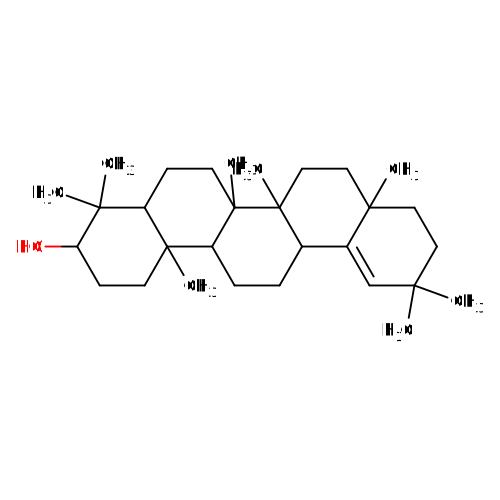
| Common Name | Germanicol |
|---|
| Description | Germanicol belongs to the class of organic compounds known as triterpenoids. These are terpene molecules containing six isoprene units. Germanicol is an extremely weak basic (essentially neutral) compound (based on its pKa). Outside of the human body, Germanicol is found, on average, in the highest concentration within tea. Germanicol has also been detected, but not quantified in, several different foods, such as common sages, cereals and cereal products, fenugreeks, asparagus, and breadfruits. Germanicol is found in Barringtonia asiatica, Barringtonia racemosa, Camellia oleifera, Chrysolaena propinqua, Cnidoscolus urens, Cuphea wrightii, Equisetum arvense, Euphorbia balsamifera , Euphorbia maculata, Euphorbia nicaeensis, Euphorbia pulcherrima, Festuca argentina, Ixeris chinensis, Koelpinia linearis, Lactarius germanicum, Lactuca saligna, Lactuca sativa, Lactuca virosa, Lactucarium germanicum, Mangifera indica, Marsypianthes chamaedrys, Olea europaea, Phoradendron reichenbachianum, Phytolacca americana, Picris hieracioides, Pistacia lentiscus, Poinsettia pulcherrima, Salvia pratensis, Scorzonera cretica, Sonchus asper, Vernonia brasiliana, Vernonia incana and Vitis vinifera. This could make germanicol a potential biomarker for the consumption of these foods. |
|---|
| Structure | CC1(C)CCC2(C)CCC3(C)C(CCC4C5(C)CCC(O)C(C)(C)C5CCC34C)C2=C1 InChI=1S/C30H50O/c1-25(2)15-16-27(5)17-18-29(7)20(21(27)19-25)9-10-23-28(6)13-12-24(31)26(3,4)22(28)11-14-30(23,29)8/h19-20,22-24,31H,9-18H2,1-8H3 |
|---|
| Synonyms | Not Available |
|---|
| Chemical Formula | C30H50O |
|---|
| Average Mass | 426.7174 Da |
|---|
| Monoisotopic Mass | 426.38617 Da |
|---|
| IUPAC Name | 4,4,6a,6b,8a,11,11,14b-octamethyl-1,2,3,4,4a,5,6,6a,6b,7,8,8a,9,10,11,12b,13,14,14a,14b-icosahydropicen-3-ol |
|---|
| Traditional Name | 4,4,6a,6b,8a,11,11,14b-octamethyl-1,2,3,4a,5,6,7,8,9,10,12b,13,14,14a-tetradecahydropicen-3-ol |
|---|
| CAS Registry Number | 465-02-1 |
|---|
| SMILES | CC1(C)CCC2(C)CCC3(C)C(CCC4C5(C)CCC(O)C(C)(C)C5CCC34C)C2=C1 |
|---|
| InChI Identifier | InChI=1S/C30H50O/c1-25(2)15-16-27(5)17-18-29(7)20(21(27)19-25)9-10-23-28(6)13-12-24(31)26(3,4)22(28)11-14-30(23,29)8/h19-20,22-24,31H,9-18H2,1-8H3 |
|---|
| InChI Key | QMUXVPRGNJLGRT-UHFFFAOYSA-N |
|---|
| Experimental Spectra |
|---|
|
| Not Available | | Predicted Spectra |
|---|
|
| Not Available | | Chemical Shift Submissions |
|---|
|
| Not Available | | Species |
|---|
| Species of Origin | |
|---|
| Chemical Taxonomy |
|---|
| Description | Belongs to the class of organic compounds known as triterpenoids. These are terpene molecules containing six isoprene units. |
|---|
| Kingdom | Organic compounds |
|---|
| Super Class | Lipids and lipid-like molecules |
|---|
| Class | Prenol lipids |
|---|
| Sub Class | Triterpenoids |
|---|
| Direct Parent | Triterpenoids |
|---|
| Alternative Parents | |
|---|
| Substituents | - Triterpenoid
- Cyclic alcohol
- Secondary alcohol
- Organic oxygen compound
- Hydrocarbon derivative
- Organooxygen compound
- Alcohol
- Aliphatic homopolycyclic compound
|
|---|
| Molecular Framework | Aliphatic homopolycyclic compounds |
|---|
| External Descriptors | |
|---|
| Physical Properties |
|---|
| State | Not Available |
|---|
| Experimental Properties | | Property | Value | Reference |
|---|
| Melting Point | Not Available | Not Available | | Boiling Point | Not Available | Not Available | | Water Solubility | Not Available | Not Available | | LogP | Not Available | Not Available |
|
|---|
| Predicted Properties | |
|---|