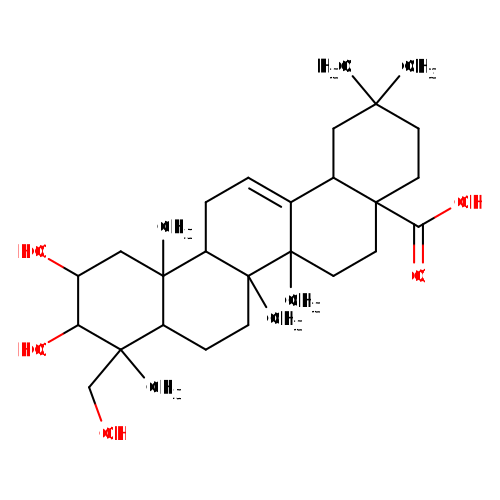
| Record Information |
|---|
| Version | 2.0 |
|---|
| Created at | 2022-03-17 20:49:15 UTC |
|---|
| Updated at | 2026-02-28 05:56:36 UTC |
|---|
| NP-MRD ID | NP0047989 |
|---|
| Natural Product DOI | https://doi.org/10.57994/0832 |
|---|
| Secondary Accession Numbers | None |
|---|
| Natural Product Identification |
|---|
| Common Name | Arjunolic acid |
|---|
| Description | Arjunolic acid, also known as arjunolate, belongs to the class of organic compounds known as triterpenoids. These are terpene molecules containing six isoprene units. Arjunolic acid is an extremely weak basic (essentially neutral) compound (based on its pKa). Outside of the human body, Arjunolic acid has been detected, but not quantified in, fruits and guava. Arjunolic acid is found in Actinidia chinensis, Aegiceras corniculatum, Akebia quinata, Akebia trifoliata, Anamirta cocculus, Anisomeles indica , Castanopsis fissa, Castanospermum australe, Centella asiatica, Cochlospermum tinctorium, Combretum fruticosum, Combretum molle , Combretum punctatum, Combretum quadrangulare , Cornus capitata, Cornus kousa, Cydonia oblonga, Durio kutejensis , Eriobotrya japonica, Eucalyptus perriniana, Eugenia crebrinervis, Eugenia gustavioides, Eugenia sandwicensis, Hedyotis lawsoniae, Ilex cornuta, Isodon japonicus, Juglans regia, Leandra chaetodon, Lophostemon confertus, Medicago arabica, Medicago arborea, Medicago hybrida, Medicago polymorpha , Medicago sativa , Medicago truncatula, Miconia dolichorrhyncha, Morella esculenta, Morella rubra, Mosla dianthera, Musanga cecropioides, Mussaenda pubescens , Myrianthus arboreus, Myrianthus libericus, Myrica gale, Photinia serratifolia, Phytolacca dodecandra, Picrorhiza kurrooa, Plumeria rubra, Premna microphylla, Prunella vulgaris, Rhabdodendron amazonicum, Rhabdodendron macrophyllum, Rosa laevigata, Salvia virgata, Siphoneugena densiflora, Stachyurus himalaicus, Symplocos lancifolia, Syzygium gustavioides, Syzygium samarangense, Syzygium sandwicense, Terminalia alata, Terminalia arjuna , Terminalia chebula, Terminalia complanata, Terminalia conferta, Terminalia fagifolia, Terminalia glabrescens, Ulmus pumila and Ulmus pumila L. . This could make arjunolic acid a potential biomarker for the consumption of these foods. |
|---|
| Structure | CC1(C)CCC2(CCC3(C)C(=CCC4C5(C)CC(O)C(O)C(C)(CO)C5CCC34C)C2C1)C(O)=O InChI=1S/C30H48O5/c1-25(2)11-13-30(24(34)35)14-12-28(5)18(19(30)15-25)7-8-22-26(3)16-20(32)23(33)27(4,17-31)21(26)9-10-29(22,28)6/h7,19-23,31-33H,8-17H2,1-6H3,(H,34,35) |
|---|
| Synonyms | | Value | Source |
|---|
| Arjunolate | Generator | | 2,3,23-Trihydroxyolean-12-en-28-Oic acid | HMDB | | 10,11-Dihydroxy-9-(hydroxymethyl)-2,2,6a,6b,9,12a-hexamethyl-1,2,3,4,4a,5,6,6a,6b,7,8,8a,9,10,11,12,12a,12b,13,14b-icosahydropicene-4a-carboxylate | Generator | | Arjunolic acid | MeSH |
|
|---|
| Chemical Formula | C30H48O5 |
|---|
| Average Mass | 488.6991 Da |
|---|
| Monoisotopic Mass | 488.35017 Da |
|---|
| IUPAC Name | 10,11-dihydroxy-9-(hydroxymethyl)-2,2,6a,6b,9,12a-hexamethyl-1,2,3,4,4a,5,6,6a,6b,7,8,8a,9,10,11,12,12a,12b,13,14b-icosahydropicene-4a-carboxylic acid |
|---|
| Traditional Name | 10,11-dihydroxy-9-(hydroxymethyl)-2,2,6a,6b,9,12a-hexamethyl-1,3,4,5,6,7,8,8a,10,11,12,12b,13,14b-tetradecahydropicene-4a-carboxylic acid |
|---|
| CAS Registry Number | 465-00-9 |
|---|
| SMILES | CC1(C)CCC2(CCC3(C)C(=CCC4C5(C)CC(O)C(O)C(C)(CO)C5CCC34C)C2C1)C(O)=O |
|---|
| InChI Identifier | InChI=1S/C30H48O5/c1-25(2)11-13-30(24(34)35)14-12-28(5)18(19(30)15-25)7-8-22-26(3)16-20(32)23(33)27(4,17-31)21(26)9-10-29(22,28)6/h7,19-23,31-33H,8-17H2,1-6H3,(H,34,35) |
|---|
| InChI Key | RWNHLTKFBKYDOJ-UHFFFAOYSA-N |
|---|
| Experimental Spectra |
|---|
|
| | Spectrum Type | Description | Depositor Email | Depositor Organization | Depositor | Deposition Date | View |
|---|
| 1D NMR | 1H NMR Spectrum (1D, 400 MHz, C5D5N, experimental) | [email protected] | Not Available | Not Available | 2024-05-09 | View Spectrum | | 1D NMR | 13C NMR Spectrum (1D, 101 MHz, C5D5N, experimental) | [email protected] | Not Available | Not Available | 2024-05-09 | View Spectrum |
| | Predicted Spectra |
|---|
|
| Not Available | | Chemical Shift Submissions |
|---|
|
| | Spectrum Type | Description | Depositor Email | Depositor Organization | Depositor | Deposition Date | View |
|---|
| 1D NMR | 1H NMR Spectrum (1D, 400, C5D5deposition_typeN, simulated) | Not Available | Not Available | Not Available | 2024-05-09 | View Spectrum |
| | Species |
|---|
| Species of Origin | |
|---|
| Chemical Taxonomy |
|---|
| Description | Belongs to the class of organic compounds known as triterpenoids. These are terpene molecules containing six isoprene units. |
|---|
| Kingdom | Organic compounds |
|---|
| Super Class | Lipids and lipid-like molecules |
|---|
| Class | Prenol lipids |
|---|
| Sub Class | Triterpenoids |
|---|
| Direct Parent | Triterpenoids |
|---|
| Alternative Parents | |
|---|
| Substituents | - Triterpenoid
- 12-hydroxysteroid
- Hydroxysteroid
- Steroid
- Cyclic alcohol
- Secondary alcohol
- Carboxylic acid derivative
- Carboxylic acid
- Monocarboxylic acid or derivatives
- Hydrocarbon derivative
- Organic oxide
- Organic oxygen compound
- Alcohol
- Carbonyl group
- Organooxygen compound
- Primary alcohol
- Aliphatic homopolycyclic compound
|
|---|
| Molecular Framework | Aliphatic homopolycyclic compounds |
|---|
| External Descriptors | Not Available |
|---|
| Physical Properties |
|---|
| State | Not Available |
|---|
| Experimental Properties | | Property | Value | Reference |
|---|
| Melting Point | Not Available | Not Available | | Boiling Point | Not Available | Not Available | | Water Solubility | Not Available | Not Available | | LogP | Not Available | Not Available |
|
|---|
| Predicted Properties | |
|---|