Np mrd loader

Record Information
Version2.0
Created at2022-03-17 20:48:06 UTC
Updated at2022-03-17 20:48:06 UTC
NP-MRD IDNP0047920
Secondary Accession NumbersNone
Natural Product Identification
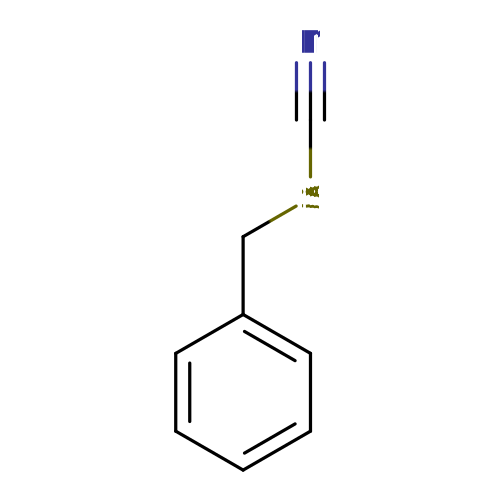
Common NameBenzyl thiocyanate
DescriptionBenzyl thiocyanate, also known as solvat 14 or tropeolin, belongs to the class of organic compounds known as benzyl thiocyanates. These are aromatic compounds containing an thiocyanate group that is S-substituted to a benzyl group. Benzyl thiocyanate is possibly neutral. Outside of the human body, Benzyl thiocyanate has been detected, but not quantified in, brassicas and garden cress. Benzyl thiocyanate is found in Cichorium endivia and Lepidium meyenii. Benzyl thiocyanate was first documented in 2002 (PMID: 12169308). This could make benzyl thiocyanate a potential biomarker for the consumption of these foods (PMID: 11925258) (PMID: 15564663) (PMID: 16956219).
Structure
Thumb
Synonyms
ValueSource
alpha-ThiocyanatotolueneChEBI
Solvat 14ChEBI
Thiocyanic acid benzyl esterChEBI
Thiocyanic acid, phenylmethyl esterChEBI
TropeolinChEBI
a-ThiocyanatotolueneGenerator
Α-thiocyanatotolueneGenerator
Thiocyanate benzyl esterGenerator
Thiocyanate, phenylmethyl esterGenerator
Benzyl thiocyanic acidGenerator
alpha -ThiocyanatotolueneHMDB
alpha-Thiocyanato-tolueneHMDB
Benzyl rhodanideHMDB
Benzyl-thiocyanateHMDB
BenzylrhodonidHMDB
BenzylthiocyanateHMDB
Phenylmethyl thiocyanateHMDB
Phenylmethyl thiocyanate, 9ciHMDB
Thiocyanic acid, benzyl esterHMDB
Chemical FormulaC8H7NS
Average Mass149.2130 Da
Monoisotopic Mass149.02992 Da
IUPAC Name(benzylsulfanyl)carbonitrile
Traditional Namebenzyl thiocyanate
CAS Registry Number3012-37-1
SMILES
N#CSCC1=CC=CC=C1
InChI Identifier
InChI=1S/C8H7NS/c9-7-10-6-8-4-2-1-3-5-8/h1-5H,6H2
InChI KeyABNDFSOIUFLJAH-UHFFFAOYSA-N
Experimental Spectra
Not Available
Predicted Spectra
Not Available
Chemical Shift Submissions
Not Available
Species
Species of Origin
Species NameSourceReference
Cichorium endiviaLOTUS Database
Lepidium meyeniiLOTUS Database
Lepidium sativumFooDB
Chemical Taxonomy
Description Belongs to the class of organic compounds known as benzyl thiocyanates. These are aromatic compounds containing an thiocyanate group that is S-substituted to a benzyl group.
KingdomOrganic compounds
Super ClassBenzenoids
ClassBenzene and substituted derivatives
Sub ClassBenzyl thiocyanates
Direct ParentBenzyl thiocyanates
Alternative Parents
Substituents
  • Benzyl thiocyanate
  • Sulfenyl compound
  • Thiocyanate
  • Organic nitrogen compound
  • Organopnictogen compound
  • Hydrocarbon derivative
  • Organosulfur compound
  • Organonitrogen compound
  • Aromatic homomonocyclic compound
Molecular FrameworkAromatic homomonocyclic compounds
External Descriptors
Physical Properties
StateNot Available
Experimental Properties
PropertyValueReference
Melting PointNot AvailableNot Available
Boiling PointNot AvailableNot Available
Water SolubilityNot AvailableNot Available
LogPNot AvailableNot Available
Predicted Properties
PropertyValueSource
logP2.18ALOGPS
logP2.51ChemAxon
logS-2.3ALOGPS
Physiological Charge0ChemAxon
Hydrogen Acceptor Count1ChemAxon
Hydrogen Donor Count0ChemAxon
Polar Surface Area23.79 ŲChemAxon
Rotatable Bond Count2ChemAxon
Refractivity44.66 m³·mol⁻¹ChemAxon
Polarizability15.78 ųChemAxon
Number of Rings1ChemAxon
BioavailabilityYesChemAxon
Rule of FiveYesChemAxon
Ghose FilterNoChemAxon
Veber's RuleYesChemAxon
MDDR-like RuleNoChemAxon
HMDB IDHMDB0034273
DrugBank IDNot Available
Phenol Explorer Compound IDNot Available
FoodDB IDFDB012606
KNApSAcK IDNot Available
Chemspider ID17163
KEGG Compound IDC02660
BioCyc IDCPD-65
BiGG IDNot Available
Wikipedia LinkNot Available
METLIN IDNot Available
PubChem Compound18170
PDB IDNot Available
ChEBI ID16017
Good Scents IDNot Available
References
General References
  1. Tellez MR, Khan IA, Kobaisy M, Schrader KK, Dayan FE, Osbrink W: Composition of the essential oil of Lepidium meyenii (Walp). Phytochemistry. 2002 Sep;61(2):149-55. doi: 10.1016/s0031-9422(02)00208-x. [PubMed:12169308 ]
  2. Batanero B, Barba F, Martin A: Preparation of 2,6-dimethyl-4-arylpyridine- 3,5-dicarbonitrile: a paired electrosynthesis. J Org Chem. 2002 Apr 5;67(7):2369-71. doi: 10.1021/jo016065h. [PubMed:11925258 ]
  3. Iwai N, Ebata T, Nagura H, Kitazume T, Nagai K, Wachi M: Structure-activity relationship of S-benzylisothiourea derivatives to induce spherical cells in Escherichia coli. Biosci Biotechnol Biochem. 2004 Nov;68(11):2265-9. doi: 10.1271/bbb.68.2265. [PubMed:15564663 ]
  4. Zhang Z, Liebeskind LS: Palladium-catalyzed, copper(I)-mediated coupling of boronic acids and benzylthiocyanate. A cyanide-free cyanation of boronic acids. Org Lett. 2006 Sep 14;8(19):4331-3. doi: 10.1021/ol061741t. [PubMed:16956219 ]