| Record Information |
|---|
| Version | 2.0 |
|---|
| Created at | 2022-03-17 20:48:04 UTC |
|---|
| Updated at | 2022-03-17 20:48:04 UTC |
|---|
| NP-MRD ID | NP0047918 |
|---|
| Secondary Accession Numbers | None |
|---|
| Natural Product Identification |
|---|
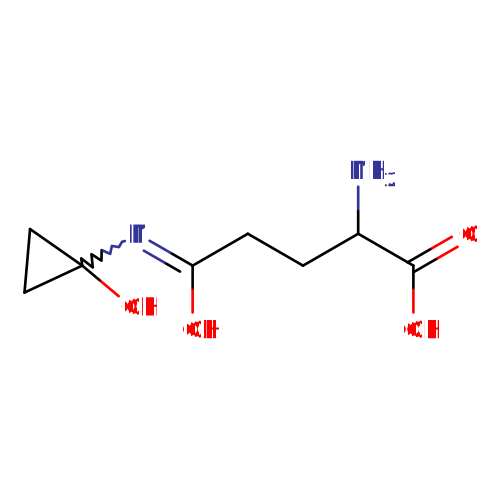
| Common Name | L-Coprine |
|---|
| Description | L-Coprine belongs to the class of organic compounds known as glutamine and derivatives. Glutamine and derivatives are compounds containing glutamine or a derivative thereof resulting from reaction of glutamine at the amino group or the carboxy group, or from the replacement of any hydrogen of glycine by a heteroatom. This causes the build of of acetaldehyde in the body. It metabolises to 1-aminocyclopropanol, a closely-related chemical to Disulfiram and exhibits the same mechanism of action: Inhibition of the enzyme acetaldehyde dehydrogenase, which is required for alchohol metabolism. L-Coprine is a very strong basic compound (based on its pKa). Outside of the human body, L-Coprine has been detected, but not quantified in, mushrooms. This could make L-coprine a potential biomarker for the consumption of these foods. L-Coprine is a potentially toxic compound. Coprine may cause symptoms such as flushing, headache, nausea, palpitations, dyspnea, dizziness. L-Coprine is found in Coprinus atramentarius . Coprine interferes with the bodys ability to metabolize alcohol. |
|---|
| Structure | NC(CCC(O)=NC1(O)CC1)C(O)=O InChI=1S/C8H14N2O4/c9-5(7(12)13)1-2-6(11)10-8(14)3-4-8/h5,14H,1-4,9H2,(H,10,11)(H,12,13) |
|---|
| Synonyms | | Value | Source |
|---|
| Coprine | HMDB | | N(5)-(1-Hydroxycyclopropyl)-L-glutamine | HMDB | | N-(1-Hydroxycyclopropyl)-L-glutamine | HMDB | | 2-Amino-4-[(1-hydroxycyclopropyl)-C-hydroxycarbonimidoyl]butanoate | Generator |
|
|---|
| Chemical Formula | C8H14N2O4 |
|---|
| Average Mass | 202.2078 Da |
|---|
| Monoisotopic Mass | 202.09536 Da |
|---|
| IUPAC Name | 2-amino-4-[(1-hydroxycyclopropyl)-C-hydroxycarbonimidoyl]butanoic acid |
|---|
| Traditional Name | 2-amino-4-[(1-hydroxycyclopropyl)-C-hydroxycarbonimidoyl]butanoic acid |
|---|
| CAS Registry Number | 58919-61-2 |
|---|
| SMILES | NC(CCC(O)=NC1(O)CC1)C(O)=O |
|---|
| InChI Identifier | InChI=1S/C8H14N2O4/c9-5(7(12)13)1-2-6(11)10-8(14)3-4-8/h5,14H,1-4,9H2,(H,10,11)(H,12,13) |
|---|
| InChI Key | OEEZRBUCLFMTLD-UHFFFAOYSA-N |
|---|
| Experimental Spectra |
|---|
|
| Not Available | | Predicted Spectra |
|---|
|
| Not Available | | Chemical Shift Submissions |
|---|
|
| Not Available | | Species |
|---|
| Species of Origin | | Species Name | Source | Reference |
|---|
| Agaricus bisporus | FooDB | - Shmuel Yannai Dictionary of Food Compounds with CD-ROM: Additives, Flavors, and Ingredients. Chap...
| | Coprinus atramentarius | Fungi | | | Pleurotus ostreatus | FooDB | - Shmuel Yannai Dictionary of Food Compounds with CD-ROM: Additives, Flavors, and Ingredients. Chap...
|
|
|---|
| Chemical Taxonomy |
|---|
| Description | Belongs to the class of organic compounds known as glutamine and derivatives. Glutamine and derivatives are compounds containing glutamine or a derivative thereof resulting from reaction of glutamine at the amino group or the carboxy group, or from the replacement of any hydrogen of glycine by a heteroatom. |
|---|
| Kingdom | Organic compounds |
|---|
| Super Class | Organic acids and derivatives |
|---|
| Class | Carboxylic acids and derivatives |
|---|
| Sub Class | Amino acids, peptides, and analogues |
|---|
| Direct Parent | Glutamine and derivatives |
|---|
| Alternative Parents | |
|---|
| Substituents | - Glutamine or derivatives
- Alpha-amino acid
- Fatty acyl
- Fatty acid
- Fatty amide
- N-acyl-amine
- Carboxamide group
- Amino acid
- Cyclopropanol
- Secondary carboxylic acid amide
- Alkanolamine
- Carboxylic acid
- Monocarboxylic acid or derivatives
- Organic nitrogen compound
- Organonitrogen compound
- Organooxygen compound
- Primary aliphatic amine
- Primary amine
- Hydrocarbon derivative
- Organic oxide
- Organopnictogen compound
- Carbonyl group
- Amine
- Organic oxygen compound
- Aliphatic homomonocyclic compound
|
|---|
| Molecular Framework | Aliphatic homomonocyclic compounds |
|---|
| External Descriptors | Not Available |
|---|
| Physical Properties |
|---|
| State | Not Available |
|---|
| Experimental Properties | | Property | Value | Reference |
|---|
| Melting Point | Not Available | Not Available | | Boiling Point | Not Available | Not Available | | Water Solubility | Not Available | Not Available | | LogP | Not Available | Not Available |
|
|---|
| Predicted Properties | |
|---|