| Record Information |
|---|
| Version | 2.0 |
|---|
| Created at | 2022-03-17 20:47:47 UTC |
|---|
| Updated at | 2022-03-17 20:47:47 UTC |
|---|
| NP-MRD ID | NP0047900 |
|---|
| Secondary Accession Numbers | None |
|---|
| Natural Product Identification |
|---|
| Common Name | Kievitone |
|---|
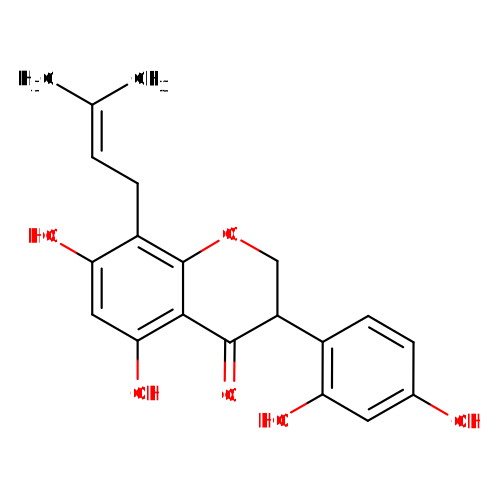
| Description | Kievitone, also known as vignatin, belongs to the class of organic compounds known as 8-prenylated isoflavanones. These are isoflavanones featuring a C5-isoprenoid unit at the 8-position. Thus, kievitone is considered to be a flavonoid lipid molecule. A hydroxyisoflavanone that is isoflavanone with hydroxy substituents at positions 5, 7, 2' and 4' and a prenyl group at position 8. Kievitone is a very hydrophobic molecule, practically insoluble (in water), and relatively neutral. Outside of the human body, Kievitone has been detected, but not quantified in, several different foods, such as yellow wax beans, mung beans, scarlet beans, adzuki beans, and cowpea. Kievitone is found in Desmodium gangeticum , Diphysa robinioides, Dipogon lignosus, Lablab niger, Macroptilium bracteatum, Macroptilium lathyroides, Macroptilium martii, Mucuna pruriens , Phaseolus aureus , Phaseolus lunatus , Sphenostylis angustifolia, Sphenostylis stenocarpa , Strongylodon macrobotrys, Strophostyles helvola, Vigna mungo and Dolichos biflorus . Kievitone was first documented in 1988 (PMID: 16665944). This could make kievitone a potential biomarker for the consumption of these foods (PMID: 21133423) (PMID: 7794275). |
|---|
| Structure | CC(C)=CCC1=C2OCC(C(=O)C2=C(O)C=C1O)C1=C(O)C=C(O)C=C1 InChI=1S/C20H20O6/c1-10(2)3-5-13-16(23)8-17(24)18-19(25)14(9-26-20(13)18)12-6-4-11(21)7-15(12)22/h3-4,6-8,14,21-24H,5,9H2,1-2H3 |
|---|
| Synonyms | | Value | Source |
|---|
| 3-(2,4-Dihydroxyphenyl)-2,3-dihydro-5,7-dihydroxy-8-(3-methyl-2-butenyl)-4H-1-benzopyran-4-one, 9ci | HMDB | | Phaseolus substance II | HMDB | | Vignatin | HMDB |
|
|---|
| Chemical Formula | C20H20O6 |
|---|
| Average Mass | 356.3692 Da |
|---|
| Monoisotopic Mass | 356.12599 Da |
|---|
| IUPAC Name | 3-(2,4-dihydroxyphenyl)-5,7-dihydroxy-8-(3-methylbut-2-en-1-yl)-3,4-dihydro-2H-1-benzopyran-4-one |
|---|
| Traditional Name | kievitone |
|---|
| CAS Registry Number | 40105-60-0 |
|---|
| SMILES | CC(C)=CCC1=C2OCC(C(=O)C2=C(O)C=C1O)C1=C(O)C=C(O)C=C1 |
|---|
| InChI Identifier | InChI=1S/C20H20O6/c1-10(2)3-5-13-16(23)8-17(24)18-19(25)14(9-26-20(13)18)12-6-4-11(21)7-15(12)22/h3-4,6-8,14,21-24H,5,9H2,1-2H3 |
|---|
| InChI Key | MERHMOCEIBOOMA-UHFFFAOYSA-N |
|---|
| Experimental Spectra |
|---|
|
| Not Available | | Predicted Spectra |
|---|
|
| Not Available | | Chemical Shift Submissions |
|---|
|
| Not Available | | Species |
|---|
| Species of Origin | |
|---|
| Chemical Taxonomy |
|---|
| Description | Belongs to the class of organic compounds known as 8-prenylated isoflavanones. These are isoflavanones featuring a C5-isoprenoid unit at the 8-position. |
|---|
| Kingdom | Organic compounds |
|---|
| Super Class | Phenylpropanoids and polyketides |
|---|
| Class | Isoflavonoids |
|---|
| Sub Class | Isoflavans |
|---|
| Direct Parent | 8-prenylated isoflavanones |
|---|
| Alternative Parents | |
|---|
| Substituents | - 8-prenylated isoflavanone
- Isoflavanol
- Hydroxyisoflavonoid
- Chromone
- 1-benzopyran
- Benzopyran
- Chromane
- Aryl alkyl ketone
- Aryl ketone
- Resorcinol
- Alkyl aryl ether
- 1-hydroxy-2-unsubstituted benzenoid
- 1-hydroxy-4-unsubstituted benzenoid
- Phenol
- Benzenoid
- Monocyclic benzene moiety
- Vinylogous acid
- Ketone
- Oxacycle
- Organoheterocyclic compound
- Ether
- Organic oxygen compound
- Hydrocarbon derivative
- Organic oxide
- Organooxygen compound
- Aromatic heteropolycyclic compound
|
|---|
| Molecular Framework | Aromatic heteropolycyclic compounds |
|---|
| External Descriptors | |
|---|
| Physical Properties |
|---|
| State | Not Available |
|---|
| Experimental Properties | | Property | Value | Reference |
|---|
| Melting Point | Not Available | Not Available | | Boiling Point | Not Available | Not Available | | Water Solubility | Not Available | Not Available | | LogP | Not Available | Not Available |
|
|---|
| Predicted Properties | |
|---|
| General References | - Rogers KR, Albert F, Anderson AJ: Lipid peroxidation is a consequence of elicitor activity. Plant Physiol. 1988 Feb;86(2):547-53. doi: 10.1104/pp.86.2.547. [PubMed:16665944 ]
- Boue SM, Burow ME, Wiese TE, Shih BY, Elliott S, Carter-Wientjes CH, McLachlan JA, Bhatnagar D: Estrogenic and antiestrogenic activities of phytoalexins from red kidney bean (Phaseolus vulgaris L.). J Agric Food Chem. 2011 Jan 12;59(1):112-20. doi: 10.1021/jf102255u. Epub 2010 Dec 6. [PubMed:21133423 ]
- Hoffman R: Potent inhibition of breast cancer cell lines by the isoflavonoid kievitone: comparison with genistein. Biochem Biophys Res Commun. 1995 Jun 15;211(2):600-6. doi: 10.1006/bbrc.1995.1855. [PubMed:7794275 ]
|
|---|