| Record Information |
|---|
| Version | 2.0 |
|---|
| Created at | 2022-03-17 20:47:21 UTC |
|---|
| Updated at | 2024-09-03 04:16:41 UTC |
|---|
| NP-MRD ID | NP0047872 |
|---|
| Natural Product DOI | https://doi.org/10.57994/0759 |
|---|
| Secondary Accession Numbers | None |
|---|
| Natural Product Identification |
|---|
| Common Name | 2-Tridecanone |
|---|
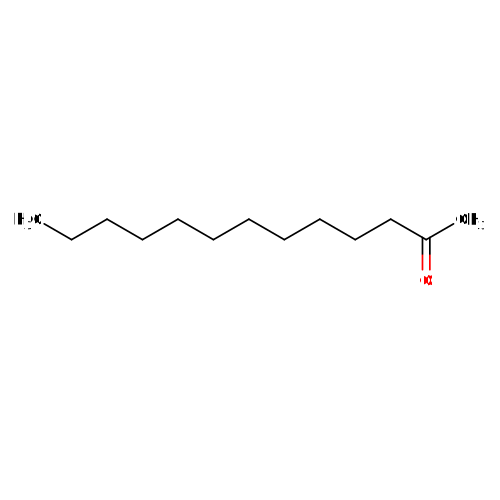
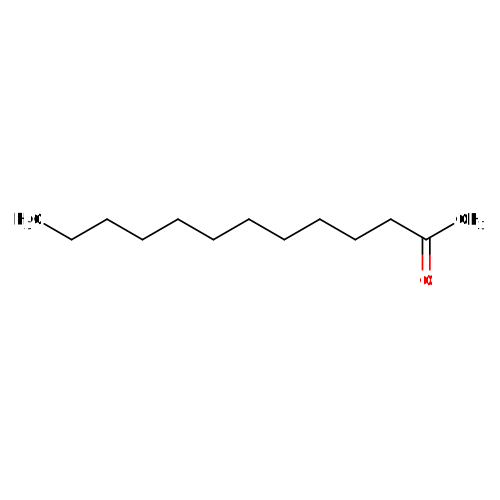
| Description | 2-Tridecanone, also known as NSC 14763 or fema 3388, belongs to the class of organic compounds known as ketones. These are organic compounds in which a carbonyl group is bonded to two carbon atoms R2C=O (neither R may be a hydrogen atom). Ketones that have one or more alpha-hydrogen atoms undergo keto-enol tautomerization, the tautomer being an enol. Thus, 2-tridecanone is considered to be an oxygenated hydrocarbon lipid molecule. 2-Tridecanone is a very hydrophobic molecule, practically insoluble (in water), and relatively neutral. 2-Tridecanone is a coconut, dairy, and earthy tasting compound. Outside of the human body, 2-Tridecanone has been detected, but not quantified in, several different foods, such as garden onions, garden tomato (var.), Citrus, evergreen blackberries, and onion-family vegetables. This could make 2-tridecanone a potential biomarker for the consumption of these foods. 2-Tridecanone, with regard to humans, has been linked to the inborn metabolic disorder celiac disease. Isolated from plant oils, e.G. 2-Tridecanone is found in Bowdichia virgilioides, Cochlospermum tinctorium, Commiphora rostrata, Drosophila buzzatii, Echinacea angustifolia, Esenbeckia yaxhoob Lundell, Etlingera elatior, Evernia prunastri, Acca sellowiana, Frullania solanderiana, Hamamelis virginiana, Hedychium spicatum, Helianthus annuus, Humulus lupulus , Juncus effusus , Nicotiana tabacum , Pilocarpus pauciflorus, Rosa rugosa , Ruta angustifolia, Ruta graveolens, Solanum agrimoniifolium, Solanum habrochaites, Sorbus tianschanica, Vaccinium corymbosum, Vaccinium macrocarpon, Vasconcellea heilbornii, Zanthoxylum ailanthoides, Zanthoxylum armatum , Zanthoxylum dipetalum, Zanthoxylum integrifoliolum, Zanthoxylum zanthoxyloides and Zingiber mioga. 2-Tridecanone was first documented in 2013 (PMID: 23374049). Palm oil, coconut oiland is also found in American cranberry, rabbiteye, blueberry, raspberry, grapefruit, onion, ginger and cheeses. |
|---|
| Structure | InChI=1S/C13H26O/c1-3-4-5-6-7-8-9-10-11-12-13(2)14/h3-12H2,1-2H3 |
|---|
| Synonyms | | Value | Source |
|---|
| Hendecyl methyl ketone | ChEBI | | Methyl N-undecyl ketone | ChEBI | | Methyl undecyl ketone | ChEBI | | NSC 14763 | ChEBI | | Tridecanone | ChEBI | | Tridecanone-2 | ChEBI | | 2-Tridecankje | HMDB | | Ammonium palmitate | HMDB | | FEMA 3388 | HMDB | | Mathyl undecyl kepoje | HMDB | | Tridecan-2-one | HMDB | | 2-Tridecanone | ChEBI |
|
|---|
| Chemical Formula | C13H26O |
|---|
| Average Mass | 198.3449 Da |
|---|
| Monoisotopic Mass | 198.19837 Da |
|---|
| IUPAC Name | tridecan-2-one |
|---|
| Traditional Name | 2-tridecanone |
|---|
| CAS Registry Number | 593-08-8 |
|---|
| SMILES | CCCCCCCCCCCC(C)=O |
|---|
| InChI Identifier | InChI=1S/C13H26O/c1-3-4-5-6-7-8-9-10-11-12-13(2)14/h3-12H2,1-2H3 |
|---|
| InChI Key | CYIFVRUOHKNECG-UHFFFAOYSA-N |
|---|
| Experimental Spectra |
|---|
|
| | Spectrum Type | Description | Depositor Email | Depositor Organization | Depositor | Deposition Date | View |
|---|
| 1D NMR | 1H NMR Spectrum (1D, 600 MHz, CDCl3, experimental) | [email protected] | Not Available | Not Available | 2023-07-28 | View Spectrum | | 1D NMR | 1H NMR Spectrum (1D, 600 MHz, CDCl3, experimental) | [email protected] | Not Available | Not Available | 2023-07-28 | View Spectrum |
| | Predicted Spectra |
|---|
|
| | Spectrum Type | Description | Depositor ID | Depositor Organization | Depositor | Deposition Date | View |
|---|
| | Chemical Shift Submissions |
|---|
|
| Not Available | | Species |
|---|
| Species of Origin | |
|---|
| Chemical Taxonomy |
|---|
| Description | Belongs to the class of organic compounds known as ketones. These are organic compounds in which a carbonyl group is bonded to two carbon atoms R2C=O (neither R may be a hydrogen atom). Ketones that have one or more alpha-hydrogen atoms undergo keto-enol tautomerization, the tautomer being an enol. |
|---|
| Kingdom | Organic compounds |
|---|
| Super Class | Organic oxygen compounds |
|---|
| Class | Organooxygen compounds |
|---|
| Sub Class | Carbonyl compounds |
|---|
| Direct Parent | Ketones |
|---|
| Alternative Parents | |
|---|
| Substituents | - Ketone
- Organic oxide
- Hydrocarbon derivative
- Aliphatic acyclic compound
|
|---|
| Molecular Framework | Aliphatic acyclic compounds |
|---|
| External Descriptors | |
|---|
| Physical Properties |
|---|
| State | Not Available |
|---|
| Experimental Properties | | Property | Value | Reference |
|---|
| Melting Point | Not Available | Not Available | | Boiling Point | Not Available | Not Available | | Water Solubility | Not Available | Not Available | | LogP | Not Available | Not Available |
|
|---|
| Predicted Properties | |
|---|