| Record Information |
|---|
| Version | 2.0 |
|---|
| Created at | 2022-03-17 20:47:13 UTC |
|---|
| Updated at | 2022-03-17 20:47:14 UTC |
|---|
| NP-MRD ID | NP0047865 |
|---|
| Secondary Accession Numbers | None |
|---|
| Natural Product Identification |
|---|
| Common Name | Osthenol |
|---|
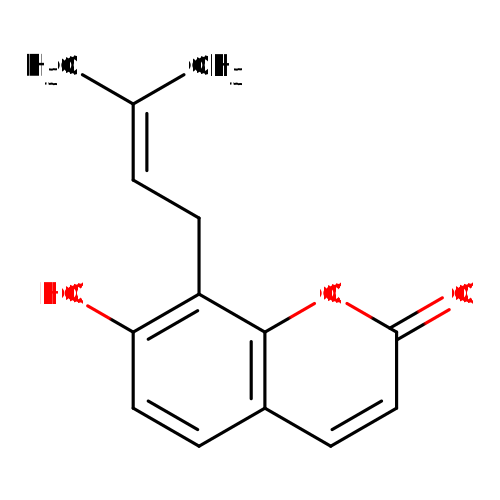
| Description | Osthenol belongs to the class of organic compounds known as 7-hydroxycoumarins. These are coumarins that contain one or more hydroxyl groups attached to the C7 position the coumarin skeleton. Osthenol is an extremely weak basic (essentially neutral) compound (based on its pKa). Outside of the human body, Osthenol has been detected, but not quantified in, several different foods, such as angelica, fennels, green vegetables, and wild celeries. This could make osthenol a potential biomarker for the consumption of these foods. Osthenol is found in Angelica dahurica, Angelica pubescens, Citrus medica, Citrus paradisi, Citrus sulcata, Feroniella lucida, Hansenia weberbaueriana, Haplophyllum patavinum, Heracleum candicans, Heracleum candicans WALL. , Juniperus chinensis, Limonia acidissima, Melicope semecarpifolia, Notopterygium incisum , Ostericum grosseserratum, Phellodendron amurense, Phellodendron amurense var.wilsonii , Prangos ferulacea, Prangos uloptera and Zanthoxylum beecheyanum. Osthenol was first documented in 2008 (PMID: 18386483). A hydroxycoumarin that is umbelliferone in which the hydrogen at position 8 has been replaced by a prenyl group (PMID: 24354545) (PMID: 26552172) (PMID: 20931624) (PMID: 26918393). |
|---|
| Structure | CC(C)=CCC1=C(O)C=CC2=C1OC(=O)C=C2 InChI=1S/C14H14O3/c1-9(2)3-6-11-12(15)7-4-10-5-8-13(16)17-14(10)11/h3-5,7-8,15H,6H2,1-2H3 |
|---|
| Synonyms | | Value | Source |
|---|
| 7-Hydroxy-8-(3-methyl-but-2-enyl)coumarin | ChEBI | | 7-Hydroxy-8-prenylcoumarin | ChEBI | | 8-(3-Methylbut-2-en-1-yl)umbelliferone | ChEBI | | 8-Prenylumbelliferone | ChEBI | | 7-Hydroxy-8-(3-methyl-2-butenyl)-2H-1-benzopyran-2-one | HMDB | | 7-Hydroxy-8-(3-methyl-2-butenyl)-2H-1-benzopyran-2-one, 9ci | HMDB |
|
|---|
| Chemical Formula | C14H14O3 |
|---|
| Average Mass | 230.2592 Da |
|---|
| Monoisotopic Mass | 230.09429 Da |
|---|
| IUPAC Name | 7-hydroxy-8-(3-methylbut-2-en-1-yl)-2H-chromen-2-one |
|---|
| Traditional Name | 7-hydroxy-8-(3-methylbut-2-en-1-yl)chromen-2-one |
|---|
| CAS Registry Number | 484-14-0 |
|---|
| SMILES | CC(C)=CCC1=C(O)C=CC2=C1OC(=O)C=C2 |
|---|
| InChI Identifier | InChI=1S/C14H14O3/c1-9(2)3-6-11-12(15)7-4-10-5-8-13(16)17-14(10)11/h3-5,7-8,15H,6H2,1-2H3 |
|---|
| InChI Key | RAKJVIPCCGXHHS-UHFFFAOYSA-N |
|---|
| Experimental Spectra |
|---|
|
| Not Available | | Predicted Spectra |
|---|
|
| Not Available | | Chemical Shift Submissions |
|---|
|
| Not Available | | Species |
|---|
| Species of Origin | |
|---|
| Chemical Taxonomy |
|---|
| Description | Belongs to the class of organic compounds known as 7-hydroxycoumarins. These are coumarins that contain one or more hydroxyl groups attached to the C7 position the coumarin skeleton. |
|---|
| Kingdom | Organic compounds |
|---|
| Super Class | Phenylpropanoids and polyketides |
|---|
| Class | Coumarins and derivatives |
|---|
| Sub Class | Hydroxycoumarins |
|---|
| Direct Parent | 7-hydroxycoumarins |
|---|
| Alternative Parents | |
|---|
| Substituents | - 7-hydroxycoumarin
- Benzopyran
- 1-benzopyran
- 1-hydroxy-2-unsubstituted benzenoid
- Pyranone
- Benzenoid
- Pyran
- Heteroaromatic compound
- Lactone
- Oxacycle
- Organoheterocyclic compound
- Organic oxygen compound
- Organooxygen compound
- Hydrocarbon derivative
- Organic oxide
- Aromatic heteropolycyclic compound
|
|---|
| Molecular Framework | Aromatic heteropolycyclic compounds |
|---|
| External Descriptors | |
|---|
| Physical Properties |
|---|
| State | Not Available |
|---|
| Experimental Properties | | Property | Value | Reference |
|---|
| Melting Point | Not Available | Not Available | | Boiling Point | Not Available | Not Available | | Water Solubility | Not Available | Not Available | | LogP | Not Available | Not Available |
|
|---|
| Predicted Properties | |
|---|
| General References | - Karamat F, Olry A, Munakata R, Koeduka T, Sugiyama A, Paris C, Hehn A, Bourgaud F, Yazaki K: A coumarin-specific prenyltransferase catalyzes the crucial biosynthetic reaction for furanocoumarin formation in parsley. Plant J. 2014 Feb;77(4):627-38. doi: 10.1111/tpj.12409. Epub 2014 Jan 24. [PubMed:24354545 ]
- Deng GG, Yang XW, Zhang YB, Xu W, Wei W, Chen TL: [Chemical constituents from lipophilic parts in roots of Angelica dahurica var. formosana cv. Chuanbaizhi]. Zhongguo Zhong Yao Za Zhi. 2015 Jun;40(11):2148-56. [PubMed:26552172 ]
- Montagner C, de Souza SM, Groposoa C, Delle Monache F, Smania EF, Smania A Jr: Antifungal activity of coumarins. Z Naturforsch C J Biosci. 2008 Jan-Feb;63(1-2):21-8. doi: 10.1515/znc-2008-1-205. [PubMed:18386483 ]
- Xie Y, Zhao W, Zhou T, Fan G, Wu Y: An efficient strategy based on MAE, HPLC-DAD-ESI-MS/MS and 2D-prep-HPLC-DAD for the rapid extraction, separation, identification and purification of five active coumarin components from Radix Angelicae Dahuricae. Phytochem Anal. 2010 Sep-Oct;21(5):473-82. doi: 10.1002/pca.1222. [PubMed:20931624 ]
- Munakata R, Olry A, Karamat F, Courdavault V, Sugiyama A, Date Y, Krieger C, Silie P, Foureau E, Papon N, Grosjean J, Yazaki K, Bourgaud F, Hehn A: Molecular evolution of parsnip (Pastinaca sativa) membrane-bound prenyltransferases for linear and/or angular furanocoumarin biosynthesis. New Phytol. 2016 Jul;211(1):332-44. doi: 10.1111/nph.13899. Epub 2016 Feb 25. [PubMed:26918393 ]
|
|---|