| Record Information |
|---|
| Version | 2.0 |
|---|
| Created at | 2022-03-17 20:47:11 UTC |
|---|
| Updated at | 2024-09-03 04:17:08 UTC |
|---|
| NP-MRD ID | NP0047863 |
|---|
| Natural Product DOI | https://doi.org/10.57994/0928 |
|---|
| Secondary Accession Numbers | None |
|---|
| Natural Product Identification |
|---|
| Common Name | Prunetin |
|---|
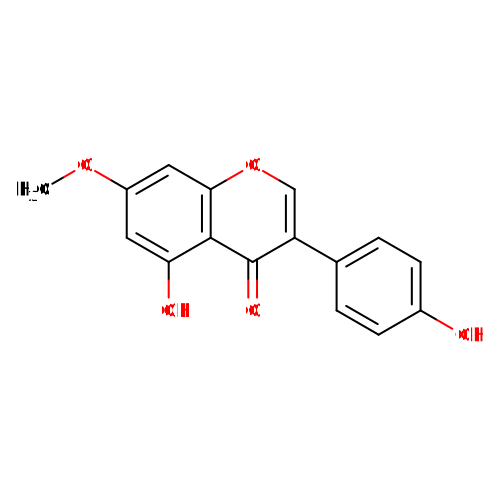
| Description | Prunetin, also known as padmakastein, belongs to the class of organic compounds known as 7-o-methylisoflavones. These are isoflavones with methoxy groups attached to the C7 atom of the isoflavone backbone. Thus, prunetin is considered to be a flavonoid lipid molecule. Prunetin is a very hydrophobic molecule, practically insoluble (in water), and relatively neutral. Prunetin is a bitter tasting compound. Outside of the human body, Prunetin has been detected, but not quantified in, several different foods, such as herbs and spices, prunus (cherry, plum), sour cherries, and tea. This could make prunetin a potential biomarker for the consumption of these foods. Prunetin is found in Achlys triphylla, Andira inermis, Andira surinamensis, Butea monosperma, Cladrastis platycarpa, Crotalaria lachnophora, Dalbergia miscolobium, Dalbergia odorifera , Dalbergia sissoo, Dalbergia violacea, Dermatophyllum secundiflorum, Derris laxiflora, Ficus nervosa, Flemingia macrophylla, Genista carinalis, Glycyrrhiza glabra , Glycyrrhiza pallidiflora, Iris milesii, Millettia erythrocalyx, Myristica malabarica , Occurs in several, Ochna calodendron, Oroxylum indicum , Pisum sativum, Prunus cerasoides, Prunus nipponica, Prunus puddum , Prunus puddun, Prunus spp. , Prunus verecunda, Pterocarpus angolensis , Pterocarpus soyauxii, Pueraria montana, Pycnanthus angolensis, Sophora secundiflora , Streptomyces sp. M491, Sophora japonica , Taxus chinensis and Trifolium pratense . Prunetin was first documented in 1949 (PMID: 15408466). A hydroxyisoflavone that is genistein in which the hydroxy group at position 7 is replaced by a methoxy group (PMID: 22148193) (PMID: 21305630) (PMID: 22010824) (PMID: 23265084). |
|---|
| Structure | COC1=CC2=C(C(O)=C1)C(=O)C(=CO2)C1=CC=C(O)C=C1 InChI=1S/C16H12O5/c1-20-11-6-13(18)15-14(7-11)21-8-12(16(15)19)9-2-4-10(17)5-3-9/h2-8,17-18H,1H3 |
|---|
| Synonyms | | Value | Source |
|---|
| 4',5-Dihydroxy-7-methoxygenistein | ChEBI | | 4',5-Dihydroxy-7-methoxyisoflavone | ChEBI | | 5-Hydroxy-3-(4-hydroxyphenyl)-7-methoxy-4-benzopyrone | ChEBI | | 5-Hydroxy-3-(4-hydroxyphenyl)-7-methoxy-4H-1-benzopyran-4-one | ChEBI | | 7-O-Methyl-genistein | ChEBI | | Padmakastein | ChEBI | | Prunusetin | ChEBI | | 5,4'-Dihydroxy-7-methoxyisoflavone | HMDB | | 5-Hydroxy-3-(4-hydroxyphenyl)-7-methoxy-4H-1-benzopyran-4-one, 9ci | HMDB | | 5-Hydroxy-3-(4-hydroxyphenyl)-7-methoxy-4H-chromen-4-one | HMDB | | Isoflavone, 4',5-dihydroxy-7-methoxy- (7ci,8ci) | HMDB |
|
|---|
| Chemical Formula | C16H12O5 |
|---|
| Average Mass | 284.2670 Da |
|---|
| Monoisotopic Mass | 284.06847 Da |
|---|
| IUPAC Name | 5-hydroxy-3-(4-hydroxyphenyl)-7-methoxy-4H-chromen-4-one |
|---|
| Traditional Name | prunetin |
|---|
| CAS Registry Number | 552-59-0 |
|---|
| SMILES | COC1=CC2=C(C(O)=C1)C(=O)C(=CO2)C1=CC=C(O)C=C1 |
|---|
| InChI Identifier | InChI=1S/C16H12O5/c1-20-11-6-13(18)15-14(7-11)21-8-12(16(15)19)9-2-4-10(17)5-3-9/h2-8,17-18H,1H3 |
|---|
| InChI Key | KQMVAGISDHMXJJ-UHFFFAOYSA-N |
|---|
| Experimental Spectra |
|---|
|
| | Spectrum Type | Description | Depositor Email | Depositor Organization | Depositor | Deposition Date | View |
|---|
| 1D NMR | 1H NMR Spectrum (1D, 600 MHz, CD3OD, experimental) | bgnzk@missouri.edu | MU Metabolomics Center, University of Missouri, Columbia. MO, USA | Dr. Bharat Goel | 2023-09-13 | View Spectrum | | 1D NMR | 1H NMR Spectrum (1D, 600 MHz, CD3OD, experimental) | bgnzk@missouri.edu | MU Metabolomics Center, University of Missouri, Columbia. MO, USA | Dr. Bharat Goel | 2023-09-13 | View Spectrum |
| | Predicted Spectra |
|---|
|
| | Spectrum Type | Description | Depositor ID | Depositor Organization | Depositor | Deposition Date | View |
|---|
| | Chemical Shift Submissions |
|---|
|
| Not Available | | Species |
|---|
| Species of Origin | |
|---|
| Chemical Taxonomy |
|---|
| Description | Belongs to the class of organic compounds known as 7-o-methylisoflavones. These are isoflavones with methoxy groups attached to the C7 atom of the isoflavone backbone. |
|---|
| Kingdom | Organic compounds |
|---|
| Super Class | Phenylpropanoids and polyketides |
|---|
| Class | Isoflavonoids |
|---|
| Sub Class | O-methylated isoflavonoids |
|---|
| Direct Parent | 7-O-methylisoflavones |
|---|
| Alternative Parents | |
|---|
| Substituents | - 7-o-methylisoflavone
- Hydroxyisoflavonoid
- Isoflavone
- Chromone
- Benzopyran
- 1-benzopyran
- Anisole
- 1-hydroxy-4-unsubstituted benzenoid
- 1-hydroxy-2-unsubstituted benzenoid
- Alkyl aryl ether
- Phenol
- Pyranone
- Monocyclic benzene moiety
- Benzenoid
- Pyran
- Heteroaromatic compound
- Vinylogous acid
- Organoheterocyclic compound
- Ether
- Oxacycle
- Organooxygen compound
- Organic oxygen compound
- Organic oxide
- Hydrocarbon derivative
- Aromatic heteropolycyclic compound
|
|---|
| Molecular Framework | Aromatic heteropolycyclic compounds |
|---|
| External Descriptors | |
|---|
| Physical Properties |
|---|
| State | Not Available |
|---|
| Experimental Properties | | Property | Value | Reference |
|---|
| Melting Point | Not Available | Not Available | | Boiling Point | Not Available | Not Available | | Water Solubility | Not Available | Not Available | | LogP | Not Available | Not Available |
|
|---|
| Predicted Properties | |
|---|
| General References | - Wong SL, Chang HS, Wang GJ, Chiang MY, Huang HY, Chen CH, Tsai SC, Lin CH, Chen IS: Secondary metabolites from the roots of Neolitsea daibuensis and their anti-inflammatory activity. J Nat Prod. 2011 Dec 27;74(12):2489-96. doi: 10.1021/np100874f. Epub 2011 Dec 7. [PubMed:22148193 ]
- IYER RN, SHAH KH, VENKATARAMAN K: A synthesis of prunetin. Curr Sci. 1949 Nov;18(11):404-6. [PubMed:15408466 ]
- Lee HJ, Lee SY, Lee MN, Kim JH, Chang GT, Seok JH, Lee CJ: Inhibition of secretion, production and gene expression of mucin from cultured airway epithelial cells by prunetin. Phytother Res. 2011 Aug;25(8):1196-200. doi: 10.1002/ptr.3362. Epub 2011 Feb 9. [PubMed:21305630 ]
- Sekine R, Vongsvivut J, Robertson EG, Spiccia L, McNaughton D: Analysis of 5-hydroxyisoflavones by surface-enhanced Raman spectroscopy: genistein and methoxy derivatives. J Phys Chem B. 2011 Dec 1;115(47):13943-54. doi: 10.1021/jp207730g. Epub 2011 Nov 7. [PubMed:22010824 ]
- Bae M, Woo M, Kusuma IW, Arung ET, Yang CH, Kim YU: Inhibitory effects of isoflavonoids on rat prostate testosterone 5alpha-reductase. J Acupunct Meridian Stud. 2012 Dec;5(6):319-22. doi: 10.1016/j.jams.2012.07.022. Epub 2012 Aug 9. [PubMed:23265084 ]
|
|---|