| Record Information |
|---|
| Version | 2.0 |
|---|
| Created at | 2022-03-17 20:46:42 UTC |
|---|
| Updated at | 2022-03-17 20:46:42 UTC |
|---|
| NP-MRD ID | NP0047832 |
|---|
| Secondary Accession Numbers | None |
|---|
| Natural Product Identification |
|---|
| Common Name | Psoralidin |
|---|
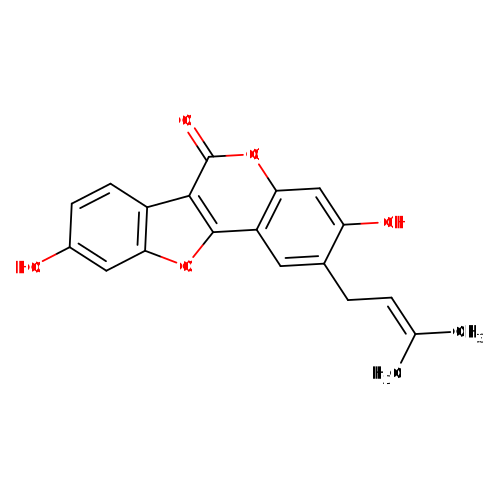
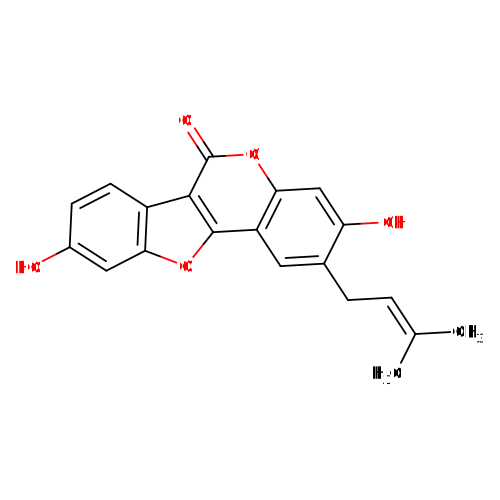
| Description | Psoralidin belongs to the class of organic compounds known as coumestans. These are polycyclic aromatic compounds containing a coumestan moiety, which consists of a benzoxole fused to a chromen-2-one to form 1-Benzoxolo[3,2-c]chromen-6-one. They are oxidation products of pterocarpan. Thus, psoralidin is considered to be a flavonoid lipid molecule. It has the capability to inhibit protein tyrosine phosphatase 1B, a key metabolite involved in insulin signaling. To form the ring of psoralidin, an intramolecular cyclization occurs, finished off by a microwave assisted cross metathesis reaction. Structurally, psoralidin is a coumestan derivative; it has an isopentenyl group at the second carbon position of coumestrol. Psoralidin is a very hydrophobic molecule, practically insoluble (in water), and relatively neutral. Outside of the human body, Psoralidin has been detected, but not quantified in, a few different foods, such as fruits, lima beans, and pulses. This could make psoralidin a potential biomarker for the consumption of these foods. Psoralidin is a natural phenolic compound found in the seeds of Psoralea corylifolia. Dopamine levels changed as well as a result of psoralidin consumption. Psoralidin raised 5-hydroxytryptamine and 5-hydroxyindoleacetic acid levels in the brain. Recently, it has shown activity in vitro against gastric, colon, prostate, and breast cancer lines. Psoralidin is found in Apis cerana, Psoralea corylifolia , Dolichos bifloru, Psoralea coryfolia and Dolichos biflorus . Psoralidin was first documented in 2014 (PMID: 24507928). Psoralidin production starts with a based catalyzed condensation between phenyl acetate and acid chloride (PMID: 25216634). |
|---|
| Structure | CC(C)=CCC1=CC2=C(OC(=O)C3=C2OC2=C3C=CC(O)=C2)C=C1O InChI=1S/C20H16O5/c1-10(2)3-4-11-7-14-17(9-15(11)22)25-20(23)18-13-6-5-12(21)8-16(13)24-19(14)18/h3,5-9,21-22H,4H2,1-2H3 |
|---|
| Synonyms | | Value | Source |
|---|
| 3,9-Dihydroxy-2-prenylcoumestan | ChEBI |
|
|---|
| Chemical Formula | C20H16O5 |
|---|
| Average Mass | 336.3380 Da |
|---|
| Monoisotopic Mass | 336.09977 Da |
|---|
| IUPAC Name | 5,14-dihydroxy-4-(3-methylbut-2-en-1-yl)-8,17-dioxatetracyclo[8.7.0.0²,⁷.0¹¹,¹⁶]heptadeca-1(10),2(7),3,5,11(16),12,14-heptaen-9-one |
|---|
| Traditional Name | psoralidin |
|---|
| CAS Registry Number | 18642-23-4 |
|---|
| SMILES | CC(C)=CCC1=CC2=C(OC(=O)C3=C2OC2=C3C=CC(O)=C2)C=C1O |
|---|
| InChI Identifier | InChI=1S/C20H16O5/c1-10(2)3-4-11-7-14-17(9-15(11)22)25-20(23)18-13-6-5-12(21)8-16(13)24-19(14)18/h3,5-9,21-22H,4H2,1-2H3 |
|---|
| InChI Key | YABIJLLNNFURIJ-UHFFFAOYSA-N |
|---|
| Experimental Spectra |
|---|
|
| Not Available | | Predicted Spectra |
|---|
|
| Not Available | | Chemical Shift Submissions |
|---|
|
| Not Available | | Species |
|---|
| Species of Origin | |
|---|
| Chemical Taxonomy |
|---|
| Description | Belongs to the class of organic compounds known as coumestans. These are polycyclic aromatic compounds containing a coumestan moiety, which consists of a benzoxole fused to a chromen-2-one to form 1-Benzoxolo[3,2-c]chromen-6-one. They are oxidation products of pterocarpan. |
|---|
| Kingdom | Organic compounds |
|---|
| Super Class | Phenylpropanoids and polyketides |
|---|
| Class | Isoflavonoids |
|---|
| Sub Class | Coumestans |
|---|
| Direct Parent | Coumestans |
|---|
| Alternative Parents | |
|---|
| Substituents | - Coumestan
- Angular furanocoumarin
- Furanocoumarin
- Coumarin
- Benzopyran
- 1-benzopyran
- Benzofuran
- Furopyran
- 1-hydroxy-2-unsubstituted benzenoid
- Pyranone
- Pyran
- Benzenoid
- Furan
- Heteroaromatic compound
- Lactone
- Organoheterocyclic compound
- Oxacycle
- Organooxygen compound
- Hydrocarbon derivative
- Organic oxide
- Organic oxygen compound
- Aromatic heteropolycyclic compound
|
|---|
| Molecular Framework | Aromatic heteropolycyclic compounds |
|---|
| External Descriptors | |
|---|
| Physical Properties |
|---|
| State | Not Available |
|---|
| Experimental Properties | | Property | Value | Reference |
|---|
| Melting Point | Not Available | Not Available | | Boiling Point | Not Available | Not Available | | Water Solubility | Not Available | Not Available | | LogP | Not Available | Not Available |
|
|---|
| Predicted Properties | |
|---|
| General References | - Liu X, Nam JW, Song YS, Viswanath AN, Pae AN, Kil YS, Kim HD, Park JH, Seo EK, Chang M: Psoralidin, a coumestan analogue, as a novel potent estrogen receptor signaling molecule isolated from Psoralea corylifolia. Bioorg Med Chem Lett. 2014 Mar 1;24(5):1403-6. doi: 10.1016/j.bmcl.2014.01.029. Epub 2014 Jan 20. [PubMed:24507928 ]
- Zhang XS, Zhao ZQ, Qin ZS, Wu K, Xia TF, Pang LQ: Herb-drug interaction between irinotecan and psoralidin-containing herbs. Eur J Drug Metab Pharmacokinet. 2015 Dec;40(4):481-4. doi: 10.1007/s13318-014-0223-8. Epub 2014 Sep 13. [PubMed:25216634 ]
|
|---|