Np mrd loader

Record Information
Version2.0
Created at2022-03-17 20:46:05 UTC
Updated at2022-03-17 20:46:05 UTC
NP-MRD IDNP0047794
Secondary Accession NumbersNone
Natural Product Identification
Common NameFalcarindiol
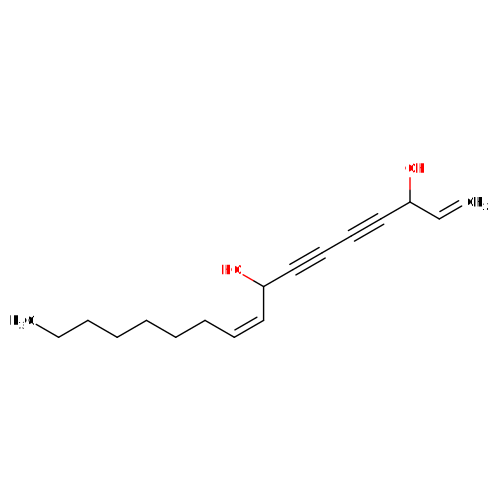
DescriptionFalcarindiol belongs to the class of organic compounds known as long-chain fatty alcohols. These are fatty alcohols that have an aliphatic tail of 13 to 21 carbon atoms. Falcarindiol is an extremely weak basic (essentially neutral) compound (based on its pKa). Falcarindiol is a bitter tasting compound. Outside of the human body, Falcarindiol is found, on average, in the highest concentration within wild carrots and carrots. Falcarindiol has also been detected, but not quantified in, several different foods, such as green vegetables, caraway, garden tomato (var.), Wild celeries, and parsley. This could make falcarindiol a potential biomarker for the consumption of these foods. Falcarindiol and other falcarindiol-type polyacetylenes are also found in many other plants of the family Apiaceae, including some commonly used seasonings such as dill and parsley. A variety of bioactivities have been reported so far for falcaridiol and the falcarindiol-type polyacetylenes, and because of potential health-promoting metabolic effects these compounds are studied as potential nutraceuticals. Falcarindiol is a polyacetylene found in carrot roots which has antifungal activity. Falcarindiol is the main compound responsible for bitterness in carrots. Falcarindiol is found in Foeniculum vulgare , Angelica acutiloba , Angelica biserrata, Angelica dahurica , Angelica furcijuga KITAGAWA, Angelica japonica, Angelica keiskei, Angelica pubescens, Angelica pubescens f.biserrta , Angelica sinensis , Anisotome pilifera, Anthriscus nitida, Anthriscus sylvestris, Aralia cordata , Bunium paucifolium, Chaerophyllum aureum, Chaerophyllum hirsutum, Cicuta virosa, Cladosporium fulvum, Crithmum maritimum , Cussonia arborea, Cussonia zimmermannii, Dendropanax arboreus, Eleutherococcus senticosus, Ferula linkii, Glehnia littoralis, Hansenia weberbaueriana, Schefflera taiwaniana, Heracleum candicans, Heracleum candicans WALL. , Heracleum moellendorffii, Heracleum yungningense, Heteromorpha arborescens, Laserpitium gallicum, Ligusticum multivittatum, Sinodielsia yunnanensis, Niphogeton ternata, Hansenia forbesii, Oenanthe fistulosa, Oenanthe javanica , Oplopanax horridus, Osmorhiza occidentalis, Peucedanum praeruptorum, Saposhnikovia divaricata, Schefflera digitata, Solanum lycopersicum , Solanum melongena and Thapsia villosa. It is the most-active among several polyynes with potential anticancer activity found in Devil's Club (Oplopanax horridus), a medicinal plant used by many indigenous peoples in Alaska and the Pacific Northwest.
Structure
Thumb
Synonyms
ValueSource
1,9-Heptadecadiene-4,6-diyne-3,8-diolHMDB
FalcalindiolHMDB
Heptadeca-1,9-diene-4,6-diyne-3,8-diolHMDB
FalcarindiolMeSH
Chemical FormulaC17H24O2
Average Mass260.3713 Da
Monoisotopic Mass260.17763 Da
IUPAC Name(9Z)-heptadeca-1,9-dien-4,6-diyne-3,8-diol
Traditional Name(9Z)-heptadeca-1,9-dien-4,6-diyne-3,8-diol
CAS Registry Number55297-87-5
SMILES
CCCCCCC\C=C/C(O)C#CC#CC(O)C=C
InChI Identifier
InChI=1S/C17H24O2/c1-3-5-6-7-8-9-10-14-17(19)15-12-11-13-16(18)4-2/h4,10,14,16-19H,2-3,5-9H2,1H3/b14-10-
InChI KeyQWCNQXNAFCBLLV-UVTDQMKNSA-N
Experimental Spectra
Not Available
Predicted Spectra
Not Available
Chemical Shift Submissions
Not Available
Species
Species of Origin
Species NameSourceReference
Anethum foeniculumPlant
Anethum graveolensFooDB
Angelica acutilobaPlant
Angelica biserrataLOTUS Database
Angelica dahuricaPlant
Angelica furcijuga KITAGAWAPlant
Angelica japonicaLOTUS Database
Angelica keiskeiLOTUS Database
Angelica pubescensLOTUS Database
Angelica pubescens f.biserrtaPlant
Angelica sinensisPlant
Anisotome piliferaLOTUS Database
Anthriscus cerefoliumFooDB
Anthriscus nitidaLOTUS Database
Anthriscus sylvestrisLOTUS Database
Apium graveolensFooDB
Apium graveolens var. dulceFooDB
Apium graveolens var. rapaceumFooDB
Aralia cordataPlant
Bunium paucifoliumLOTUS Database
Carum carviFooDB
Chaerophyllum aureumLOTUS Database
Chaerophyllum hirsutumPlant
Cicuta virosaLOTUS Database
Cladosporium fulvumFungi
Crithmum maritimumPlant
Cussonia arboreaLOTUS Database
Cussonia zimmermanniiLOTUS Database
Daucus carotaFooDB
Daucus carota ssp. sativusFooDB
Dendropanax arboreusLOTUS Database
Eleutherococcus senticosusLOTUS Database
Ferula linkiiLOTUS Database
Foeniculum vulgareFooDB
Glehnia littoralisLOTUS Database
Hansenia weberbauerianaLOTUS Database
Heptapleurum taiwanianumLOTUS Database
Heracleum candicansLOTUS Database
Heracleum candicans WALL.Plant
Heracleum moellendorffii HanceLOTUS Database
Heracleum yungningenseLOTUS Database
Heteromorpha arborescensLOTUS Database
Laserpitium gallicumLOTUS Database
Levisticum officinaleFooDB
Ligusticum multivittatumPlant
Meeboldia yunnanensisPlant
Niphogeton ternataLOTUS Database
Notopterygium franchetiiLOTUS Database
Oenanthe fistulosaLOTUS Database
Oenanthe javanicaPlant
Oplopanax horridusLOTUS Database
Osmorhiza occidentalisLOTUS Database
Pastinaca sativaFooDB
Petroselinum crispumFooDB
Peucedanum praeruptorumLOTUS Database
Saposhnikovia divaricataLOTUS Database
Schefflera digitataLOTUS Database
Solanum lycopersicumPlant
Solanum lycopersicum var. lycopersicumFooDB
Solanum melongenaLOTUS Database
Thapsia villosaLOTUS Database
Chemical Taxonomy
Description Belongs to the class of organic compounds known as long-chain fatty alcohols. These are fatty alcohols that have an aliphatic tail of 13 to 21 carbon atoms.
KingdomOrganic compounds
Super ClassLipids and lipid-like molecules
ClassFatty Acyls
Sub ClassFatty alcohols
Direct ParentLong-chain fatty alcohols
Alternative Parents
Substituents
  • Long chain fatty alcohol
  • Secondary alcohol
  • Organic oxygen compound
  • Hydrocarbon derivative
  • Organooxygen compound
  • Alcohol
  • Aliphatic acyclic compound
Molecular FrameworkAliphatic acyclic compounds
External DescriptorsNot Available
Physical Properties
StateNot Available
Experimental Properties
PropertyValueReference
Melting PointNot AvailableNot Available
Boiling PointNot AvailableNot Available
Water SolubilityNot AvailableNot Available
LogPNot AvailableNot Available
Predicted Properties
PropertyValueSource
logP4.4ALOGPS
logP4.38ChemAxon
logS-4.6ALOGPS
pKa (Strongest Acidic)13.03ChemAxon
pKa (Strongest Basic)-3.5ChemAxon
Physiological Charge0ChemAxon
Hydrogen Acceptor Count2ChemAxon
Hydrogen Donor Count2ChemAxon
Polar Surface Area40.46 ŲChemAxon
Rotatable Bond Count11ChemAxon
Refractivity82.63 m³·mol⁻¹ChemAxon
Polarizability32.6 ųChemAxon
Number of Rings0ChemAxon
BioavailabilityYesChemAxon
Rule of FiveYesChemAxon
Ghose FilterYesChemAxon
Veber's RuleNoChemAxon
MDDR-like RuleNoChemAxon
HMDB IDHMDB0033941
DrugBank IDNot Available
Phenol Explorer Compound IDNot Available
FoodDB IDFDB012149
KNApSAcK IDC00001283
Chemspider ID4476194
KEGG Compound IDC08449
BioCyc IDNot Available
BiGG IDNot Available
Wikipedia LinkFalcarindiol
METLIN IDNot Available
PubChem Compound5317309
PDB IDNot Available
ChEBI IDNot Available
Good Scents IDNot Available
References
General References