| Record Information |
|---|
| Version | 2.0 |
|---|
| Created at | 2022-03-17 20:46:03 UTC |
|---|
| Updated at | 2022-03-17 20:46:03 UTC |
|---|
| NP-MRD ID | NP0047792 |
|---|
| Secondary Accession Numbers | None |
|---|
| Natural Product Identification |
|---|
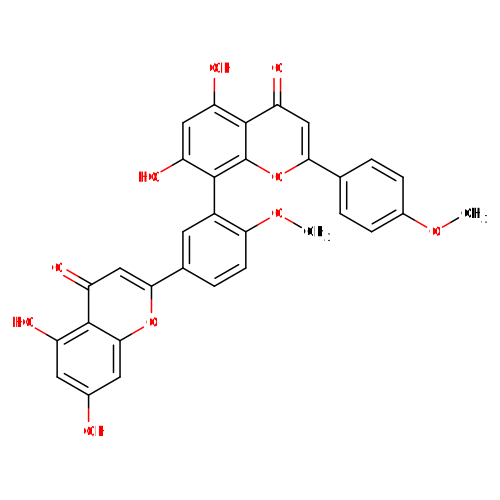
| Common Name | Isoginkgetin |
|---|
| Description | Isoginkgetin, also known as sciadopitysin, belongs to the class of organic compounds known as biflavonoids and polyflavonoids. These are organic compounds containing at least two flavan/flavone units. These units are usually linked through CC or C-O-C bonds. Some examples include C2-O-C3, C2-O-C4, C3'-C3''', and C6-C8''. Isoginkgetin is an extremely weak basic (essentially neutral) compound (based on its pKa). Outside of the human body, Isoginkgetin has been detected, but not quantified in, fats and oils and ginkgo nuts. Isoginkgetin is found in Podocarpus gracilior, Bowenia spp., Callitropsis nootkatensis, Cycas circinalis, Dacrydium spp., Decussocarpus spp., Encephalartos spp., Epimedium koreanum , Halocarpus spp., Lepidozamia spp., Podocarpus nagi , Podocarpus elongatus and Podocarpus macrophyllus. Isoginkgetin was first documented in 2006 (PMID: 17121913). This could make isoginkgetin a potential biomarker for the consumption of these foods (PMID: 17761896) (PMID: 18826947) (PMID: 23624148). |
|---|
| Structure | COC1=CC=C(C=C1)C1=CC(=O)C2=C(O)C=C(O)C(=C2O1)C1=C(OC)C=CC(=C1)C1=CC(=O)C2=C(O)C=C(O)C=C2O1 InChI=1S/C32H22O10/c1-39-18-6-3-15(4-7-18)26-14-24(38)31-22(36)12-21(35)29(32(31)42-26)19-9-16(5-8-25(19)40-2)27-13-23(37)30-20(34)10-17(33)11-28(30)41-27/h3-14,33-36H,1-2H3 |
|---|
| Synonyms | | Value | Source |
|---|
| 4',4'''-dimethylamentoflavone | ChEBI | | Iso-ginkgetin | ChEBI | | Sciadopitysin | HMDB |
|
|---|
| Chemical Formula | C32H22O10 |
|---|
| Average Mass | 566.5111 Da |
|---|
| Monoisotopic Mass | 566.12130 Da |
|---|
| IUPAC Name | 8-[5-(5,7-dihydroxy-4-oxo-4H-chromen-2-yl)-2-methoxyphenyl]-5,7-dihydroxy-2-(4-methoxyphenyl)-4H-chromen-4-one |
|---|
| Traditional Name | 8-[5-(5,7-dihydroxy-4-oxochromen-2-yl)-2-methoxyphenyl]-5,7-dihydroxy-2-(4-methoxyphenyl)chromen-4-one |
|---|
| CAS Registry Number | 548-19-6 |
|---|
| SMILES | COC1=CC=C(C=C1)C1=CC(=O)C2=C(O)C=C(O)C(=C2O1)C1=C(OC)C=CC(=C1)C1=CC(=O)C2=C(O)C=C(O)C=C2O1 |
|---|
| InChI Identifier | InChI=1S/C32H22O10/c1-39-18-6-3-15(4-7-18)26-14-24(38)31-22(36)12-21(35)29(32(31)42-26)19-9-16(5-8-25(19)40-2)27-13-23(37)30-20(34)10-17(33)11-28(30)41-27/h3-14,33-36H,1-2H3 |
|---|
| InChI Key | HUOOMAOYXQFIDQ-UHFFFAOYSA-N |
|---|
| Experimental Spectra |
|---|
|
| Not Available | | Predicted Spectra |
|---|
|
| Not Available | | Chemical Shift Submissions |
|---|
|
| Not Available | | Species |
|---|
| Species of Origin | |
|---|
| Chemical Taxonomy |
|---|
| Description | Belongs to the class of organic compounds known as biflavonoids and polyflavonoids. These are organic compounds containing at least two flavan/flavone units. These units are usually linked through CC or C-O-C bonds. Some examples include C2-O-C3, C2-O-C4, C3'-C3''', and C6-C8''. |
|---|
| Kingdom | Organic compounds |
|---|
| Super Class | Phenylpropanoids and polyketides |
|---|
| Class | Flavonoids |
|---|
| Sub Class | Biflavonoids and polyflavonoids |
|---|
| Direct Parent | Biflavonoids and polyflavonoids |
|---|
| Alternative Parents | |
|---|
| Substituents | - Bi- and polyflavonoid skeleton
- 4p-methoxyflavonoid-skeleton
- 5-hydroxyflavonoid
- 7-hydroxyflavonoid
- Flavone
- Hydroxyflavonoid
- Chromone
- Benzopyran
- 1-benzopyran
- Phenoxy compound
- Anisole
- Methoxybenzene
- Phenol ether
- 1-hydroxy-4-unsubstituted benzenoid
- 1-hydroxy-2-unsubstituted benzenoid
- Alkyl aryl ether
- Pyranone
- Monocyclic benzene moiety
- Benzenoid
- Pyran
- Vinylogous acid
- Heteroaromatic compound
- Organoheterocyclic compound
- Ether
- Oxacycle
- Hydrocarbon derivative
- Organic oxide
- Organooxygen compound
- Organic oxygen compound
- Aromatic heteropolycyclic compound
|
|---|
| Molecular Framework | Aromatic heteropolycyclic compounds |
|---|
| External Descriptors | |
|---|
| Physical Properties |
|---|
| State | Not Available |
|---|
| Experimental Properties | | Property | Value | Reference |
|---|
| Melting Point | Not Available | Not Available | | Boiling Point | Not Available | Not Available | | Water Solubility | Not Available | Not Available | | LogP | Not Available | Not Available |
|
|---|
| Predicted Properties | |
|---|
| General References | - Yoon SO, Shin S, Lee HJ, Chun HK, Chung AS: Isoginkgetin inhibits tumor cell invasion by regulating phosphatidylinositol 3-kinase/Akt-dependent matrix metalloproteinase-9 expression. Mol Cancer Ther. 2006 Nov;5(11):2666-75. doi: 10.1158/1535-7163.MCT-06-0321. [PubMed:17121913 ]
- Liu G, Grifman M, Macdonald J, Moller P, Wong-Staal F, Li QX: Isoginkgetin enhances adiponectin secretion from differentiated adiposarcoma cells via a novel pathway involving AMP-activated protein kinase. J Endocrinol. 2007 Sep;194(3):569-78. doi: 10.1677/JOE-07-0200. [PubMed:17761896 ]
- O'Brien K, Matlin AJ, Lowell AM, Moore MJ: The biflavonoid isoginkgetin is a general inhibitor of Pre-mRNA splicing. J Biol Chem. 2008 Nov 28;283(48):33147-54. doi: 10.1074/jbc.M805556200. Epub 2008 Sep 30. [PubMed:18826947 ]
- Suh KS, Lee YS, Kim YS, Choi EM: Sciadopitysin protects osteoblast function via its antioxidant activity in MC3T3-E1 cells. Food Chem Toxicol. 2013 Aug;58:220-7. doi: 10.1016/j.fct.2013.04.028. Epub 2013 Apr 23. [PubMed:23624148 ]
|
|---|