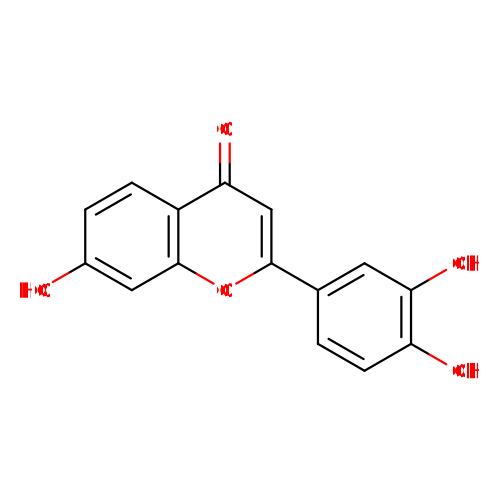
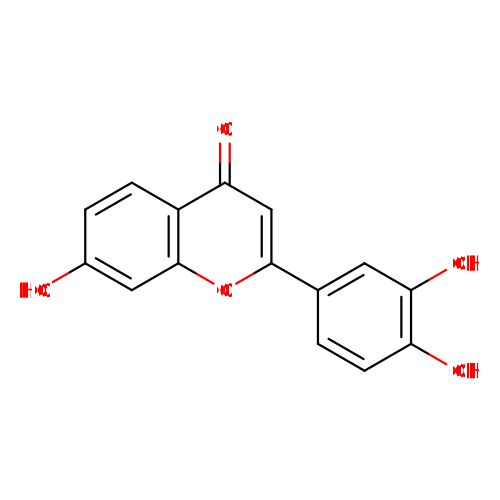
| Description | 2-(3,4-Dihydroxyphenyl)-7-hydroxy-4H-chromen-4-one, also known as 3'4'7-trihydroxyflavon, belongs to the class of organic compounds known as flavones. These are flavonoids with a structure based on the backbone of 2-phenylchromen-4-one (2-phenyl-1-benzopyran-4-one). Thus, 2-(3,4-dihydroxyphenyl)-7-hydroxy-4H-chromen-4-one is considered to be a flavonoid lipid molecule. 2-(3,4-Dihydroxyphenyl)-7-hydroxy-4H-chromen-4-one is a very hydrophobic molecule, practically insoluble (in water), and relatively neutral. Outside of the human body, 2-(3,4-dihydroxyphenyl)-7-hydroxy-4H-chromen-4-one is found, on average, in the highest concentration within broad beans. 2-(3,4-Dihydroxyphenyl)-7-hydroxy-4H-chromen-4-one has also been detected, but not quantified in, alfalfa and fenugreeks. 3',4',7-Trihydroxyflavone is found in Acacia confusa, Acacia fasciculifera, Albizia julibrissin , Baptisia arachnifera, Baptisia australis, Baptisia bracteata, Baptisia calycosa, Baptisia cinerea, Baptisia lanceolata, Baptisia lecontei, Baptisia megacarpa, Baptisia nuttalliana, Baptisia perfoliata, Baptisia simplicifolia, Brucea javanica, Butea monosperma, Carex longebrachiata, Bauhinia glauca, Cyclopia falcata, Cyclopia intermedia, Dipteryx lacunifera, Glycyrrhiza uralensis , Juncus trifidus, Luzula purpurea, Medicago coronata, Medicago littoralis, Medicago monspeliaca, Medicago orbicularis , Medicago polymorpha , Sophora alopecuroides, Sophora microphylla , Sophora prostrata, Sophora viciifolia, Spatholobus suberectus Dunn , Thermopsis macrophylla, Thermopsis mollis, Thermopsis rhombifolia, Thermopsis villosa, Trifolium repens , Trifolium subterraneum , Trigonella anguina, Trigonella coerulescens, Trigonella laciniata, Trigonella maritima and Trigonella spicata. This could make 2-(3,4-dihydroxyphenyl)-7-hydroxy-4H-chromen-4-one a potential biomarker for the consumption of these foods. |
|---|