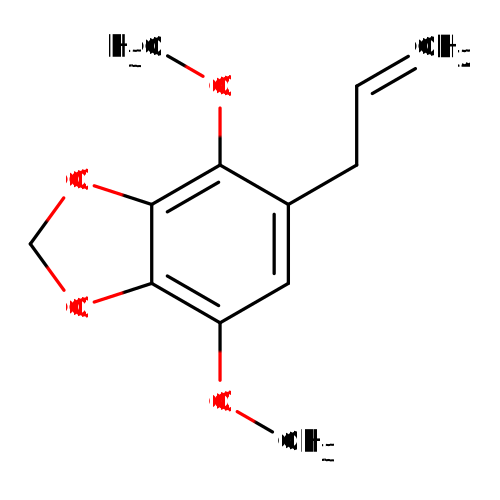
| Record Information |
|---|
| Version | 2.0 |
|---|
| Created at | 2022-03-17 20:45:05 UTC |
|---|
| Updated at | 2022-03-17 20:45:06 UTC |
|---|
| NP-MRD ID | NP0047736 |
|---|
| Secondary Accession Numbers | None |
|---|
| Natural Product Identification |
|---|
| Common Name | Apiole |
|---|
| Description | Apiole, also known as apiol or camphre de persil, belongs to the class of organic compounds known as benzodioxoles. These are organic compounds containing a benzene ring fused to either isomers of dioxole. Dioxole is a five-membered unsaturated ring of two oxygen atoms and three carbon atoms. According to a book called PIHKAL, Apiole had been used to synthesize a psychedelic amphetamine called DMMDA. In 1855 Joret and Homolle discovered that apiol was an effective treatment of amenorrea or lack of menstruation. In medicine it has been used, as essential oil or in purified form, for the treatment of menstrual disorders and as an abortifacient. The name apiole is also used for a closely related compound found in dill and in fennel roots, the positional isomer (dillapiole, 1-allyl-2,3-dimethoxy-4,5-methylenedioxybenzene. Apiole is an extremely weak basic (essentially neutral) compound (based on its pKa). Apiole is a faint and parsley tasting compound. Outside of the human body, Apiole is found, on average, in the highest concentration within parsley. Apiole has also been detected, but not quantified in, several different foods, such as fennels, dills, wild celeries, herbs and spices, and lovages. This could make apiole a potential biomarker for the consumption of these foods. No carcinogenicity was detected with parsley apiol or dill apiol in mice. Hippocrates wrote about parsley as an herb to cause an abortion. It is an irritant and, in high doses, it can cause liver and kidney damage. Apiole is found in Foeniculum vulgare , Asarum okinawense, Asarum petelotii, Brucea javanica, Chuquiraga spinosa, Cinnamomum camphora , Crithmum maritimum , Vincetoxicum hirundinaria, Daucus carota, Degeneria vitiensis, Heracleum pyrenaicum, Mosla cavaleriei, Nigella sativa L , Niphogeton dissecta, Ocimum gratissimum, Ocotea spp., Oenanthe javanica, Peperomia pellucida, Piper angustifolium, Piper artanthe, Piper brachystachyum, Piper lhotzkyanum, Piper marginatum , Piper mullesua, Piper regnellii , Piper schmidtii, Piper solmsianum, Sassafras albidum , Spatoglossum variabile, Stellaria pallida, Todaroa aurea and Zingiber cassumunar Roxb. . Plants containing apiole were used by women in the Middle Ages to terminate pregnancies. |
|---|
| Structure | COC1=C2OCOC2=C(OC)C(CC=C)=C1 InChI=1S/C12H14O4/c1-4-5-8-6-9(13-2)11-12(10(8)14-3)16-7-15-11/h4,6H,1,5,7H2,2-3H3 |
|---|
| Synonyms | | Value | Source |
|---|
| 1-Allyl-2,5-dimethoxy-3, 4-(methylenedioxy)benzene | HMDB | | 1-Allyl-2,5-dimethoxy-3,4-(methylenedioxy)-benzene | HMDB | | 1-Allyl-2,5-dimethoxy-3,4-(methylenedioxy)benzene | HMDB | | 1-Allyl-2,5-dimethoxy-3,4-methylenedioxybenzene | HMDB | | 4,7-Dimethoxy-5-(2-propen-1-yl)-1,3-benzodioxole | HMDB | | 4,7-Dimethoxy-5-(2-propenyl)-1,3-benzodioxole | HMDB | | 4,7-Dimethoxy-5-(2-propenyl)-1,3-benzodioxole, 9ci | HMDB | | 5-Allyl-4,7-dimethoxy-1,3-benzodioxol | HMDB | | 5-Allyl-4,7-dimethoxy-1,3-benzodioxole | HMDB | | Apiol | HMDB | | Apiole (parsley) | HMDB | | Apioline | HMDB | | Camphre de persil | HMDB | | Parsley apiol | HMDB | | Parsley apiole | HMDB | | Parsley camphor | HMDB | | Petersiliencampher | HMDB |
|
|---|
| Chemical Formula | C12H14O4 |
|---|
| Average Mass | 222.2372 Da |
|---|
| Monoisotopic Mass | 222.08921 Da |
|---|
| IUPAC Name | 4,7-dimethoxy-5-(prop-2-en-1-yl)-2H-1,3-benzodioxole |
|---|
| Traditional Name | apiol |
|---|
| CAS Registry Number | 523-80-8 |
|---|
| SMILES | COC1=C2OCOC2=C(OC)C(CC=C)=C1 |
|---|
| InChI Identifier | InChI=1S/C12H14O4/c1-4-5-8-6-9(13-2)11-12(10(8)14-3)16-7-15-11/h4,6H,1,5,7H2,2-3H3 |
|---|
| InChI Key | QQRSPHJOOXUALR-UHFFFAOYSA-N |
|---|
| Experimental Spectra |
|---|
|
| Not Available | | Predicted Spectra |
|---|
|
| Not Available | | Chemical Shift Submissions |
|---|
|
| Not Available | | Species |
|---|
| Species of Origin | |
|---|
| Chemical Taxonomy |
|---|
| Description | Belongs to the class of organic compounds known as benzodioxoles. These are organic compounds containing a benzene ring fused to either isomers of dioxole. Dioxole is a five-membered unsaturated ring of two oxygen atoms and three carbon atoms. |
|---|
| Kingdom | Organic compounds |
|---|
| Super Class | Organoheterocyclic compounds |
|---|
| Class | Benzodioxoles |
|---|
| Sub Class | Not Available |
|---|
| Direct Parent | Benzodioxoles |
|---|
| Alternative Parents | |
|---|
| Substituents | - Benzodioxole
- Anisole
- Alkyl aryl ether
- Benzenoid
- Oxacycle
- Ether
- Acetal
- Organic oxygen compound
- Hydrocarbon derivative
- Organooxygen compound
- Aromatic heteropolycyclic compound
|
|---|
| Molecular Framework | Aromatic heteropolycyclic compounds |
|---|
| External Descriptors | |
|---|
| Physical Properties |
|---|
| State | Not Available |
|---|
| Experimental Properties | | Property | Value | Reference |
|---|
| Melting Point | Not Available | Not Available | | Boiling Point | Not Available | Not Available | | Water Solubility | Not Available | Not Available | | LogP | Not Available | Not Available |
|
|---|
| Predicted Properties | |
|---|