Np mrd loader

Record Information
Version2.0
Created at2022-03-17 20:44:59 UTC
Updated at2022-03-17 20:44:59 UTC
NP-MRD IDNP0047729
Secondary Accession NumbersNone
Natural Product Identification
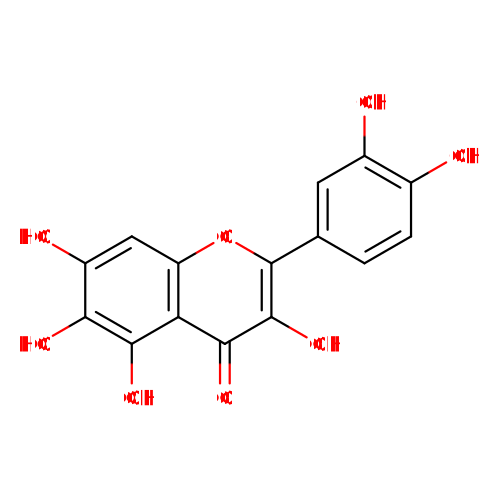
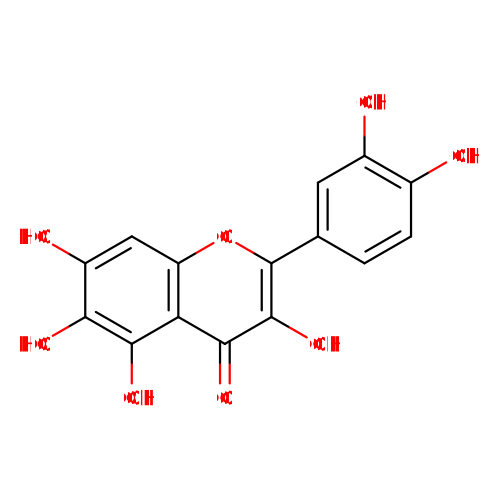
Common NameQuercetagetin
Description2-(3,4-Dihydroxyphenyl)-3,5,6,7-tetrahydroxy-4H-chromen-4-one, also known as 6-hydroxyquercetin or 3,3',4',5,6,7-hexahydroxyflavone, belongs to the class of organic compounds known as flavonols. Flavonols are compounds that contain a flavone (2-phenyl-1-benzopyran-4-one) backbone carrying a hydroxyl group at the 3-position. Thus, 2-(3,4-dihydroxyphenyl)-3,5,6,7-tetrahydroxy-4H-chromen-4-one is considered to be a flavonoid lipid molecule. A hexahydroxyflavone that is flavone substituted by hydroxy groups at positions 3, 5, 6, 7, 3' and 4' respectively. 2-(3,4-Dihydroxyphenyl)-3,5,6,7-tetrahydroxy-4H-chromen-4-one is a very hydrophobic molecule, practically insoluble (in water), and relatively neutral. 2-(3,4-Dihydroxyphenyl)-3,5,6,7-tetrahydroxy-4H-chromen-4-one is a bitter tasting compound. Outside of the human body, 2-(3,4-dihydroxyphenyl)-3,5,6,7-tetrahydroxy-4H-chromen-4-one has been detected, but not quantified in, sweet oranges. Quercetagetin is found in Acacia catechu , Achyrocline tomentosa, Actinocephalus polyanthus, Tagetes erecta , Alnus glutinosa, Anthemis cotula, Anthemis spp., Artemisia nova, Artemisia tridentata, Brickellia cylindracea, Brickellia microphylla, Chrysanthemum spp., Citrus aurantium, Citrus reticulata, Citrus sinensis, Cupressus sempervirens, Eriocaulon spp., Eupatorium gracile, Glechoma hederacea, Helichrysum stoechas, Hymenoxys scaposa, Leucaena glauca , Leucanthemum atratum, Neurolaena lobata, Paepalanthus polyanthus, Paepalanthus ramosus, Paepalanthus robustus, Platycodon grandiflorus, Rhaponticum carthamoides , Rudbeckia hirta, Senecio oryzetorum, Tagetes lucida, Tagetes minuta, Tagetes patula , Tagetes subulata, Tagetes tenuifolia and Viguiera dentata. Quercetagetin was first documented in 2010 (PMID: 20685402). This could make 2-(3,4-dihydroxyphenyl)-3,5,6,7-tetrahydroxy-4H-chromen-4-one a potential biomarker for the consumption of these foods (PMID: 22223143) (PMID: 23000494) (PMID: 23142567).
Structure
Thumb
Synonyms
ValueSource
2-(3,4-Dihydroxyphenyl)-3,5,6,7-tetrahydroxy-4-benzopyroneChEBI
3,3',4',5,6,7-HexahydroxyflavoneChEBI
6-HydroxyquercetinChEBI
3,5,6,7,3',4'-HexamethoxyflavoneMeSH
3,5,6,7-Tetrahydroxy-2-(3,4-dihydroxyphenyl)-4H-1-benzopyran-4-oneMeSH
QuercetogetinMeSH
Chemical FormulaC15H10O8
Average Mass318.2351 Da
Monoisotopic Mass318.03757 Da
IUPAC Name2-(3,4-dihydroxyphenyl)-3,5,6,7-tetrahydroxy-4H-chromen-4-one
Traditional Namequercetagetin
CAS Registry Number90-18-6
SMILES
OC1=CC2=C(C(O)=C1O)C(=O)C(O)=C(O2)C1=CC(O)=C(O)C=C1
InChI Identifier
InChI=1S/C15H10O8/c16-6-2-1-5(3-7(6)17)15-14(22)13(21)10-9(23-15)4-8(18)11(19)12(10)20/h1-4,16-20,22H
InChI KeyZVOLCUVKHLEPEV-UHFFFAOYSA-N
Experimental Spectra
Not Available
Predicted Spectra
Not Available
Chemical Shift Submissions
Not Available
Species
Species of Origin
Species NameSourceReference
Acacia catechuPlant
Achyrocline tomentosaLOTUS Database
Actinocephalus polyanthusLOTUS Database
African marigoldPlant
Alnus glutinosaLOTUS Database
Anthemis cotulaLOTUS Database
Anthemis spp.Plant
Artemisia novaLOTUS Database
Artemisia tridentataLOTUS Database
Brickellia cylindraceaLOTUS Database
Brickellia microphyllaLOTUS Database
Chrysanthemum spp.Plant
Citrus aurantiumLOTUS Database
Citrus reticulataLOTUS Database
Citrus sinensisLOTUS Database
Citrus X sinensis (L.) Osbeck (pro. sp.)FooDB
Cupressus sempervirensLOTUS Database
Eriocaulon spp.Plant
Eupatorium gracilePlant
Glechoma hederaceaLOTUS Database
Helichrysum stoechasLOTUS Database
Hymenoxys scaposaPlant
Leucaena glaucaPlant
Leucanthemum atratumPlant
Neurolaena lobataLOTUS Database
Paepalanthus polyanthusPlant
Paepalanthus ramosusPlant
Paepalanthus robustusPlant
Platycodon grandiflorusLOTUS Database
Rhaponticum carthamoidesPlant
Rudbeckia hirtaPlant
Senecio oryzetorumPlant
Tagetes lucidaLOTUS Database
Tagetes minutaLOTUS Database
Tagetes patulaPlant
Tagetes subulataLOTUS Database
Tagetes tenuifoliaLOTUS Database
Viguiera dentataLOTUS Database
Chemical Taxonomy
Description Belongs to the class of organic compounds known as flavonols. Flavonols are compounds that contain a flavone (2-phenyl-1-benzopyran-4-one) backbone carrying a hydroxyl group at the 3-position.
KingdomOrganic compounds
Super ClassPhenylpropanoids and polyketides
ClassFlavonoids
Sub ClassFlavones
Direct ParentFlavonols
Alternative Parents
Substituents
  • 3-hydroxyflavone
  • 3'-hydroxyflavonoid
  • 3-hydroxyflavonoid
  • 4'-hydroxyflavonoid
  • 5-hydroxyflavonoid
  • 6-hydroxyflavonoid
  • 7-hydroxyflavonoid
  • Hydroxyflavonoid
  • Chromone
  • Benzopyran
  • 1-benzopyran
  • Catechol
  • 1-hydroxy-4-unsubstituted benzenoid
  • 1-hydroxy-2-unsubstituted benzenoid
  • Pyranone
  • Phenol
  • Monocyclic benzene moiety
  • Benzenoid
  • Pyran
  • Vinylogous acid
  • Heteroaromatic compound
  • Organoheterocyclic compound
  • Oxacycle
  • Polyol
  • Organic oxide
  • Organic oxygen compound
  • Hydrocarbon derivative
  • Organooxygen compound
  • Aromatic heteropolycyclic compound
Molecular FrameworkAromatic heteropolycyclic compounds
External Descriptors
Physical Properties
StateNot Available
Experimental Properties
PropertyValueReference
Melting PointNot AvailableNot Available
Boiling PointNot AvailableNot Available
Water SolubilityNot AvailableNot Available
LogPNot AvailableNot Available
Predicted Properties
PropertyValueSource
logP1.7ALOGPS
logP1.85ChemAxon
logS-3ALOGPS
pKa (Strongest Acidic)6.56ChemAxon
pKa (Strongest Basic)-4ChemAxon
Physiological Charge-1ChemAxon
Hydrogen Acceptor Count8ChemAxon
Hydrogen Donor Count6ChemAxon
Polar Surface Area147.68 ŲChemAxon
Rotatable Bond Count1ChemAxon
Refractivity78.84 m³·mol⁻¹ChemAxon
Polarizability29.49 ųChemAxon
Number of Rings3ChemAxon
BioavailabilityYesChemAxon
Rule of FiveNoChemAxon
Ghose FilterYesChemAxon
Veber's RuleNoChemAxon
MDDR-like RuleNoChemAxon
HMDB IDHMDB0126560
DrugBank IDNot Available
Phenol Explorer Compound ID354
FoodDB IDFDB011897
KNApSAcK IDC00004677
Chemspider ID4444999
KEGG Compound IDC10122
BioCyc IDNot Available
BiGG IDNot Available
Wikipedia LinkQuercetagetin
METLIN IDNot Available
PubChem Compound5281680
PDB IDMYU
ChEBI ID8695
Good Scents IDNot Available
References
General References
  1. Gutierrez-Venegas G, Bando-Campos CG: The flavonoids luteolin and quercetagetin inhibit lipoteichoic acid actions on H9c2 cardiomyocytes. Int Immunopharmacol. 2010 Sep;10(9):1003-9. doi: 10.1016/j.intimp.2010.05.012. Epub 2010 Jun 4. [PubMed:20685402 ]
  2. Gong Y, Liu X, He WH, Xu HG, Yuan F, Gao YX: Investigation into the antioxidant activity and chemical composition of alcoholic extracts from defatted marigold (Tagetes erecta L.) residue. Fitoterapia. 2012 Apr;83(3):481-9. doi: 10.1016/j.fitote.2011.12.013. Epub 2011 Dec 22. [PubMed:22223143 ]
  3. Cotin S, Calliste CA, Mazeron MC, Hantz S, Duroux JL, Rawlinson WD, Ploy MC, Alain S: Eight flavonoids and their potential as inhibitors of human cytomegalovirus replication. Antiviral Res. 2012 Nov;96(2):181-6. doi: 10.1016/j.antiviral.2012.09.010. Epub 2012 Sep 21. [PubMed:23000494 ]
  4. Baek S, Kang NJ, Popowicz GM, Arciniega M, Jung SK, Byun S, Song NR, Heo YS, Kim BY, Lee HJ, Holak TA, Augustin M, Bode AM, Huber R, Dong Z, Lee KW: Structural and functional analysis of the natural JNK1 inhibitor quercetagetin. J Mol Biol. 2013 Jan 23;425(2):411-23. doi: 10.1016/j.jmb.2012.10.019. Epub 2012 Nov 8. [PubMed:23142567 ]