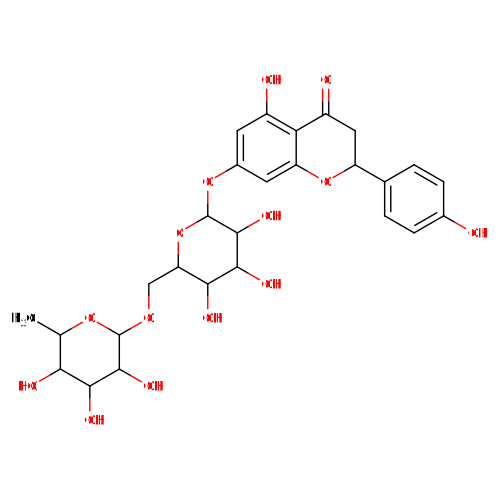
| Record Information |
|---|
| Version | 2.0 |
|---|
| Created at | 2022-03-17 20:44:52 UTC |
|---|
| Updated at | 2022-03-17 20:44:52 UTC |
|---|
| NP-MRD ID | NP0047722 |
|---|
| Secondary Accession Numbers | None |
|---|
| Natural Product Identification |
|---|
| Common Name | Narirutin |
|---|
| Description | Narirutin, also known as isonaringenin, belongs to the class of organic compounds known as flavonoid-7-o-glycosides. These are phenolic compounds containing a flavonoid moiety which is O-glycosidically linked to carbohydrate moiety at the C7-position. Narirutin is an extremely weak basic (essentially neutral) compound (based on its pKa). Narirutin is a bland tasting compound. Outside of the human body, Narirutin is found, on average, in the highest concentration within a few different foods, such as peppermints, grapefruit/pummelo hybrids, and grapefruits and in a lower concentration in mandarin orange (clementine, tangerine), sweet oranges, and limes. Narirutin has also been detected, but not quantified in, a few different foods, such as globe artichokes, pummelo, and tea. This could make narirutin a potential biomarker for the consumption of these foods. Narirutin is found in Acinos suaveolens, Camellia sinensis , Citrus aurantium, Citrus aurantium L. var. amara , Citrus junos, Citrus medica, Citrus natsudaidai, Citrus sinensis, Citrus spp., Citrus sudachi , Citrus unshiu, Citrus unshiu Markovich , Citrus webberi, Cyclopia falcata, Cyclopia subternata, Cynara cardunculus, Hamelia patens , Houttuynia cordata, Mentha piperita, Streptomyces lanatus and Thymus vulgaris. Narirutin was first documented in 2007 (PMID: 17600554). Narirutin is a flavanone-7-O-glycoside between the flavanone naringenin and the disaccharide rutinose. |
|---|
| Structure | CC1OC(OCC2OC(OC3=CC(O)=C4C(=O)CC(OC4=C3)C3=CC=C(O)C=C3)C(O)C(O)C2O)C(O)C(O)C1O InChI=1S/C27H32O14/c1-10-20(31)22(33)24(35)26(38-10)37-9-18-21(32)23(34)25(36)27(41-18)39-13-6-14(29)19-15(30)8-16(40-17(19)7-13)11-2-4-12(28)5-3-11/h2-7,10,16,18,20-29,31-36H,8-9H2,1H3 |
|---|
| Synonyms | | Value | Source |
|---|
| Isonaringenin | HMDB | | Isonaringin | HMDB | | Naringenin 7-O-rutinoside | HMDB | | Naringenin 7-rutinoside | HMDB |
|
|---|
| Chemical Formula | C27H32O14 |
|---|
| Average Mass | 580.5346 Da |
|---|
| Monoisotopic Mass | 580.17921 Da |
|---|
| IUPAC Name | 5-hydroxy-2-(4-hydroxyphenyl)-7-[(3,4,5-trihydroxy-6-{[(3,4,5-trihydroxy-6-methyloxan-2-yl)oxy]methyl}oxan-2-yl)oxy]-3,4-dihydro-2H-1-benzopyran-4-one |
|---|
| Traditional Name | 5-hydroxy-2-(4-hydroxyphenyl)-7-[(3,4,5-trihydroxy-6-{[(3,4,5-trihydroxy-6-methyloxan-2-yl)oxy]methyl}oxan-2-yl)oxy]-2,3-dihydro-1-benzopyran-4-one |
|---|
| CAS Registry Number | 14259-46-2 |
|---|
| SMILES | CC1OC(OCC2OC(OC3=CC(O)=C4C(=O)CC(OC4=C3)C3=CC=C(O)C=C3)C(O)C(O)C2O)C(O)C(O)C1O |
|---|
| InChI Identifier | InChI=1S/C27H32O14/c1-10-20(31)22(33)24(35)26(38-10)37-9-18-21(32)23(34)25(36)27(41-18)39-13-6-14(29)19-15(30)8-16(40-17(19)7-13)11-2-4-12(28)5-3-11/h2-7,10,16,18,20-29,31-36H,8-9H2,1H3 |
|---|
| InChI Key | HXTFHSYLYXVTHC-UHFFFAOYSA-N |
|---|
| Experimental Spectra |
|---|
|
| Not Available | | Predicted Spectra |
|---|
|
| Not Available | | Chemical Shift Submissions |
|---|
|
| Not Available | | Species |
|---|
| Species of Origin | |
|---|
| Chemical Taxonomy |
|---|
| Description | Belongs to the class of organic compounds known as flavonoid-7-o-glycosides. These are phenolic compounds containing a flavonoid moiety which is O-glycosidically linked to carbohydrate moiety at the C7-position. |
|---|
| Kingdom | Organic compounds |
|---|
| Super Class | Phenylpropanoids and polyketides |
|---|
| Class | Flavonoids |
|---|
| Sub Class | Flavonoid glycosides |
|---|
| Direct Parent | Flavonoid-7-O-glycosides |
|---|
| Alternative Parents | |
|---|
| Substituents | - Flavonoid-7-o-glycoside
- 4'-hydroxyflavonoid
- 5-hydroxyflavonoid
- Flavanone
- Hydroxyflavonoid
- Flavan
- Phenolic glycoside
- Chromone
- Disaccharide
- Glycosyl compound
- O-glycosyl compound
- Chromane
- Benzopyran
- 1-benzopyran
- Aryl alkyl ketone
- Aryl ketone
- Phenol
- 1-hydroxy-2-unsubstituted benzenoid
- 1-hydroxy-4-unsubstituted benzenoid
- Alkyl aryl ether
- Oxane
- Benzenoid
- Monocyclic benzene moiety
- Vinylogous acid
- Secondary alcohol
- Ketone
- Polyol
- Acetal
- Organoheterocyclic compound
- Ether
- Oxacycle
- Alcohol
- Organic oxygen compound
- Organic oxide
- Hydrocarbon derivative
- Organooxygen compound
- Aromatic heteropolycyclic compound
|
|---|
| Molecular Framework | Aromatic heteropolycyclic compounds |
|---|
| External Descriptors | |
|---|
| Physical Properties |
|---|
| State | Not Available |
|---|
| Experimental Properties | | Property | Value | Reference |
|---|
| Melting Point | Not Available | Not Available | | Boiling Point | Not Available | Not Available | | Water Solubility | Not Available | Not Available | | LogP | Not Available | Not Available |
|
|---|
| Predicted Properties | |
|---|
| General References | - Funaguchi N, Ohno Y, La BL, Asai T, Yuhgetsu H, Sawada M, Takemura G, Minatoguchi S, Fujiwara T, Fujiwara H: Narirutin inhibits airway inflammation in an allergic mouse model. Clin Exp Pharmacol Physiol. 2007 Aug;34(8):766-70. doi: 10.1111/j.1440-1681.2007.04636.x. [PubMed:17600554 ]
|
|---|