| Record Information |
|---|
| Version | 2.0 |
|---|
| Created at | 2022-03-17 20:41:58 UTC |
|---|
| Updated at | 2022-03-17 20:41:58 UTC |
|---|
| NP-MRD ID | NP0047548 |
|---|
| Secondary Accession Numbers | None |
|---|
| Natural Product Identification |
|---|
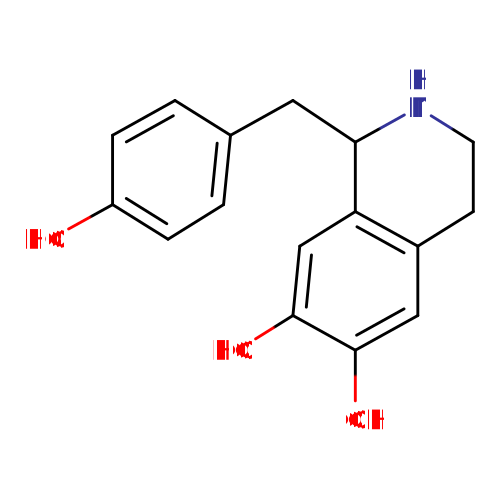
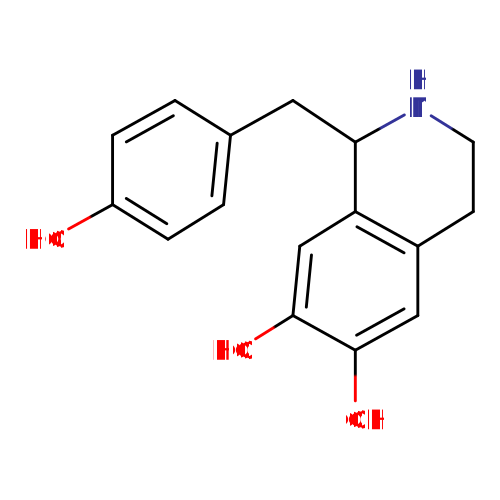
| Common Name | (R)-Higenamine |
|---|
| Description | (R)-Higenamine, also known as norcoclaurine, belongs to the class of organic compounds known as benzylisoquinolines. These are organic compounds containing an isoquinoline to which a benzyl group is attached (R)-Higenamine is a very strong basic compound (based on its pKa) (R)-Higenamine is a sweet, fruity, and milky tasting compound. Outside of the human body, (R)-Higenamine has been detected, but not quantified in, custard apples and opium poppies. This could make (R)-higenamine a potential biomarker for the consumption of these foods. (R)-Higenamine is found in Aconitum japonicum, Argemone mexicana, Asarum sieboldii, Gnetum parvifolium , Macleaya cordata, Nelumbo nucifera, Phoebe chekiangensis and Tinospora crispa . Higenamine is under investigation in clinical trial NCT01451229 (Pharmacokinetics and Pharmacodynamics of Higenamine in Chinese Healthy Subjects). |
|---|
| Structure | OC1=CC=C(CC2NCCC3=C2C=C(O)C(O)=C3)C=C1 InChI=1S/C16H17NO3/c18-12-3-1-10(2-4-12)7-14-13-9-16(20)15(19)8-11(13)5-6-17-14/h1-4,8-9,14,17-20H,5-7H2 |
|---|
| Synonyms | | Value | Source |
|---|
| (+-)-1,2,3,4-Tetrahydro-1-((4-hydroxyphenyl)methyl)-6,7-isoquinolinediol | ChEBI | | (+-)-Demethylcoclaurine | ChEBI | | (+-)-Norcoclaurine | ChEBI | | (+-)-O-Demethylcoclaurine | ChEBI | | (R,S)-Norcoclaurine | ChEBI | | 6,7-Dihydroxy-1-[(4-hydroxyphenyl)methyl]-1,2,3,4-tetrahydroisoquinoline | ChEBI | | Higenamine | ChEBI | | Norcoclaurine | ChEBI | | (+)-Demethylcoclaurine | HMDB | | (R)-Norcoclaurine | HMDB | | Higenamine hydrobromide, (+-)-isomer | HMDB | | Higenamine oxalate (1:1), (+-)-isomer | HMDB | | Higenamine, tartrate (1:1), R-(r*,r*)-(+-)-isomer | HMDB | | 1-(p-Hydroxybenzyl)-6,7-dihydroxy-1,2,3,4-tetrahydroisoquinoline | HMDB | | O-Demethylcoclaurine | HMDB | | Higenamine hydrochloride, (S)-isomer | HMDB | | 1(S)-Norcoclaurine | HMDB |
|
|---|
| Chemical Formula | C16H17NO3 |
|---|
| Average Mass | 271.3111 Da |
|---|
| Monoisotopic Mass | 271.12084 Da |
|---|
| IUPAC Name | 1-[(4-hydroxyphenyl)methyl]-1,2,3,4-tetrahydroisoquinoline-6,7-diol |
|---|
| Traditional Name | higenamine |
|---|
| CAS Registry Number | 106032-53-5 |
|---|
| SMILES | OC1=CC=C(CC2NCCC3=C2C=C(O)C(O)=C3)C=C1 |
|---|
| InChI Identifier | InChI=1S/C16H17NO3/c18-12-3-1-10(2-4-12)7-14-13-9-16(20)15(19)8-11(13)5-6-17-14/h1-4,8-9,14,17-20H,5-7H2 |
|---|
| InChI Key | WZRCQWQRFZITDX-UHFFFAOYSA-N |
|---|
| Experimental Spectra |
|---|
|
| Not Available | | Predicted Spectra |
|---|
|
| Not Available | | Chemical Shift Submissions |
|---|
|
| Not Available | | Species |
|---|
| Species of Origin | |
|---|
| Chemical Taxonomy |
|---|
| Description | Belongs to the class of organic compounds known as benzylisoquinolines. These are organic compounds containing an isoquinoline to which a benzyl group is attached. |
|---|
| Kingdom | Organic compounds |
|---|
| Super Class | Organoheterocyclic compounds |
|---|
| Class | Isoquinolines and derivatives |
|---|
| Sub Class | Benzylisoquinolines |
|---|
| Direct Parent | Benzylisoquinolines |
|---|
| Alternative Parents | |
|---|
| Substituents | - Benzylisoquinoline
- Tetrahydroisoquinoline
- 1-hydroxy-2-unsubstituted benzenoid
- Phenol
- Aralkylamine
- Monocyclic benzene moiety
- Benzenoid
- Secondary aliphatic amine
- Secondary amine
- Azacycle
- Organopnictogen compound
- Organooxygen compound
- Organonitrogen compound
- Amine
- Organic oxygen compound
- Hydrocarbon derivative
- Organic nitrogen compound
- Aromatic heteropolycyclic compound
|
|---|
| Molecular Framework | Aromatic heteropolycyclic compounds |
|---|
| External Descriptors | |
|---|
| Physical Properties |
|---|
| State | Not Available |
|---|
| Experimental Properties | | Property | Value | Reference |
|---|
| Melting Point | Not Available | Not Available | | Boiling Point | Not Available | Not Available | | Water Solubility | Not Available | Not Available | | LogP | Not Available | Not Available |
|
|---|
| Predicted Properties | |
|---|