Np mrd loader

Record Information
Version2.0
Created at2022-03-17 20:39:47 UTC
Updated at2022-03-17 20:39:47 UTC
NP-MRD IDNP0047412
Secondary Accession NumbersNone
Natural Product Identification
Common NameZingerone
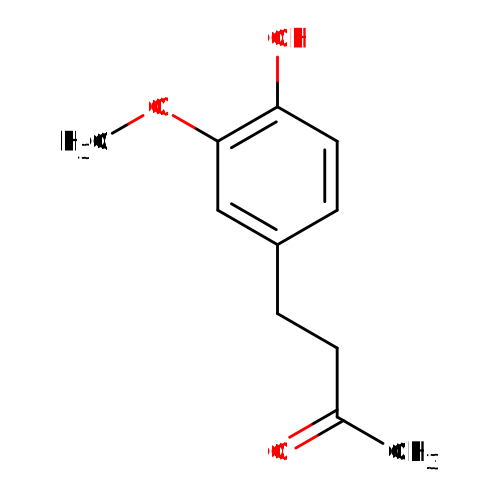
DescriptionZingerone, also known as vanillylacetone or [0]-paradol, belongs to the class of organic compounds known as methoxyphenols. Methoxyphenols are compounds containing a methoxy group attached to the benzene ring of a phenol moiety. Zingerone is an extremely weak basic (essentially neutral) compound (based on its pKa). Zingerone is a sweet, animal, and clove tasting compound. Outside of the human body, Zingerone is found, on average, in the highest concentration within pot marjorams and gingers. Zingerone has also been detected, but not quantified in, fruits and herbs and spices. This could make zingerone a potential biomarker for the consumption of these foods. Zingerone is found in Aframomum melegueta, Alpinia officinarum and Pinus contorta. Zingerone was first documented in 2008 (PMID: 18472135). A ketone that is 4-phenylbutan-2-one in which the phenyl ring is substituted at positions 3 and 4 by methoxy and hydroxy groups respectively (PMID: 18670185) (PMID: 19367122) (PMID: 19459736) (PMID: 19463966).
Structure
Thumb
Synonyms
ValueSource
(0)-ParadolChEBI
(4-Hydroxy-3-methoxyphenyl)ethyl methyl ketoneChEBI
2-(4-Hydroxy-3-methoxyphenyl)ethyl methyl ketoneChEBI
3-Methoxy-4-hydroxybenzylacetoneChEBI
4-(3-Methoxy-4-hydroxyphenyl)-2-butanoneChEBI
4-(3-Methoxy-4-hydroxyphenyl)butan-2-oneChEBI
4-(4-Hydroxy-3-methoxyphenyl)-2-butanoneChEBI
4-Hydroxy-3-methoxybenzylacetoneChEBI
[0]-ParadolChEBI
GingeroneChEBI
VanillylacetoneChEBI
ZingheroneChEBI
ZingiberoneChEBI
4-(4-Hydroxy-3-methoxy-phenyl)-butan-2-oneHMDB
4-(4-Hydroxy-3-methoxyphenyl)-2-butanone, 9ci, 8ciHMDB
4-(4-Hydroxy-3-methoxyphenyl)butan-2-oneHMDB
FEMA 3124HMDB
Vanillyl acetoneHMDB
[0]ParadolHMDB
0 ParadolMeSH
Chemical FormulaC11H14O3
Average Mass194.2271 Da
Monoisotopic Mass194.09429 Da
IUPAC Name4-(4-hydroxy-3-methoxyphenyl)butan-2-one
Traditional Namezingerone
CAS Registry Number122-48-5
SMILES
COC1=C(O)C=CC(CCC(C)=O)=C1
InChI Identifier
InChI=1S/C11H14O3/c1-8(12)3-4-9-5-6-10(13)11(7-9)14-2/h5-7,13H,3-4H2,1-2H3
InChI KeyOJYLAHXKWMRDGS-UHFFFAOYSA-N
Experimental Spectra
Not Available
Predicted Spectra
Not Available
Chemical Shift Submissions
Not Available
Species
Species of Origin
Species NameSourceReference
Aframomum meleguetaLOTUS Database
Alpinia officinarumLOTUS Database
Origanum onitesFooDB
Pinus contortaLOTUS Database
Zingiber officinaleFooDB
Chemical Taxonomy
Description Belongs to the class of organic compounds known as methoxyphenols. Methoxyphenols are compounds containing a methoxy group attached to the benzene ring of a phenol moiety.
KingdomOrganic compounds
Super ClassBenzenoids
ClassPhenols
Sub ClassMethoxyphenols
Direct ParentMethoxyphenols
Alternative Parents
Substituents
  • Methoxyphenol
  • Phenoxy compound
  • Anisole
  • Methoxybenzene
  • Phenol ether
  • 1-hydroxy-2-unsubstituted benzenoid
  • Alkyl aryl ether
  • Monocyclic benzene moiety
  • Ketone
  • Ether
  • Organic oxygen compound
  • Organooxygen compound
  • Carbonyl group
  • Hydrocarbon derivative
  • Organic oxide
  • Aromatic homomonocyclic compound
Molecular FrameworkAromatic homomonocyclic compounds
External Descriptors
Physical Properties
StateNot Available
Experimental Properties
PropertyValueReference
Melting PointNot AvailableNot Available
Boiling PointNot AvailableNot Available
Water SolubilityNot AvailableNot Available
LogPNot AvailableNot Available
Predicted Properties
PropertyValueSource
logP2.02ALOGPS
logP1.92ChemAxon
logS-2.5ALOGPS
pKa (Strongest Acidic)9.95ChemAxon
pKa (Strongest Basic)-4.9ChemAxon
Physiological Charge0ChemAxon
Hydrogen Acceptor Count3ChemAxon
Hydrogen Donor Count1ChemAxon
Polar Surface Area46.53 ŲChemAxon
Rotatable Bond Count4ChemAxon
Refractivity53.96 m³·mol⁻¹ChemAxon
Polarizability20.95 ųChemAxon
Number of Rings1ChemAxon
BioavailabilityYesChemAxon
Rule of FiveYesChemAxon
Ghose FilterYesChemAxon
Veber's RuleNoChemAxon
MDDR-like RuleNoChemAxon
HMDB IDHMDB0032590
DrugBank IDNot Available
Phenol Explorer Compound IDNot Available
FoodDB IDFDB010527
KNApSAcK IDNot Available
Chemspider ID28952
KEGG Compound IDC17497
BioCyc IDNot Available
BiGG IDNot Available
Wikipedia LinkZingerone
METLIN IDNot Available
PubChem Compound31211
PDB IDNot Available
ChEBI ID68657
Good Scents IDNot Available
References
General References
  1. Hwang S, Lee CH, Ahn IS, Park K: Manganese peroxidase-catalyzed oxidative degradation of vanillylacetone. Chemosphere. 2008 Jun;72(4):572-7. doi: 10.1016/j.chemosphere.2008.03.013. Epub 2008 May 9. [PubMed:18472135 ]
  2. Han LK, Morimoto C, Zheng YN, Li W, Asami E, Okuda H, Saito M: [Effects of zingerone on fat storage in ovariectomized rats]. Yakugaku Zasshi. 2008 Aug;128(8):1195-201. doi: 10.1248/yakushi.128.1195. [PubMed:18670185 ]
  3. Kundu JK, Na HK, Surh YJ: Ginger-derived phenolic substances with cancer preventive and therapeutic potential. Forum Nutr. 2009;61:182-192. doi: 10.1159/000212750. Epub 2009 Apr 7. [PubMed:19367122 ]
  4. Chung SW, Kim MK, Chung JH, Kim DH, Choi JS, Anton S, Seo AY, Park KY, Yokozawa T, Rhee SH, Yu BP, Chung HY: Peroxisome proliferator-activated receptor activation by a short-term feeding of zingerone in aged rats. J Med Food. 2009 Apr;12(2):345-50. doi: 10.1089/jmf.2007.0660. [PubMed:19459736 ]
  5. Rao BN, Rao BS, Aithal BK, Kumar MR: Radiomodifying and anticlastogenic effect of Zingerone on Swiss albino mice exposed to whole body gamma radiation. Mutat Res. 2009 Jun-Jul;677(1-2):33-41. doi: 10.1016/j.mrgentox.2009.05.004. Epub 2009 May 20. [PubMed:19463966 ]