| Record Information |
|---|
| Version | 2.0 |
|---|
| Created at | 2022-03-17 20:39:21 UTC |
|---|
| Updated at | 2022-03-17 20:39:22 UTC |
|---|
| NP-MRD ID | NP0047387 |
|---|
| Secondary Accession Numbers | None |
|---|
| Natural Product Identification |
|---|
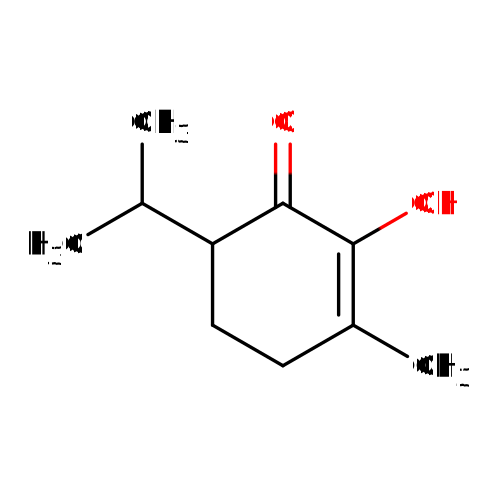
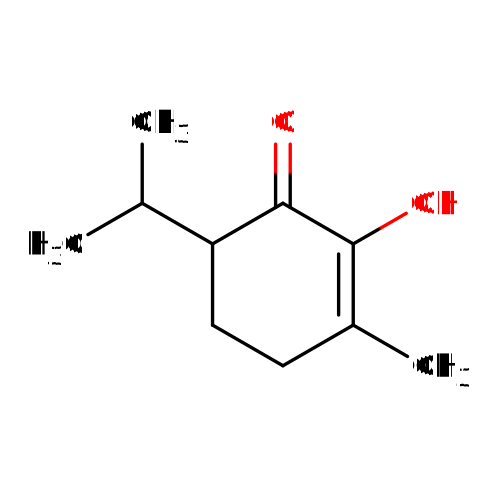
| Common Name | (+/-)-2-Hydroxypiperitone |
|---|
| Description | (+/-)-2-Hydroxypiperitone, also known as barosma camphor or buccocamphor, belongs to the class of organic compounds known as menthane monoterpenoids. These are monoterpenoids with a structure based on the o-, m-, or p-menthane backbone. P-menthane consists of the cyclohexane ring with a methyl group and a (2-methyl)-propyl group at the 1 and 4 ring position, respectively. The o- and m- menthanes are much rarer, and presumably arise by alkyl migration of p-menthanes. (+/-)-2-Hydroxypiperitone is found in Agathosma betulina, Arctium lappa, Artemisia judaica, Barosma betulina, Barosma crenulata, Barosma serratifolia, Cymbopogon densiflorus , Mentha rotundifolia and Spirostachys africana. Thus, (+/-)-2-hydroxypiperitone is considered to be an isoprenoid lipid molecule (+/-)-2-Hydroxypiperitone is a very hydrophobic molecule, practically insoluble (in water), and relatively neutral. |
|---|
| Structure | InChI=1S/C10H16O2/c1-6(2)8-5-4-7(3)9(11)10(8)12/h6,8,11H,4-5H2,1-3H3 |
|---|
| Synonyms | | Value | Source |
|---|
| 2-Hydroxy-6-isopropyl-3-methyl-2-cyclohexen-1-one | ChEBI | | 2-Hydroxypiperitone | ChEBI | | Barosma camphor | ChEBI | | Buccocamphor | ChEBI | | Buchu camphor | ChEBI |
|
|---|
| Chemical Formula | C10H16O2 |
|---|
| Average Mass | 168.2328 Da |
|---|
| Monoisotopic Mass | 168.11503 Da |
|---|
| IUPAC Name | 2-hydroxy-3-methyl-6-(propan-2-yl)cyclohex-2-en-1-one |
|---|
| Traditional Name | diosphenol |
|---|
| CAS Registry Number | 490-03-9 |
|---|
| SMILES | CC(C)C1CCC(C)=C(O)C1=O |
|---|
| InChI Identifier | InChI=1S/C10H16O2/c1-6(2)8-5-4-7(3)9(11)10(8)12/h6,8,11H,4-5H2,1-3H3 |
|---|
| InChI Key | QSIMLPCPCXVYDD-UHFFFAOYSA-N |
|---|
| Experimental Spectra |
|---|
|
| | Spectrum Type | Description | Depositor Email | Depositor Organization | Depositor | Deposition Date | View |
|---|
| 1D NMR | 1H NMR Spectrum (1D, 400 MHz, CDCl3, experimental) | Wishart Lab | Wishart Lab | David Wishart | 2021-06-20 | View Spectrum | | 1D NMR | 13C NMR Spectrum (1D, 100.40 MHz, CDCl3, experimental) | Wishart Lab | Wishart Lab | David Wishart | 2021-06-20 | View Spectrum |
| | Predicted Spectra |
|---|
|
| Not Available | | Chemical Shift Submissions |
|---|
|
| Not Available | | Species |
|---|
| Species of Origin | |
|---|
| Chemical Taxonomy |
|---|
| Description | Belongs to the class of organic compounds known as menthane monoterpenoids. These are monoterpenoids with a structure based on the o-, m-, or p-menthane backbone. P-menthane consists of the cyclohexane ring with a methyl group and a (2-methyl)-propyl group at the 1 and 4 ring position, respectively. The o- and m- menthanes are much rarer, and presumably arise by alkyl migration of p-menthanes. |
|---|
| Kingdom | Organic compounds |
|---|
| Super Class | Lipids and lipid-like molecules |
|---|
| Class | Prenol lipids |
|---|
| Sub Class | Monoterpenoids |
|---|
| Direct Parent | Menthane monoterpenoids |
|---|
| Alternative Parents | |
|---|
| Substituents | - P-menthane monoterpenoid
- Monocyclic monoterpenoid
- Cyclohexenone
- Cyclic ketone
- Ketone
- Enol
- Organic oxygen compound
- Organic oxide
- Hydrocarbon derivative
- Organooxygen compound
- Carbonyl group
- Aliphatic homomonocyclic compound
|
|---|
| Molecular Framework | Aliphatic homomonocyclic compounds |
|---|
| External Descriptors | |
|---|
| Physical Properties |
|---|
| State | Not Available |
|---|
| Experimental Properties | | Property | Value | Reference |
|---|
| Melting Point | Not Available | Not Available | | Boiling Point | Not Available | Not Available | | Water Solubility | Not Available | Not Available | | LogP | Not Available | Not Available |
|
|---|
| Predicted Properties | |
|---|