Np mrd loader

Record Information
Version2.0
Created at2022-03-17 20:39:15 UTC
Updated at2022-03-17 20:39:15 UTC
NP-MRD IDNP0047381
Secondary Accession NumbersNone
Natural Product Identification
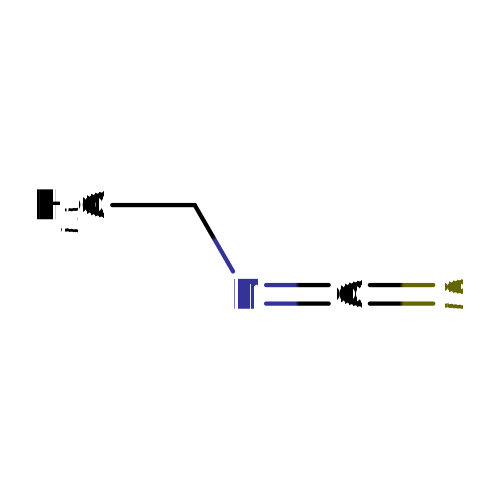
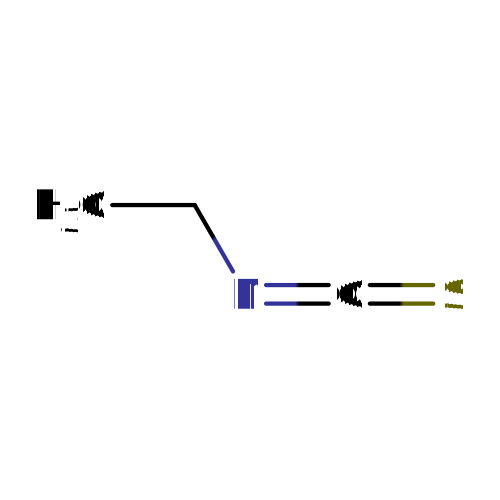
Common NameEthyl isothiocyanate
Description Ethyl isothiocyanate was first documented in 2013 (PMID: 24039128).
Structure
Thumb
Synonyms
ValueSource
EITCChEBI
Isothiocyanic acid, ethyl esterChEBI
Isothiocyanate, ethyl esterGenerator
Ethyl isothiocyanic acidGenerator
EthylisothiocyanateMeSH
Chemical FormulaC3H5NS
Average Mass87.1430 Da
Monoisotopic Mass87.01427 Da
IUPAC Nameisothiocyanatoethane
Traditional Nameisothiocyanatoethane
CAS Registry Number542-85-8
SMILES
CCN=C=S
InChI Identifier
InChI=1S/C3H5NS/c1-2-4-3-5/h2H2,1H3
InChI KeyHBNYJWAFDZLWRS-UHFFFAOYSA-N
Experimental Spectra
Not Available
Predicted Spectra
Not Available
Chemical Shift Submissions
Not Available
Species
Species of Origin
Species NameSourceReference
Armoracia rusticanaFooDB
Chemical Taxonomy
Description Belongs to the class of organic compounds known as isothiocyanates. These are organic compounds containing the isothiocyanate group, an isocyanate analogue with the general formula RN=C=S.
KingdomOrganic compounds
Super ClassOrganosulfur compounds
ClassIsothiocyanates
Sub ClassNot Available
Direct ParentIsothiocyanates
Alternative Parents
Substituents
  • Isothiocyanate
  • Organic 1,3-dipolar compound
  • Propargyl-type 1,3-dipolar organic compound
  • Organic nitrogen compound
  • Organopnictogen compound
  • Hydrocarbon derivative
  • Organonitrogen compound
  • Aliphatic acyclic compound
Molecular FrameworkAliphatic acyclic compounds
External Descriptors
Physical Properties
StateNot Available
Experimental Properties
PropertyValueReference
Melting PointNot AvailableNot Available
Boiling PointNot AvailableNot Available
Water SolubilityNot AvailableNot Available
LogPNot AvailableNot Available
Predicted Properties
PropertyValueSource
logP1.78ALOGPS
logP1.43ChemAxon
logS-1.8ALOGPS
pKa (Strongest Basic)-3.1ChemAxon
Physiological Charge0ChemAxon
Hydrogen Acceptor Count1ChemAxon
Hydrogen Donor Count0ChemAxon
Polar Surface Area12.36 ŲChemAxon
Rotatable Bond Count1ChemAxon
Refractivity26.08 m³·mol⁻¹ChemAxon
Polarizability9.28 ųChemAxon
Number of Rings0ChemAxon
BioavailabilityYesChemAxon
Rule of FiveYesChemAxon
Ghose FilterNoChemAxon
Veber's RuleYesChemAxon
MDDR-like RuleNoChemAxon
HMDB IDNot Available
DrugBank IDNot Available
Phenol Explorer Compound IDNot Available
FoodDB IDFDB009395
KNApSAcK IDNot Available
Chemspider IDNot Available
KEGG Compound IDNot Available
BioCyc IDNot Available
BiGG IDNot Available
Wikipedia LinkNot Available
METLIN IDNot Available
PubChem Compound10966
PDB IDNot Available
ChEBI ID85098
Good Scents IDNot Available
References
General References
  1. Ramzy AG, Hagvall L, Pei MN, Samuelsson K, Nilsson U: Investigation of diethylthiourea and ethyl isothiocyanate as potent skin allergens in chloroprene rubber. Contact Dermatitis. 2015 Mar;72(3):139-46. doi: 10.1111/cod.12318. Epub 2014 Dec 23. [PubMed:25532938 ]
  2. Ramzy AG, Lammintausta K, Matura M, Brared Christensson J, Nilsson U, Hagvall L: Isothiocyanates are important as haptens in contact allergy to chloroprene rubber. Br J Dermatol. 2017 Aug;177(2):522-530. doi: 10.1111/bjd.15444. Epub 2017 Jun 29. [PubMed:28295200 ]
  3. Gum SI, Cho MK: Differential hepatic GSTA2 expression of arylalkyl isothiocyanates in vivo and in vitro: the molecular mechanism of gene induction by phenethyl isothiocyanate. Mol Nutr Food Res. 2013 Dec;57(12):2223-32. doi: 10.1002/mnfr.201300259. Epub 2013 Sep 3. [PubMed:24039128 ]