| Record Information |
|---|
| Version | 2.0 |
|---|
| Created at | 2022-03-17 20:38:55 UTC |
|---|
| Updated at | 2024-09-03 04:16:38 UTC |
|---|
| NP-MRD ID | NP0047361 |
|---|
| Natural Product DOI | https://doi.org/10.57994/0743 |
|---|
| Secondary Accession Numbers | None |
|---|
| Natural Product Identification |
|---|
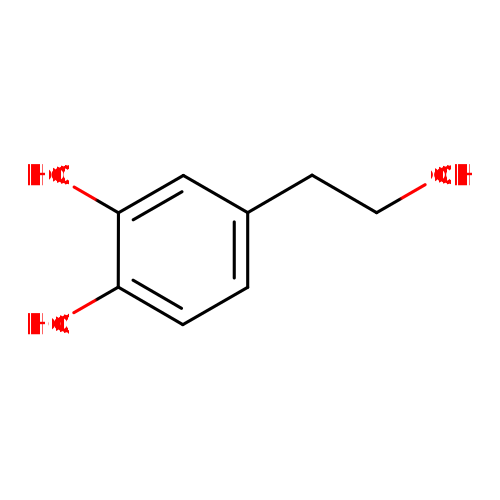
| Common Name | Hydroxytyrosol |
|---|
| Description | Hydroxytyrosol, also known as dopet, belongs to the class of organic compounds known as tyrosols. These are organic aromatic compounds containing a phenethyl alcohol moiety that carries a hydroxyl group at the 4-position of the benzene group. However, it was found that black olives, such as common canned variety, containing iron(II) gluconate contained little hydroxytyrosol, as iron salts are catalysts for its oxidation. Hydroxytyrosol is an extremely weak basic (essentially neutral) compound (based on its pKa). Outside of the human body, Hydroxytyrosol is found, on average, in the highest concentration within olives and grape wines. Hydroxytyrosol has also been detected, but not quantified in, several different foods, such as cloves, fruits, olive oils, and rapes. This could make hydroxytyrosol a potential biomarker for the consumption of these foods. Hydroxytyrosol is mentioned by the scientific committee of the European Food Safety Authority as one of several olive oil polyphenols under preliminary research for the potential to affect blood lipid levels, although there is no evidence from high-quality clinical research to indicate that this effect exists. The olives, leaves and olive pulp contain large amounts of hydroxytyrosol (compared to olive oil), most of which can be recovered to produce hydroxytyrosol extracts. As of 2015, the NOAEL for hydroxytyrosol in rats is 250 mg/kg/day, with a LOAEL of 500 mg/kg/day. Hydroxytyrosol is a phenylethanoid, a type of phenolic phytochemical with antioxidant properties in vitro. Hydroxytyrosol is found in Cinnamomum subavenium, Clematis terniflora, Fraxinus americana, Jasminum grandiflorum, Ligustrum japonicum, Ligustrum vulgare, Peperomia duclouxii C. DC., Peperomia heyneana, Sargentodoxa cuneata, Sparganium stoloniferum, Syringa reticulata, Syringa amurensis, Syringa vulgaris and Vitis vinifera. Hydroxytyrosol was first documented in 2004 (PMID: 15476671). Hydroxytyrosol itself in pure form is a colorless, odorless liquid (PMID: 15749387) (PMID: 22948011) (PMID: 22014120) (PMID: 22924436) (PMID: 23017390) (PMID: 23244583). |
|---|
| Structure | InChI=1S/C8H10O3/c9-4-3-6-1-2-7(10)8(11)5-6/h1-2,5,9-11H,3-4H2 |
|---|
| Synonyms | | Value | Source |
|---|
| 3,4-Dihydroxyphenylethanol | ChEBI | | Dopet | ChEBI | | 2-(3,4-Dihydroxyphenyl)ethanol | HMDB | | 3-Hydroxytyrosol | HMDB | | 4-(2-Hydroxyethyl)-1,2-benzenediol | HMDB | | beta-3,4-Dihydroxyphenylethyl alcohol | HMDB | | 2-(3'-hydroxyphenyl)ethanol | | | 2-(3-hydroxyphenyl)ethanol | |
|
|---|
| Chemical Formula | C8H10O3 |
|---|
| Average Mass | 154.1632 Da |
|---|
| Monoisotopic Mass | 154.06299 Da |
|---|
| IUPAC Name | 4-(2-hydroxyethyl)benzene-1,2-diol |
|---|
| Traditional Name | hydroxytyrosol |
|---|
| CAS Registry Number | 10597-60-1 |
|---|
| SMILES | OCCC1=CC=C(O)C(O)=C1 |
|---|
| InChI Identifier | InChI=1S/C8H10O3/c9-4-3-6-1-2-7(10)8(11)5-6/h1-2,5,9-11H,3-4H2 |
|---|
| InChI Key | JUUBCHWRXWPFFH-UHFFFAOYSA-N |
|---|
| Experimental Spectra |
|---|
|
| | Spectrum Type | Description | Depositor Email | Depositor Organization | Depositor | Deposition Date | View |
|---|
| HMBC NMR | [1H, 13C] NMR Spectrum (2D, 600 MHz, CD3OD, experimental) | yupingfu424@163.com | Not Available | Not Available | 2023-07-17 | View Spectrum | | HSQC NMR | [1H, 13C] NMR Spectrum (2D, 600 MHz, CD3OD, experimental) | yupingfu424@163.com | Not Available | Not Available | 2023-07-17 | View Spectrum | | COSY NMR | [1H, 1H] NMR Spectrum (2D, 600 MHz, CD3OD, experimental) | yupingfu424@163.com | Not Available | Not Available | 2023-07-17 | View Spectrum | | 1D NMR | 1H NMR Spectrum (1D, 600 MHz, CD3OD, experimental) | yupingfu424@163.com | Not Available | Not Available | 2023-07-17 | View Spectrum | | HMBC NMR | [1H, 13C] NMR Spectrum (2D, 600 MHz, CD3OD, experimental) | yupingfu424@163.com | Not Available | Not Available | 2023-07-17 | View Spectrum | | 1D NMR | 1H NMR Spectrum (1D, 600 MHz, CD3OD, experimental) | yupingfu424@163.com | Not Available | Not Available | 2023-07-17 | View Spectrum | | HSQC NMR | [1H, 13C] NMR Spectrum (2D, 600 MHz, CD3OD, experimental) | yupingfu424@163.com | Not Available | Not Available | 2023-07-17 | View Spectrum | | COSY NMR | [1H, 1H] NMR Spectrum (2D, 600 MHz, CD3OD, experimental) | yupingfu424@163.com | Not Available | Not Available | 2023-07-17 | View Spectrum | | 1D NMR | 1H NMR Spectrum (1D, 600 MHz, CD3OD, experimental) | yupingfu424@163.com | Not Available | Not Available | 2023-07-17 | View Spectrum | | 1D NMR | 13C NMR Spectrum (1D, 151 MHz, CD3OD, experimental) | yupingfu424@163.com | Not Available | Not Available | 2023-07-17 | View Spectrum |
| | Predicted Spectra |
|---|
|
| | Spectrum Type | Description | Depositor ID | Depositor Organization | Depositor | Deposition Date | View |
|---|
| | Chemical Shift Submissions |
|---|
|
| Not Available | | Species |
|---|
| Species of Origin | |
|---|
| Chemical Taxonomy |
|---|
| Description | Belongs to the class of organic compounds known as tyrosols. These are organic aromatic compounds containing a phenethyl alcohol moiety that carries a hydroxyl group at the 4-position of the benzene group. |
|---|
| Kingdom | Organic compounds |
|---|
| Super Class | Benzenoids |
|---|
| Class | Phenols |
|---|
| Sub Class | Tyrosols and derivatives |
|---|
| Direct Parent | Tyrosols |
|---|
| Alternative Parents | |
|---|
| Substituents | - Tyrosol
- Catechol
- 1-hydroxy-4-unsubstituted benzenoid
- 1-hydroxy-2-unsubstituted benzenoid
- Monocyclic benzene moiety
- Organic oxygen compound
- Hydrocarbon derivative
- Primary alcohol
- Organooxygen compound
- Alcohol
- Aromatic homomonocyclic compound
|
|---|
| Molecular Framework | Aromatic homomonocyclic compounds |
|---|
| External Descriptors | |
|---|
| Physical Properties |
|---|
| State | Not Available |
|---|
| Experimental Properties | | Property | Value | Reference |
|---|
| Melting Point | Not Available | Not Available | | Boiling Point | Not Available | Not Available | | Water Solubility | Not Available | Not Available | | LogP | Not Available | Not Available |
|
|---|
| Predicted Properties | |
|---|
| General References | - O'Dowd Y, Driss F, Dang PM, Elbim C, Gougerot-Pocidalo MA, Pasquier C, El-Benna J: Antioxidant effect of hydroxytyrosol, a polyphenol from olive oil: scavenging of hydrogen peroxide but not superoxide anion produced by human neutrophils. Biochem Pharmacol. 2004 Nov 15;68(10):2003-8. doi: 10.1016/j.bcp.2004.06.023. [PubMed:15476671 ]
- D'Angelo S, Ingrosso D, Migliardi V, Sorrentino A, Donnarumma G, Baroni A, Masella L, Tufano MA, Zappia M, Galletti P: Hydroxytyrosol, a natural antioxidant from olive oil, prevents protein damage induced by long-wave ultraviolet radiation in melanoma cells. Free Radic Biol Med. 2005 Apr 1;38(7):908-19. doi: 10.1016/j.freeradbiomed.2004.12.015. [PubMed:15749387 ]
- Satoh Y, Tajima K, Munekata M, Keasling JD, Lee TS: Engineering of L-tyrosine oxidation in Escherichia coli and microbial production of hydroxytyrosol. Metab Eng. 2012 Nov;14(6):603-10. doi: 10.1016/j.ymben.2012.08.002. Epub 2012 Aug 29. [PubMed:22948011 ]
- Procopio A, Celia C, Nardi M, Oliverio M, Paolino D, Sindona G: Lipophilic hydroxytyrosol esters: fatty acid conjugates for potential topical administration. J Nat Prod. 2011 Nov 28;74(11):2377-81. doi: 10.1021/np200405s. Epub 2011 Oct 20. [PubMed:22014120 ]
- Romero C, Brenes M: Analysis of total contents of hydroxytyrosol and tyrosol in olive oils. J Agric Food Chem. 2012 Sep 12;60(36):9017-22. doi: 10.1021/jf3026666. Epub 2012 Aug 31. [PubMed:22924436 ]
- Dagdelen A, Tumen G, Ozcan MM, Dundar E: Phenolics profiles of olive fruits (Olea europaea L.) and oils from Ayvalik, Domat and Gemlik varieties at different ripening stages. Food Chem. 2013 Jan 1;136(1):41-5. doi: 10.1016/j.foodchem.2012.07.046. Epub 2012 Jul 28. [PubMed:23017390 ]
- Bernini R, Merendino N, Romani A, Velotti F: Naturally occurring hydroxytyrosol: synthesis and anticancer potential. Curr Med Chem. 2013;20(5):655-70. doi: 10.2174/092986713804999367. [PubMed:23244583 ]
- DOI: 10.1002/cbdv.202300161
|
|---|