| Record Information |
|---|
| Version | 2.0 |
|---|
| Created at | 2022-03-17 20:37:59 UTC |
|---|
| Updated at | 2022-03-17 20:37:59 UTC |
|---|
| NP-MRD ID | NP0047306 |
|---|
| Secondary Accession Numbers | None |
|---|
| Natural Product Identification |
|---|
| Common Name | Daucic acid |
|---|
| Description | Daucic acid, also known as daucate, belongs to the class of organic compounds known as beta hydroxy acids and derivatives. Beta hydroxy acids and derivatives are compounds containing a carboxylic acid substituted with a hydroxyl group on the C3 carbon atom. Daucic acid is an extremely weak basic (essentially neutral) compound (based on its pKa). Outside of the human body, Daucic acid has been detected, but not quantified in, several different foods, such as carrots, sunflowers, wild carrots, root vegetables, and cereals and cereal products. Daucic acid was first documented in 2003 (PMID: 14673913). This could make daucic acid a potential biomarker for the consumption of these foods. |
|---|
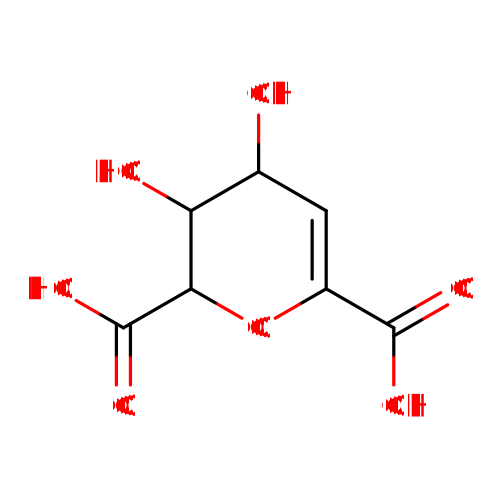
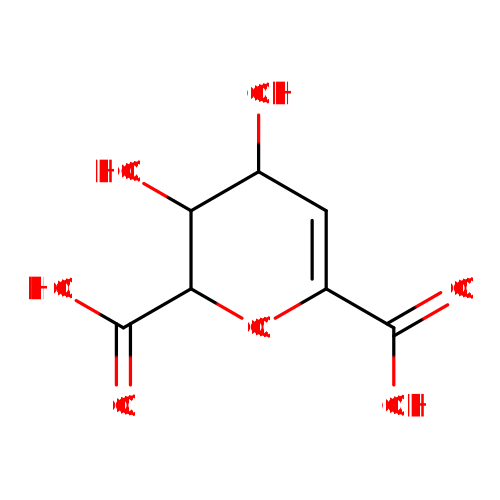
| Structure | OC1C=C(OC(C1O)C(O)=O)C(O)=O InChI=1S/C7H8O7/c8-2-1-3(6(10)11)14-5(4(2)9)7(12)13/h1-2,4-5,8-9H,(H,10,11)(H,12,13) |
|---|
| Synonyms | | Value | Source |
|---|
| Daucate | Generator | | (-)-Daucic acid | HMDB | | 2,6-Anhydro-3-deoxy-D-lyxo-hept-2-enaric acid | HMDB | | 2,6-Anhydro-3-deoxy-D-xylo-hept-2-enaric acid, 9ci | HMDB | | 3,4-Dihydroxy-3,4-dihydro-2H-pyran-2,6-dicarboxylate | Generator | | Daucic acid | MeSH |
|
|---|
| Chemical Formula | C7H8O7 |
|---|
| Average Mass | 204.1342 Da |
|---|
| Monoisotopic Mass | 204.02700 Da |
|---|
| IUPAC Name | 3,4-dihydroxy-3,4-dihydro-2H-pyran-2,6-dicarboxylic acid |
|---|
| Traditional Name | 3,4-dihydroxy-3,4-dihydro-2H-pyran-2,6-dicarboxylic acid |
|---|
| CAS Registry Number | 34098-52-7 |
|---|
| SMILES | OC1C=C(OC(C1O)C(O)=O)C(O)=O |
|---|
| InChI Identifier | InChI=1S/C7H8O7/c8-2-1-3(6(10)11)14-5(4(2)9)7(12)13/h1-2,4-5,8-9H,(H,10,11)(H,12,13) |
|---|
| InChI Key | KUKCUROTFRBUNU-UHFFFAOYSA-N |
|---|
| Experimental Spectra |
|---|
|
| Not Available | | Predicted Spectra |
|---|
|
| Not Available | | Chemical Shift Submissions |
|---|
|
| Not Available | | Species |
|---|
| Species of Origin | |
|---|
| Chemical Taxonomy |
|---|
| Description | Belongs to the class of organic compounds known as beta hydroxy acids and derivatives. Beta hydroxy acids and derivatives are compounds containing a carboxylic acid substituted with a hydroxyl group on the C3 carbon atom. |
|---|
| Kingdom | Organic compounds |
|---|
| Super Class | Organic acids and derivatives |
|---|
| Class | Hydroxy acids and derivatives |
|---|
| Sub Class | Beta hydroxy acids and derivatives |
|---|
| Direct Parent | Beta hydroxy acids and derivatives |
|---|
| Alternative Parents | |
|---|
| Substituents | - Beta-hydroxy acid
- Pyran
- Dicarboxylic acid or derivatives
- 1,2-diol
- Secondary alcohol
- Carboxylic acid derivative
- Oxacycle
- Organoheterocyclic compound
- Carboxylic acid
- Organic oxygen compound
- Organooxygen compound
- Hydrocarbon derivative
- Carbonyl group
- Organic oxide
- Alcohol
- Aliphatic heteromonocyclic compound
|
|---|
| Molecular Framework | Aliphatic heteromonocyclic compounds |
|---|
| External Descriptors | Not Available |
|---|
| Physical Properties |
|---|
| State | Not Available |
|---|
| Experimental Properties | | Property | Value | Reference |
|---|
| Melting Point | Not Available | Not Available | | Boiling Point | Not Available | Not Available | | Water Solubility | Not Available | Not Available | | LogP | Not Available | Not Available |
|
|---|
| Predicted Properties | |
|---|