| Record Information |
|---|
| Version | 2.0 |
|---|
| Created at | 2022-03-17 20:37:21 UTC |
|---|
| Updated at | 2022-03-17 20:37:21 UTC |
|---|
| NP-MRD ID | NP0047267 |
|---|
| Secondary Accession Numbers | None |
|---|
| Natural Product Identification |
|---|
| Common Name | 4,4'-Diaminodibutylamine |
|---|
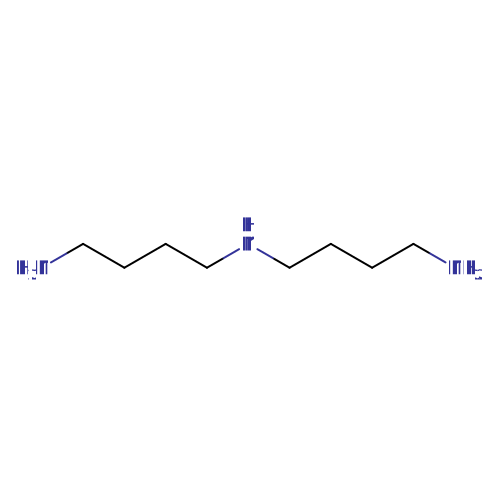
| Description | 4,4'-Diaminodibutylamine, also known as homospermidine or 1,6,11-triazaundecane, belongs to the class of organic compounds known as dialkylamines. These are organic compounds containing a dialkylamine group, characterized by two alkyl groups bonded to the amino nitrogen. 4,4'-Diaminodibutylamine is a very strong basic compound (based on its pKa). 4,4'-Diaminodibutylamine exists in all living organisms, ranging from bacteria to humans. Outside of the human body, 4,4'-Diaminodibutylamine has been detected, but not quantified in, cereals and cereal products and soy beans. This could make 4,4'-diaminodibutylamine a potential biomarker for the consumption of these foods. 4,4'-Diaminodibutylamine is found in Brasenia schreberi, Canavalia gladiata, Eupatorium cannabinum, Heliotropium angiospermum, Lyallia kerguelensis, Nicotiana alata, Periplaneta americana, Pisum sativum, Santalum album , Senecio vulgaris and Utricularia intermedia. A polyazaalkane comprising undecane with three aza groups placed at the 1-, 6- and 11-positions. |
|---|
| Structure | InChI=1S/C8H21N3/c9-5-1-3-7-11-8-4-2-6-10/h11H,1-10H2 |
|---|
| Synonyms | | Value | Source |
|---|
| 1,6,11-Triazaundecane | ChEBI | | Bis(4-aminobutyl)amine | ChEBI | | Homospermidine | ChEBI | | N-(4-Aminobutyl)-1,4-butanediamine | ChEBI | | 1,9-Diamino-5-azanonane | HMDB | | N-(4-Aminobutyl)-1,4-butanediamine, 9ci | HMDB | | N-(4-Aminobutyl)butane-1,4-diamine | HMDB | | Sym-homospermidine | HMDB |
|
|---|
| Chemical Formula | C8H21N3 |
|---|
| Average Mass | 159.2724 Da |
|---|
| Monoisotopic Mass | 159.17355 Da |
|---|
| IUPAC Name | bis(4-aminobutyl)amine |
|---|
| Traditional Name | homospermidine |
|---|
| CAS Registry Number | 4427-76-3 |
|---|
| SMILES | NCCCCNCCCCN |
|---|
| InChI Identifier | InChI=1S/C8H21N3/c9-5-1-3-7-11-8-4-2-6-10/h11H,1-10H2 |
|---|
| InChI Key | UODZHRGDSPLRMD-UHFFFAOYSA-N |
|---|
| Experimental Spectra |
|---|
|
| Not Available | | Predicted Spectra |
|---|
|
| Not Available | | Chemical Shift Submissions |
|---|
|
| Not Available | | Species |
|---|
| Species of Origin | |
|---|
| Chemical Taxonomy |
|---|
| Description | Belongs to the class of organic compounds known as dialkylamines. These are organic compounds containing a dialkylamine group, characterized by two alkyl groups bonded to the amino nitrogen. |
|---|
| Kingdom | Organic compounds |
|---|
| Super Class | Organic nitrogen compounds |
|---|
| Class | Organonitrogen compounds |
|---|
| Sub Class | Amines |
|---|
| Direct Parent | Dialkylamines |
|---|
| Alternative Parents | |
|---|
| Substituents | - Secondary aliphatic amine
- Organopnictogen compound
- Hydrocarbon derivative
- Primary amine
- Primary aliphatic amine
- Aliphatic acyclic compound
|
|---|
| Molecular Framework | Aliphatic acyclic compounds |
|---|
| External Descriptors | |
|---|
| Physical Properties |
|---|
| State | Not Available |
|---|
| Experimental Properties | | Property | Value | Reference |
|---|
| Melting Point | Not Available | Not Available | | Boiling Point | Not Available | Not Available | | Water Solubility | Not Available | Not Available | | LogP | Not Available | Not Available |
|
|---|
| Predicted Properties | |
|---|