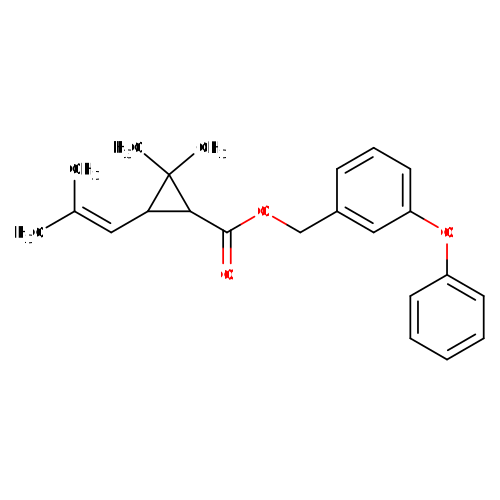
| Record Information |
|---|
| Version | 2.0 |
|---|
| Created at | 2022-03-17 20:34:53 UTC |
|---|
| Updated at | 2022-03-17 20:34:53 UTC |
|---|
| NP-MRD ID | NP0047115 |
|---|
| Secondary Accession Numbers | None |
|---|
| Natural Product Identification |
|---|
| Common Name | Fenugrin A |
|---|
| Description | Phenothrin, also known as sumithrin or hegor antipoux, belongs to the class of organic compounds known as pyrethroids. These are organic compounds similar to the pyrethrins. Some pyrethroids containing a chrysanthemic acid esterified with a cyclopentenone (pyrethrins), or with a phenoxybenzyl group. Phenothrin is an extremely weak basic (essentially neutral) compound (based on its pKa). Phenothrin is a potentially toxic compound. |
|---|
| Structure | CC(C)=CC1C(C(=O)OCC2=CC(OC3=CC=CC=C3)=CC=C2)C1(C)C InChI=1S/C23H26O3/c1-16(2)13-20-21(23(20,3)4)22(24)25-15-17-9-8-12-19(14-17)26-18-10-6-5-7-11-18/h5-14,20-21H,15H2,1-4H3 |
|---|
| Synonyms | | Value | Source |
|---|
| 2,2-Dimethyl-3-(2-methyl-1-propenyl)cyclopropanecarboxylic acid (3-phenoxyphenyl)methyl ester | ChEBI | | Sumithrin | ChEBI | | Hegor antipoux | Kegg | | 2,2-Dimethyl-3-(2-methyl-1-propenyl)cyclopropanecarboxylate (3-phenoxyphenyl)methyl ester | Generator | | (3-Phenoxyphenyl)methyl cis,trans-(+)-2,2-dimethyl-3-(2-methylpropenyl)cyclopropanecarboxylate | MeSH | | Phenothrin, (cis-(+-))-isomer | MeSH | | Phenothrin, (1S-cis)-isomer | MeSH | | D-Phenothrin | MeSH | | Phenothrin, (1S-trans)-isomer | MeSH | | Phenothrin, (1R-trans)-isomer | MeSH | | Phenothrin, (1R-cis)-isomer | MeSH | | Phenothrin, (trans-(+-))-isomer | MeSH |
|
|---|
| Chemical Formula | C23H26O3 |
|---|
| Average Mass | 350.4507 Da |
|---|
| Monoisotopic Mass | 350.18819 Da |
|---|
| IUPAC Name | (3-phenoxyphenyl)methyl 2,2-dimethyl-3-(2-methylprop-1-en-1-yl)cyclopropane-1-carboxylate |
|---|
| Traditional Name | phenothrin |
|---|
| CAS Registry Number | 26002-80-2 |
|---|
| SMILES | CC(C)=CC1C(C(=O)OCC2=CC(OC3=CC=CC=C3)=CC=C2)C1(C)C |
|---|
| InChI Identifier | InChI=1S/C23H26O3/c1-16(2)13-20-21(23(20,3)4)22(24)25-15-17-9-8-12-19(14-17)26-18-10-6-5-7-11-18/h5-14,20-21H,15H2,1-4H3 |
|---|
| InChI Key | SBNFWQZLDJGRLK-UHFFFAOYSA-N |
|---|
| Experimental Spectra |
|---|
|
| Not Available | | Predicted Spectra |
|---|
|
| Not Available | | Chemical Shift Submissions |
|---|
|
| Not Available | | Species |
|---|
| Species of Origin | |
|---|
| Chemical Taxonomy |
|---|
| Description | Belongs to the class of organic compounds known as pyrethroids. These are organic compounds similar to the pyrethrins. Some pyrethroids containing a chrysanthemic acid esterified with a cyclopentenone (pyrethrins), or with a phenoxybenzyl group. |
|---|
| Kingdom | Organic compounds |
|---|
| Super Class | Lipids and lipid-like molecules |
|---|
| Class | Fatty Acyls |
|---|
| Sub Class | Fatty acid esters |
|---|
| Direct Parent | Pyrethroids |
|---|
| Alternative Parents | |
|---|
| Substituents | - Pyrethroid skeleton
- Diphenylether
- Diaryl ether
- Aromatic monoterpenoid
- Benzyloxycarbonyl
- Monocyclic monoterpenoid
- Monoterpenoid
- Phenoxy compound
- Phenol ether
- Monocyclic benzene moiety
- Cyclopropanecarboxylic acid or derivatives
- Benzenoid
- Carboxylic acid ester
- Ether
- Carboxylic acid derivative
- Monocarboxylic acid or derivatives
- Hydrocarbon derivative
- Organic oxygen compound
- Carbonyl group
- Organic oxide
- Organooxygen compound
- Aromatic homomonocyclic compound
|
|---|
| Molecular Framework | Aromatic homomonocyclic compounds |
|---|
| External Descriptors | |
|---|
| Physical Properties |
|---|
| State | Not Available |
|---|
| Experimental Properties | | Property | Value | Reference |
|---|
| Melting Point | Not Available | Not Available | | Boiling Point | Not Available | Not Available | | Water Solubility | Not Available | Not Available | | LogP | Not Available | Not Available |
|
|---|
| Predicted Properties | |
|---|