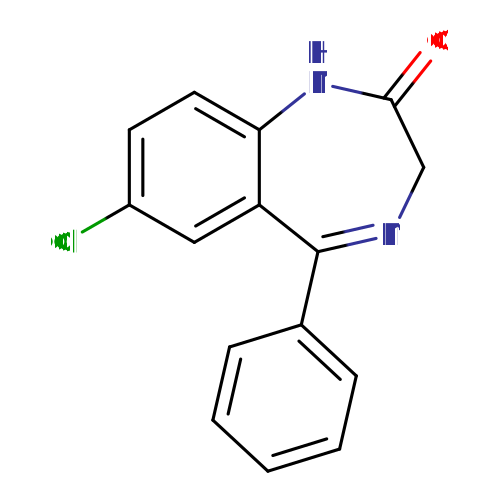
| Record Information |
|---|
| Version | 2.0 |
|---|
| Created at | 2022-03-17 20:33:56 UTC |
|---|
| Updated at | 2022-03-17 20:33:56 UTC |
|---|
| NP-MRD ID | NP0047059 |
|---|
| Secondary Accession Numbers | None |
|---|
| Natural Product Identification |
|---|
| Common Name | N-Demethyldiazepam |
|---|
| Description | Nordiazepam, also known as desmethyldiazepam or dealkylprazepam, belongs to the class of organic compounds known as 1,4-benzodiazepines. These are organic compounds containing a benzene ring fused to a 1,4-azepine. It is contraindicated in patients who are on long-term benzodiazepines, those who have ingested a substance that lowers the seizure threshold, or in patients who have tachycardia or a history of seizures. Nordiazepam is a moderately basic compound (based on its pKa). Outside of the human body, Nordiazepam has been detected, but not quantified in, a few different foods, such as common wheats, corns, and potato. This could make nordiazepam a potential biomarker for the consumption of these foods. Binding of the inhibitory neurotransmitter GABA to the site opens the chloride channel, resulting in a hyperpolarized cell membrane that prevents further excitation of the cell. Nordiazepam is a potentially toxic compound. As benzodiazepine receptors are thought to be coupled to gamma-aminobutyric acid-A (GABAA) receptors, this enhances the effects of GABA by increasing GABA affinity for the GABA receptor. Benzodiazepines bind nonspecifically to benzodiazepine receptors BNZ1, which mediates sleep, and BNZ2, which affects affects muscle relaxation, anticonvulsant activity, motor coordination, and memory. As a general rule, medical observation and supportive care are the mainstay of treatment of benzodiazepine overdose. It is recommended only if benzodiazepines have been taken in combination with other drugs that may benefit from decontamination. In particular, flumazenil is very effective at reversing the CNS depression associated with benzodiazepines but is less effective at reversing respiratory depression. Dialysis is of limited value. Flumazenil (Anexate) is a competitive benzodiazepine receptor antagonist that can be used as an antidote for benzodiazepine overdose. N-Demethyldiazepam is found in Apis cerana, Glycine max, Homo sapiens and Lens culinaris. N-Demethyldiazepam was first documented in 1977 (PMID: 16622). General supportive measures should be employed, along with intravenous fluids, and an adequate airway maintained (PMID: 19604) (PMID: 360230) (PMID: 367407). |
|---|
| Structure | ClC1=CC=C2NC(=O)CN=C(C3=CC=CC=C3)C2=C1 InChI=1S/C15H11ClN2O/c16-11-6-7-13-12(8-11)15(17-9-14(19)18-13)10-4-2-1-3-5-10/h1-8H,9H2,(H,18,19) |
|---|
| Synonyms | | Value | Source |
|---|
| 1-Demethyldiazepam | ChEBI | | 7-Chloro-1,3-dihydro-5-phenyl-(2H)-1,4-benzodiazepin-2-one | ChEBI | | 7-Chloro-1,3-dihydro-5-phenyl-2H-1,4-benzodiazepin-2-one | ChEBI | | 7-Chloro-5-phenyl-1,3-dihydro-2H-1,4-benzodiazepin-2-one | ChEBI | | Chlordesmethyldiazepam | ChEBI | | Dealkylprazepam | ChEBI | | Desmethyldiazepam | ChEBI | | N-Demethyldiazepam | ChEBI | | N-Deoxydemoxepam | ChEBI | | N-Desmethyldiazepam | ChEBI | | N1-Desmethyldiazepam | ChEBI | | Nordazepamum | ChEBI | | Norprazepam | ChEBI | | Calmday | Kegg | | Nordiazepam | ChEBI | | N-Descyclopropylmethylprazepam | MeSH | | Tranxilium N | MeSH | | Vegesan | MeSH | | N Descyclopropylmethyl prazepam | MeSH | | N Desalkylhalazepam | MeSH | | N Destrifluoroethylhalazepam | MeSH | | N Descyclopropylmethylprazepam | MeSH | | Nordaz | MeSH | | Nordazepam | MeSH | | Demethyldiazepam | MeSH | | N-Descyclopropylmethyl-prazepam | MeSH | | N-Destrifluoroethylhalazepam | MeSH | | Deoxydemoxepam | MeSH | | N-Desalkylhalazepam | MeSH |
|
|---|
| Chemical Formula | C15H11ClN2O |
|---|
| Average Mass | 270.7140 Da |
|---|
| Monoisotopic Mass | 270.05599 Da |
|---|
| IUPAC Name | 7-chloro-5-phenyl-2,3-dihydro-1H-1,4-benzodiazepin-2-one |
|---|
| Traditional Name | nordiazepam |
|---|
| CAS Registry Number | 1088-11-5 |
|---|
| SMILES | ClC1=CC=C2NC(=O)CN=C(C3=CC=CC=C3)C2=C1 |
|---|
| InChI Identifier | InChI=1S/C15H11ClN2O/c16-11-6-7-13-12(8-11)15(17-9-14(19)18-13)10-4-2-1-3-5-10/h1-8H,9H2,(H,18,19) |
|---|
| InChI Key | AKPLHCDWDRPJGD-UHFFFAOYSA-N |
|---|
| Experimental Spectra |
|---|
|
| Not Available | | Predicted Spectra |
|---|
|
| Not Available | | Chemical Shift Submissions |
|---|
|
| Not Available | | Species |
|---|
| Species of Origin | |
|---|
| Chemical Taxonomy |
|---|
| Description | Belongs to the class of organic compounds known as 1,4-benzodiazepines. These are organic compounds containing a benzene ring fused to a 1,4-azepine. |
|---|
| Kingdom | Organic compounds |
|---|
| Super Class | Organoheterocyclic compounds |
|---|
| Class | Benzodiazepines |
|---|
| Sub Class | 1,4-benzodiazepines |
|---|
| Direct Parent | 1,4-benzodiazepines |
|---|
| Alternative Parents | |
|---|
| Substituents | - 1,4-benzodiazepine
- Aryl chloride
- Aryl halide
- Monocyclic benzene moiety
- Benzenoid
- Cyclic carboximidic acid
- Ketimine
- Organic 1,3-dipolar compound
- Propargyl-type 1,3-dipolar organic compound
- Azacycle
- Hydrocarbon derivative
- Organooxygen compound
- Organonitrogen compound
- Organochloride
- Organohalogen compound
- Imine
- Organopnictogen compound
- Organic oxygen compound
- Organic nitrogen compound
- Aromatic heteropolycyclic compound
|
|---|
| Molecular Framework | Aromatic heteropolycyclic compounds |
|---|
| External Descriptors | |
|---|
| Physical Properties |
|---|
| State | Not Available |
|---|
| Experimental Properties | | Property | Value | Reference |
|---|
| Melting Point | Not Available | Not Available | | Boiling Point | Not Available | Not Available | | Water Solubility | Not Available | Not Available | | LogP | Not Available | Not Available |
|
|---|
| Predicted Properties | |
|---|
| General References | - Andreoli V, Maffei F, Montanaro N, Morandini G: Double-blind cross-over clinical comparison of two 2'-chloro benzodiazepines: 7-chloro-5-(2-chlorophenyl)-1,3-dihydro-2H-1,4-benzodiazepin-2-one (chlordesmethyldiazepam) versus 7-chloro-5-(o-chlorophenyl)-1,3-dihydro-3-hydroxy-2H-1,4-benzodiazepin-2-one (lorazepam) in neurotic anxiety. Arzneimittelforschung. 1977 Feb;27(2):436-9. [PubMed:16622 ]
- Traversa U, de Angelis L, Vertua R: On the hypnogenic and anticonvulsant activities of demethyldiazepam and chlordemethyldiazepam: time-effect relations. J Pharm Pharmacol. 1977 Aug;29(8):504-6. doi: 10.1111/j.2042-7158.1977.tb11380.x. [PubMed:19604 ]
- Babbini M, Gaiardi M, Bartoletti M: Influence of the 2'-chloro substitution on central activity of desmethyldiazepam. Pharmacology. 1978;17(3):121-7. doi: 10.1159/000136845. [PubMed:360230 ]
- Klotz U, Muller-Seydlitz P: Altered elimination of desmethyldiazepam in the elderly. Br J Clin Pharmacol. 1979 Jan;7(1):119-20. doi: 10.1111/j.1365-2125.1979.tb00908.x. [PubMed:367407 ]
|
|---|