| Record Information |
|---|
| Version | 2.0 |
|---|
| Created at | 2022-03-17 20:33:50 UTC |
|---|
| Updated at | 2022-03-17 20:33:50 UTC |
|---|
| NP-MRD ID | NP0047053 |
|---|
| Secondary Accession Numbers | None |
|---|
| Natural Product Identification |
|---|
| Common Name | Diazepam |
|---|
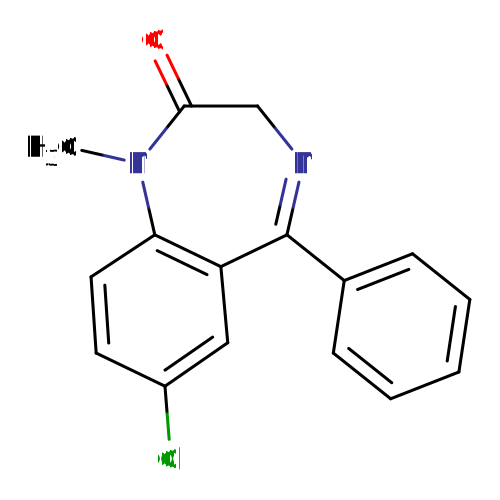
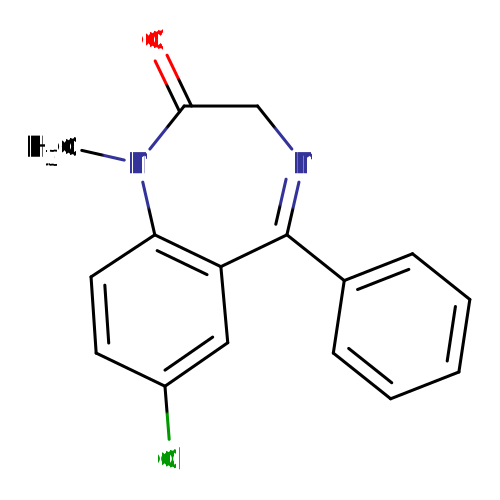
| Description | Diazepam, also known as valium or diastat, belongs to the class of organic compounds known as 1,4-benzodiazepines. These are organic compounds containing a benzene ring fused to a 1,4-azepine. Diazepam is a moderately basic compound (based on its pKa). Outside of the human body, Diazepam has been detected, but not quantified in, common wheats and potato. This could make diazepam a potential biomarker for the consumption of these foods. Diazepam is a potentially toxic compound. Diazepam is found in Glycine max, Homo sapiens and Mentha spicata. Diazepam was first documented in 1979 (PMID: 458601). A 1,4-benzodiazepinone that is 1,3-dihydro-2H-1,4-benzodiazepin-2-one substituted by a chloro group at position 7, a methyl group at position 1 and a phenyl group at position 5 (PMID: 2450203) (PMID: 3089825) (PMID: 7911332) (PMID: 11995921). |
|---|
| Structure | CN1C2=C(C=C(Cl)C=C2)C(=NCC1=O)C1=CC=CC=C1 InChI=1S/C16H13ClN2O/c1-19-14-8-7-12(17)9-13(14)16(18-10-15(19)20)11-5-3-2-4-6-11/h2-9H,10H2,1H3 |
|---|
| Synonyms | | Value | Source |
|---|
| 7-Chloro-1,3-dihydro-1-methyl-5-phenyl-2H-1,4-benzodiazepin-2-one | ChEBI | | Methyl diazepinone | ChEBI | | Valium | ChEBI | | Diastat | Kegg | | Methyldiazepinone | HMDB | | Apaurin | HMDB | | Faustan | HMDB | | Relanium | HMDB | | Seduxen | HMDB | | Diazemuls | HMDB | | Sibazon | HMDB | | Stesolid | HMDB |
|
|---|
| Chemical Formula | C16H13ClN2O |
|---|
| Average Mass | 284.7400 Da |
|---|
| Monoisotopic Mass | 284.07164 Da |
|---|
| IUPAC Name | 7-chloro-1-methyl-5-phenyl-2,3-dihydro-1H-1,4-benzodiazepin-2-one |
|---|
| Traditional Name | diazepam |
|---|
| CAS Registry Number | 439-14-5 |
|---|
| SMILES | CN1C2=C(C=C(Cl)C=C2)C(=NCC1=O)C1=CC=CC=C1 |
|---|
| InChI Identifier | InChI=1S/C16H13ClN2O/c1-19-14-8-7-12(17)9-13(14)16(18-10-15(19)20)11-5-3-2-4-6-11/h2-9H,10H2,1H3 |
|---|
| InChI Key | AAOVKJBEBIDNHE-UHFFFAOYSA-N |
|---|
| Experimental Spectra |
|---|
|
| Not Available | | Predicted Spectra |
|---|
|
| Not Available | | Chemical Shift Submissions |
|---|
|
| Not Available | | Species |
|---|
| Species of Origin | |
|---|
| Chemical Taxonomy |
|---|
| Description | Belongs to the class of organic compounds known as 1,4-benzodiazepines. These are organic compounds containing a benzene ring fused to a 1,4-azepine. |
|---|
| Kingdom | Organic compounds |
|---|
| Super Class | Organoheterocyclic compounds |
|---|
| Class | Benzodiazepines |
|---|
| Sub Class | 1,4-benzodiazepines |
|---|
| Direct Parent | 1,4-benzodiazepines |
|---|
| Alternative Parents | |
|---|
| Substituents | - 1,4-benzodiazepine
- Alpha-amino acid or derivatives
- Aryl chloride
- Aryl halide
- Monocyclic benzene moiety
- Benzenoid
- Tertiary carboxylic acid amide
- Carboxamide group
- Ketimine
- Lactam
- Carboxylic acid derivative
- Azacycle
- Propargyl-type 1,3-dipolar organic compound
- Organic 1,3-dipolar compound
- Hydrocarbon derivative
- Organooxygen compound
- Organonitrogen compound
- Organochloride
- Organohalogen compound
- Organic oxygen compound
- Imine
- Organic nitrogen compound
- Carbonyl group
- Organic oxide
- Organopnictogen compound
- Aromatic heteropolycyclic compound
|
|---|
| Molecular Framework | Aromatic heteropolycyclic compounds |
|---|
| External Descriptors | |
|---|
| Physical Properties |
|---|
| State | Not Available |
|---|
| Experimental Properties | | Property | Value | Reference |
|---|
| Melting Point | Not Available | Not Available | | Boiling Point | Not Available | Not Available | | Water Solubility | Not Available | Not Available | | LogP | Not Available | Not Available |
|
|---|
| Predicted Properties | |
|---|
| General References | - Earley JV, Fryer RI, Ning RY: Quinazolines and 1,4-benzodiazepines. LXXXIX: Haptens useful in benzodiazepine immunoassay development. J Pharm Sci. 1979 Jul;68(7):845-50. doi: 10.1002/jps.2600680715. [PubMed:458601 ]
- McLean MJ, Macdonald RL: Benzodiazepines, but not beta carbolines, limit high frequency repetitive firing of action potentials of spinal cord neurons in cell culture. J Pharmacol Exp Ther. 1988 Feb;244(2):789-95. [PubMed:2450203 ]
- Oishi R, Nishibori M, Itoh Y, Saeki K: Diazepam-induced decrease in histamine turnover in mouse brain. Eur J Pharmacol. 1986 May 27;124(3):337-42. doi: 10.1016/0014-2999(86)90236-0. [PubMed:3089825 ]
- Mant A, Whicker SD, McManus P, Birkett DJ, Edmonds D, Dumbrell D: Benzodiazepine utilisation in Australia: report from a new pharmacoepidemiological database. Aust J Public Health. 1993 Dec;17(4):345-9. doi: 10.1111/j.1753-6405.1993.tb00167.x. [PubMed:7911332 ]
- Usami N, Yamamoto T, Shintani S, Ishikura S, Higaki Y, Katagiri Y, Hara A: Substrate specificity of human 3(20)alpha-hydroxysteroid dehydrogenase for neurosteroids and its inhibition by benzodiazepines. Biol Pharm Bull. 2002 Apr;25(4):441-5. doi: 10.1248/bpb.25.441. [PubMed:11995921 ]
|
|---|