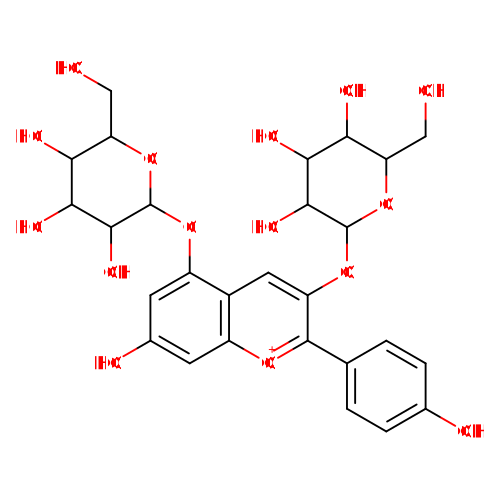
| Record Information |
|---|
| Version | 2.0 |
|---|
| Created at | 2022-03-17 20:32:41 UTC |
|---|
| Updated at | 2022-03-17 20:32:41 UTC |
|---|
| NP-MRD ID | NP0046982 |
|---|
| Secondary Accession Numbers | None |
|---|
| Natural Product Identification |
|---|
| Common Name | Pelargonidin 3,5-di-O-glucoside |
|---|
| Description | Pelargonin, also known as monardin or punicin, belongs to the class of organic compounds known as anthocyanidin-5-o-glycosides. These are phenolic compounds containing one anthocyanidin moiety which is O-glycosidically linked to a carbohydrate moiety at the C5-position. It is the 3,5-O-diglucoside of pelargonidin. Pelargonin is an extremely weak basic (essentially neutral) compound (based on its pKa). Outside of the human body, pelargonin is found, on average, in the highest concentration in common beans and pomegranates. Pelargonin has also been detected, but not quantified in, several different foods, such as fruits, grass pea, green beans, rose hips, and yellow wax beans. This could make pelargonin a potential biomarker for the consumption of these foods. Pelargonin is a pigment, found in barberries, the petals of the scarlet pelargonium flower pomegranates, and red wine. Pelargonidin 3,5-di-O-glucoside is found in Broughtonia spp., Callistemon lanceolatus, Commiphora mukul , Dianthus caryophyllus , Erythrina suberosa , Eustoma grandiflorum, Fuchsia spp., Gladiolus spp., Impatiens balsamina , Ipomoea nil , Lathyrus odoratus , Lathyrus sativus , Lumnitzera littorea, Pelargonium dolomiticum, Pelargonium zonale , Phaseolus vulgaris , Rosa spp., Ruellia spp., Saraca indica , Silene dioica and Victoria regia . Pelargonin is an anthocyanin. |
|---|
| Structure | OCC1OC(OC2=CC(O)=CC3=C2C=C(OC2OC(CO)C(O)C(O)C2O)C(=[O+]3)C2=CC=C(O)C=C2)C(O)C(O)C1O InChI=1S/C27H30O15/c28-8-17-19(32)21(34)23(36)26(41-17)39-15-6-12(31)5-14-13(15)7-16(25(38-14)10-1-3-11(30)4-2-10)40-27-24(37)22(35)20(33)18(9-29)42-27/h1-7,17-24,26-29,32-37H,8-9H2,(H-,30,31)/p+1 |
|---|
| Synonyms | | Value | Source |
|---|
| Monardin | HMDB | | Pelargonidin 3,5-di-beta-D-glucopyranoside | HMDB | | Pelargonidin 3,5-di-beta-D-glucoside | HMDB | | Pelargonidin 3,5-diglucoside | HMDB | | Pelargonidin 3,5-O-diglucoside | HMDB | | Pelargonin? | HMDB | | Punicin | HMDB | | Salvinin? | HMDB |
|
|---|
| Chemical Formula | C27H31O15 |
|---|
| Average Mass | 595.5260 Da |
|---|
| Monoisotopic Mass | 595.16630 Da |
|---|
| IUPAC Name | 7-hydroxy-2-(4-hydroxyphenyl)-3,5-bis({[3,4,5-trihydroxy-6-(hydroxymethyl)oxan-2-yl]oxy})-1λ⁴-chromen-1-ylium |
|---|
| Traditional Name | 7-hydroxy-2-(4-hydroxyphenyl)-3,5-bis({[3,4,5-trihydroxy-6-(hydroxymethyl)oxan-2-yl]oxy})-1λ⁴-chromen-1-ylium |
|---|
| CAS Registry Number | 17334-58-6 |
|---|
| SMILES | OCC1OC(OC2=CC(O)=CC3=C2C=C(OC2OC(CO)C(O)C(O)C2O)C(=[O+]3)C2=CC=C(O)C=C2)C(O)C(O)C1O |
|---|
| InChI Identifier | InChI=1S/C27H30O15/c28-8-17-19(32)21(34)23(36)26(41-17)39-15-6-12(31)5-14-13(15)7-16(25(38-14)10-1-3-11(30)4-2-10)40-27-24(37)22(35)20(33)18(9-29)42-27/h1-7,17-24,26-29,32-37H,8-9H2,(H-,30,31)/p+1 |
|---|
| InChI Key | SLCKJKWFULXZBD-UHFFFAOYSA-O |
|---|
| Experimental Spectra |
|---|
|
| Not Available | | Predicted Spectra |
|---|
|
| Not Available | | Chemical Shift Submissions |
|---|
|
| Not Available | | Species |
|---|
| Species of Origin | |
|---|
| Chemical Taxonomy |
|---|
| Description | Belongs to the class of organic compounds known as anthocyanidin-5-o-glycosides. These are phenolic compounds containing one anthocyanidin moiety which is O-glycosidically linked to a carbohydrate moiety at the C5-position. |
|---|
| Kingdom | Organic compounds |
|---|
| Super Class | Phenylpropanoids and polyketides |
|---|
| Class | Flavonoids |
|---|
| Sub Class | Flavonoid glycosides |
|---|
| Direct Parent | Anthocyanidin-5-O-glycosides |
|---|
| Alternative Parents | |
|---|
| Substituents | - Anthocyanidin-3-o-glycoside
- Anthocyanidin-5-o-glycoside
- Flavonoid-3-o-glycoside
- 4'-hydroxyflavonoid
- 7-hydroxyflavonoid
- Hydroxyflavonoid
- Anthocyanidin
- Phenolic glycoside
- Hexose monosaccharide
- Glycosyl compound
- O-glycosyl compound
- Benzopyran
- 1-benzopyran
- 1-hydroxy-2-unsubstituted benzenoid
- Phenol
- Monocyclic benzene moiety
- Benzenoid
- Monosaccharide
- Oxane
- Heteroaromatic compound
- Secondary alcohol
- Organoheterocyclic compound
- Oxacycle
- Acetal
- Polyol
- Primary alcohol
- Hydrocarbon derivative
- Organic oxygen compound
- Organooxygen compound
- Alcohol
- Organic cation
- Aromatic heteropolycyclic compound
|
|---|
| Molecular Framework | Aromatic heteropolycyclic compounds |
|---|
| External Descriptors | Not Available |
|---|
| Physical Properties |
|---|
| State | Not Available |
|---|
| Experimental Properties | | Property | Value | Reference |
|---|
| Melting Point | Not Available | Not Available | | Boiling Point | Not Available | Not Available | | Water Solubility | Not Available | Not Available | | LogP | Not Available | Not Available |
|
|---|
| Predicted Properties | |
|---|