| Record Information |
|---|
| Version | 2.0 |
|---|
| Created at | 2022-03-17 20:32:38 UTC |
|---|
| Updated at | 2022-03-17 20:32:39 UTC |
|---|
| NP-MRD ID | NP0046979 |
|---|
| Secondary Accession Numbers | None |
|---|
| Natural Product Identification |
|---|
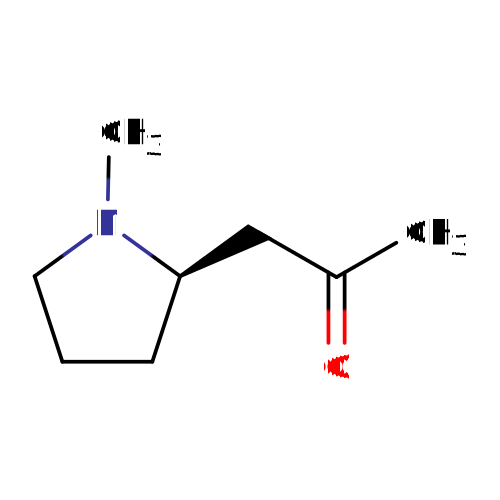
| Common Name | Hygrine |
|---|
| Description | Hygrine is found in Atropa belladonna, Brugmansia candida, Convolvulus arvensis, Datura ferox, Datura inoxia, Datura quercifolia, Datura stramonium, Dendrobium chrysanthum, Dendrobium polyanthum, Duboisia myoporoides, Erythroxylum argentinum, Erythroxylum coca, Erythroxylum monogynum, Erythroxylum novogranatense, Erythroxylum zambesiacum, Hyoscyamus albus, Nierembergia hippomanica, Physalis peruviana, Picea breweriana, Sedum laconicum and Sedum urvillei. Hygrine was first documented in 1949 (PMID: 18224841). |
|---|
| Structure | InChI=1S/C8H15NO/c1-7(10)6-8-4-3-5-9(8)2/h8H,3-6H2,1-2H3/t8-/m1/s1 |
|---|
| Synonyms | | Value | Source |
|---|
| (+)-Hygrine | ChEBI | | (+)-N-Methyl-2-acetonylpyrrolidine | ChEBI | | (R)-(+)-Hygrine | ChEBI | | (R)-1-(1-Methyl-2-pyrrolidinyl)-2-propanone | ChEBI | | (R)-Hygrine | ChEBI | | 1-[(2R)-1-Methylpyrrolidin-2-yl]acetone | ChEBI | | Hygrine, 2-(14)C-labeled, (+-)-isomer | MeSH | | 1-[(2R)-1-Methyl-2-pyrrolidinyl]-2-propanone | PhytoBank | | D-(+)-Hygrine | PhytoBank |
|
|---|
| Chemical Formula | C8H15NO |
|---|
| Average Mass | 141.2108 Da |
|---|
| Monoisotopic Mass | 141.11536 Da |
|---|
| IUPAC Name | 1-[(2R)-1-methylpyrrolidin-2-yl]propan-2-one |
|---|
| Traditional Name | (+)-hygrine |
|---|
| CAS Registry Number | 496-49-1 |
|---|
| SMILES | CN1CCC[C@@H]1CC(C)=O |
|---|
| InChI Identifier | InChI=1S/C8H15NO/c1-7(10)6-8-4-3-5-9(8)2/h8H,3-6H2,1-2H3/t8-/m1/s1 |
|---|
| InChI Key | ADKXZIOQKHHDNQ-MRVPVSSYSA-N |
|---|
| Experimental Spectra |
|---|
|
| Not Available | | Predicted Spectra |
|---|
|
| Not Available | | Chemical Shift Submissions |
|---|
|
| Not Available | | Species |
|---|
| Species of Origin | |
|---|
| Chemical Taxonomy |
|---|
| Description | Belongs to the class of organic compounds known as alkaloids and derivatives. These are naturally occurring chemical compounds that contain mostly basic nitrogen atoms. This group also includes some related compounds with neutral and even weakly acidic properties. Also some synthetic compounds of similar structure are attributed to alkaloids. In addition to carbon, hydrogen and nitrogen, alkaloids may also contain oxygen, sulfur and more rarely other elements such as chlorine, bromine, and phosphorus. |
|---|
| Kingdom | Organic compounds |
|---|
| Super Class | Alkaloids and derivatives |
|---|
| Class | Not Available |
|---|
| Sub Class | Not Available |
|---|
| Direct Parent | Alkaloids and derivatives |
|---|
| Alternative Parents | |
|---|
| Substituents | - Alkaloid or derivatives
- Beta-aminoketone
- N-alkylpyrrolidine
- Pyrrolidine
- Ketone
- Tertiary amine
- Tertiary aliphatic amine
- Organoheterocyclic compound
- Azacycle
- Organopnictogen compound
- Organic nitrogen compound
- Amine
- Organic oxygen compound
- Organooxygen compound
- Organonitrogen compound
- Carbonyl group
- Organic oxide
- Hydrocarbon derivative
- Aliphatic heteromonocyclic compound
|
|---|
| Molecular Framework | Aliphatic heteromonocyclic compounds |
|---|
| External Descriptors | |
|---|
| Physical Properties |
|---|
| State | Not Available |
|---|
| Experimental Properties | | Property | Value | Reference |
|---|
| Melting Point | Not Available | Not Available | | Boiling Point | Not Available | Not Available | | Water Solubility | Not Available | Not Available | | LogP | Not Available | Not Available |
|
|---|
| Predicted Properties | |
|---|
| General References | - Lee JH, Jeong BS, Ku JM, Jew SS, Park HG: Total synthesis of (+)-hygrine via asymmetric phase-transfer catalytic alkylation. J Org Chem. 2006 Aug 18;71(17):6690-2. doi: 10.1021/jo061108l. [PubMed:16901174 ]
- ANET E, HUGHES GK, et al.: Syntheses of hygrine and cuscohygrine. Nature. 1949 Feb 19;163(4138):289. doi: 10.1038/163289a0. [PubMed:18224841 ]
- McGaw BA, Woolley JC: The separate roles of hygrine enantiomers in the biosynthesis of tropane alkaloids [proceedings]. J Pharm Pharmacol. 1977 Dec;29 Suppl:16P. doi: 10.1111/j.2042-7158.1977.tb11484.x. [PubMed:22644 ]
- Parr AJ: Alternative metabolic fates of hygrine in transformed root cultures of Nicandra physaloides. Plant Cell Rep. 1992 Jun;11(5-6):270-3. doi: 10.1007/BF00235080. [PubMed:24203138 ]
- Rubio NC, Strano-Rossi S, Tabernero MJ, Gonzalez JL, Anzillotti L, Chiarotti M, Bermejo AM: Application of hygrine and cuscohygrine as possible markers to distinguish coca chewing from cocaine abuse on WDT and forensic cases. Forensic Sci Int. 2014 Oct;243:30-4. doi: 10.1016/j.forsciint.2014.02.024. Epub 2014 Mar 6. [PubMed:24656326 ]
|
|---|