| Record Information |
|---|
| Version | 2.0 |
|---|
| Created at | 2022-03-17 20:32:36 UTC |
|---|
| Updated at | 2022-03-17 20:32:36 UTC |
|---|
| NP-MRD ID | NP0046976 |
|---|
| Secondary Accession Numbers | None |
|---|
| Natural Product Identification |
|---|
| Common Name | Corilagin |
|---|
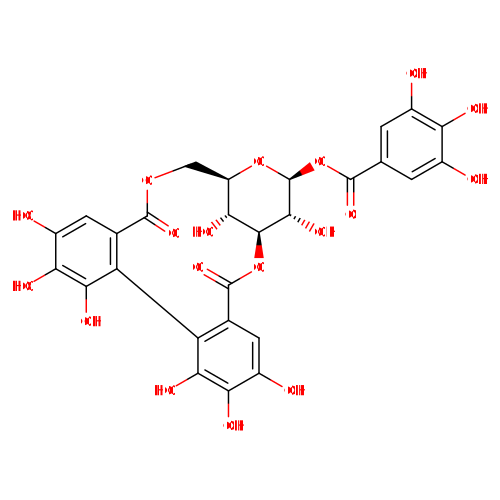
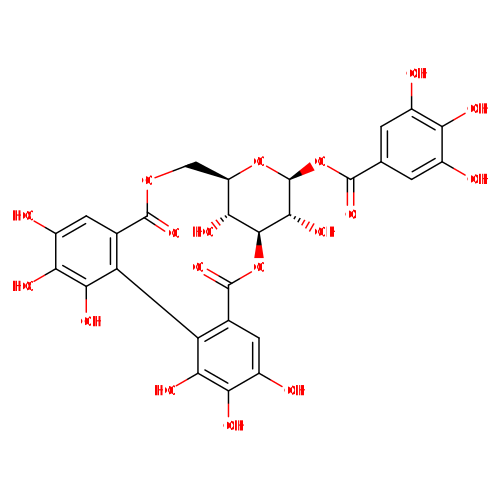
| Description | Corilagin, also known as gallotannin, belongs to the class of organic compounds known as hydrolyzable tannins. These are tannins with a structure characterized by either of the following models. In model 1, the structure contains galloyl units (in some cases, shikimic acid units) that are linked to diverse polyol carbohydrate-, catechin-, or triterpenoid units. In model 2, contains at least two galloyl units C-C coupled to each other, and do not contain a glycosidically linked catechin unit. Corilagin is an extremely weak basic (essentially neutral) compound (based on its pKa). Outside of the human body, Corilagin has been detected, but not quantified in, pomegranates. This could make corilagin a potential biomarker for the consumption of these foods. Corilagin is found in Acalypha australis, Acalypha hispida, Acalypha indica, Acer nikoense , Acer spp., Aleurites cordata, Anogeissus latifolia , Arctostaphylos uva-ursi, Bischofia javanica, Carpinus laxiflora, Caryocar villosum, Cercidiphyllum japonicum, Cunonia macrophylla, Euphoria longana , Erodium cicutarium, Erodium moschatum, Erodium stephanianum, Tetradium glabrifolium, Euphorbia fischeriana, Euphorbia helioscopia, Euphorbia humifusa, Euphorbia hyssopifolia, Euphorbia jolkinii, Euphorbia maculata, Euphorbia makinoi, Euphorbia prostrata, Euphorbia thymifolia, Excoecaria agallocha, Geranium sibiricum, Geranium thunbergii, Lotus corniculatus, Lumnitzera racemosa, Macaranga tanarius, Mallotus japonicus, Mallotus repandus, Nephelium lappaceum, Nymphaea alba , Nymphaea nouchali, Nymphaea stellata , Pelargonium reniforme, Phyllanthus amarus, Phyllanthus emblica , Phyllanthus flexuosus, Phyllanthus niruri, Phyllanthus tenellus, Phyllanthus urinaria , Phyllanthus virgatus, Poupartia fordii, Rhus semialata , Ricinus communis , Sapium japonicum, Sapium sebiferum , Terminalia catappa, Terminalia chebula , Terminalia citrina, Triadica sebifera and Vernicia fordii. Corilagin was first documented in 2003 (PMID: 14750026). An ellagitannin with a hexahydroxydiphenoyl group bridging over the 3-O and 6-O of the glucose core (PMID: 18486919). |
|---|
| Structure | O[C@@H]1[C@H]2COC(=O)C3=C(C(O)=C(O)C(O)=C3)C3=C(C=C(O)C(O)=C3O)C(=O)O[C@@H]1[C@@H](O)[C@H](OC(=O)C1=CC(O)=C(O)C(O)=C1)O2 InChI=1S/C27H22O18/c28-9-1-6(2-10(29)16(9)32)24(39)45-27-22(38)23-19(35)13(43-27)5-42-25(40)7-3-11(30)17(33)20(36)14(7)15-8(26(41)44-23)4-12(31)18(34)21(15)37/h1-4,13,19,22-23,27-38H,5H2/t13-,19-,22-,23+,27+/m1/s1 |
|---|
| Synonyms | | Value | Source |
|---|
| (beta-1-O-Galloyl-3,6-(R)-hexahydroxydiphenoyl-D-glucose) | ChEBI | | 1-O-Galloyl-3,6-hexahydroxydiphenic acid-beta-D-glucopyranose | ChEBI | | (b-1-O-Galloyl-3,6-(R)-hexahydroxydiphenoyl-D-glucose) | Generator | | (Β-1-O-galloyl-3,6-(R)-hexahydroxydiphenoyl-D-glucose) | Generator | | 1-O-Galloyl-3,6-hexahydroxydiphenate-b-D-glucopyranose | Generator | | 1-O-Galloyl-3,6-hexahydroxydiphenate-beta-D-glucopyranose | Generator | | 1-O-Galloyl-3,6-hexahydroxydiphenate-β-D-glucopyranose | Generator | | 1-O-Galloyl-3,6-hexahydroxydiphenic acid-b-D-glucopyranose | Generator | | 1-O-Galloyl-3,6-hexahydroxydiphenic acid-β-D-glucopyranose | Generator | | Corillagin | HMDB | | 1-O-Galloyl-3,6-(R)-hexahydroxydiphenol-beta-D-glucose | MeSH |
|
|---|
| Chemical Formula | C27H22O18 |
|---|
| Average Mass | 634.4528 Da |
|---|
| Monoisotopic Mass | 634.08061 Da |
|---|
| IUPAC Name | (1S,19R,21S,22R,23R)-6,7,8,11,12,13,22,23-octahydroxy-3,16-dioxo-2,17,20-trioxatetracyclo[17.3.1.0^{4,9}.0^{10,15}]tricosa-4,6,8,10,12,14-hexaen-21-yl 3,4,5-trihydroxybenzoate |
|---|
| Traditional Name | (1S,19R,21S,22R,23R)-6,7,8,11,12,13,22,23-octahydroxy-3,16-dioxo-2,17,20-trioxatetracyclo[17.3.1.0^{4,9}.0^{10,15}]tricosa-4,6,8,10,12,14-hexaen-21-yl 3,4,5-trihydroxybenzoate |
|---|
| CAS Registry Number | 23094-69-1 |
|---|
| SMILES | O[C@@H]1[C@H]2COC(=O)C3=C(C(O)=C(O)C(O)=C3)C3=C(C=C(O)C(O)=C3O)C(=O)O[C@@H]1[C@@H](O)[C@H](OC(=O)C1=CC(O)=C(O)C(O)=C1)O2 |
|---|
| InChI Identifier | InChI=1S/C27H22O18/c28-9-1-6(2-10(29)16(9)32)24(39)45-27-22(38)23-19(35)13(43-27)5-42-25(40)7-3-11(30)17(33)20(36)14(7)15-8(26(41)44-23)4-12(31)18(34)21(15)37/h1-4,13,19,22-23,27-38H,5H2/t13-,19-,22-,23+,27+/m1/s1 |
|---|
| InChI Key | TUSDEZXZIZRFGC-XIGLUPEJSA-N |
|---|
| Experimental Spectra |
|---|
|
| Not Available | | Predicted Spectra |
|---|
|
| Not Available | | Chemical Shift Submissions |
|---|
|
| Not Available | | Species |
|---|
| Species of Origin | |
|---|
| Chemical Taxonomy |
|---|
| Description | Belongs to the class of organic compounds known as hydrolyzable tannins. These are tannins with a structure characterized by either of the following models. In model 1, the structure contains galloyl units (in some cases, shikimic acid units) that are linked to diverse polyol carbohydrate-, catechin-, or triterpenoid units. In model 2, contains at least two galloyl units C-C coupled to each other, and do not contain a glycosidically linked catechin unit. |
|---|
| Kingdom | Organic compounds |
|---|
| Super Class | Phenylpropanoids and polyketides |
|---|
| Class | Tannins |
|---|
| Sub Class | Hydrolyzable tannins |
|---|
| Direct Parent | Hydrolyzable tannins |
|---|
| Alternative Parents | |
|---|
| Substituents | - Hydrolyzable tannin
- Macrolide
- Galloyl ester
- Gallic acid or derivatives
- P-hydroxybenzoic acid alkyl ester
- M-hydroxybenzoic acid ester
- P-hydroxybenzoic acid ester
- Benzoate ester
- Pyrogallol derivative
- Tricarboxylic acid or derivatives
- Benzenetriol
- Benzoic acid or derivatives
- Benzoyl
- 1-hydroxy-4-unsubstituted benzenoid
- Phenol
- 1-hydroxy-2-unsubstituted benzenoid
- Oxane
- Monocyclic benzene moiety
- Benzenoid
- Monosaccharide
- Lactone
- Secondary alcohol
- Carboxylic acid ester
- Acetal
- Oxacycle
- Organoheterocyclic compound
- Carboxylic acid derivative
- Polyol
- Hydrocarbon derivative
- Alcohol
- Organic oxygen compound
- Organic oxide
- Organooxygen compound
- Aromatic heteropolycyclic compound
|
|---|
| Molecular Framework | Aromatic heteropolycyclic compounds |
|---|
| External Descriptors | |
|---|
| Physical Properties |
|---|
| State | Not Available |
|---|
| Experimental Properties | | Property | Value | Reference |
|---|
| Melting Point | Not Available | Not Available | | Boiling Point | Not Available | Not Available | | Water Solubility | Not Available | Not Available | | LogP | Not Available | Not Available |
|
|---|
| Predicted Properties | |
|---|