| Record Information |
|---|
| Version | 2.0 |
|---|
| Created at | 2022-03-17 20:31:25 UTC |
|---|
| Updated at | 2022-03-17 20:31:25 UTC |
|---|
| NP-MRD ID | NP0046902 |
|---|
| Secondary Accession Numbers | None |
|---|
| Natural Product Identification |
|---|
| Common Name | Ceramide |
|---|
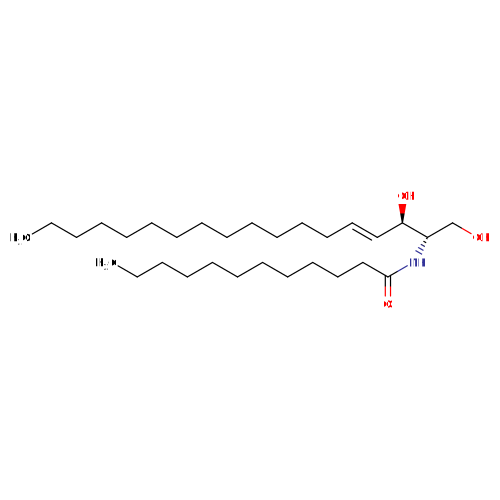
| Description | Ceramide (d18:1/12:0), Also known as N-(lauroyl)sphing-4-enine or N-(dodecanoyl)ceramide, belongs to the class of organic compounds known as ceramides. These are lipid molecules containing a sphingosine in which the amine group is linked to a fatty acid. Thus, ceramide (D18:1/12:0) Is considered to be a ceramide lipid molecule. Ceramide (d18:1/12:0) Is a very hydrophobic molecule, practically insoluble (in water), and relatively neutral. Outside of the human body, Ceramide (d18:1/12:0) Is found, on average, in the highest concentration within rices. Ceramide was first documented in 1990 (PMID: 2213006). This could make ceramide (D18:1/12:0) A potential biomarker for the consumption of these foods (PMID: 14722105) (PMID: 9545298) (PMID: 15067322) (PMID: 14693694) (PMID: 8163674) (PMID: 7954976). |
|---|
| Structure | [H][C@@](CO)(NC(=O)CCCCCCCCCCC)[C@H](O)\C=C\CCCCCCCCCCCCC InChI=1S/C30H59NO3/c1-3-5-7-9-11-13-14-15-16-18-19-21-23-25-29(33)28(27-32)31-30(34)26-24-22-20-17-12-10-8-6-4-2/h23,25,28-29,32-33H,3-22,24,26-27H2,1-2H3,(H,31,34)/b25-23+/t28-,29+/m0/s1 |
|---|
| Synonyms | | Value | Source |
|---|
| Cer(d18:1/12:0) | ChEBI | | Dodecyl sphingosine | ChEBI | | Laurylsphingosine | ChEBI | | N-(Dodecanoyl)ceramide | ChEBI | | N-(Dodecanoyl)sphing-4-enine | ChEBI | | N-(Lauroyl)ceramide | ChEBI | | N-(Lauroyl)sphing-4-enine | ChEBI | | N-Dodecanoylsphing-4-enine | ChEBI | | N-Lauroylsphing-4-enine | ChEBI | | N-Lauroylsphingosine | ChEBI | | (2S,3R,4E)-2-acylamino-1,3-Octadec-4-enediol | HMDB | | (2S,3R,4E)-2-Acylaminooctadec-4-ene-1,3-diol | HMDB | | Cer | HMDB | | Ceramide | HMDB | | N-Acylsphingosine | HMDB | | N-[(1S,2R,3E)-2-Hydroxy-1-(hydroxymethyl)-3-heptadecenyl]-octadecanamide | HMDB | | C12-Ceramide | HMDB | | Cer d18:1/12:0 | HMDB | | Ceramide (d18:1,C12:0) | HMDB | | Ceramide (d18:1/12:0) | HMDB | | Ceramide 12 | HMDB | | Ceramide(d18:1/12:0) | HMDB | | N-Lauroyl-D-erythro-sphingosine | HMDB | | N-Laurylsphingosine | HMDB |
|
|---|
| Chemical Formula | C30H59NO3 |
|---|
| Average Mass | 481.7944 Da |
|---|
| Monoisotopic Mass | 481.44949 Da |
|---|
| IUPAC Name | N-[(2S,3R,4E)-1,3-dihydroxyoctadec-4-en-2-yl]dodecanamide |
|---|
| Traditional Name | N-(dodecanoyl)-ceramide |
|---|
| CAS Registry Number | 74713-60-3 |
|---|
| SMILES | [H][C@@](CO)(NC(=O)CCCCCCCCCCC)[C@H](O)\C=C\CCCCCCCCCCCCC |
|---|
| InChI Identifier | InChI=1S/C30H59NO3/c1-3-5-7-9-11-13-14-15-16-18-19-21-23-25-29(33)28(27-32)31-30(34)26-24-22-20-17-12-10-8-6-4-2/h23,25,28-29,32-33H,3-22,24,26-27H2,1-2H3,(H,31,34)/b25-23+/t28-,29+/m0/s1 |
|---|
| InChI Key | HXFPPRPLRSPNIB-VARSQMIESA-N |
|---|
| Experimental Spectra |
|---|
|
| Not Available | | Predicted Spectra |
|---|
|
| Not Available | | Chemical Shift Submissions |
|---|
|
| Not Available | | Species |
|---|
| Species of Origin | |
|---|
| Chemical Taxonomy |
|---|
| Description | Belongs to the class of organic compounds known as ceramides. These are lipid molecules containing a sphingosine in which the amine group is linked to a fatty acid. |
|---|
| Kingdom | Organic compounds |
|---|
| Super Class | Lipids and lipid-like molecules |
|---|
| Class | Sphingolipids |
|---|
| Sub Class | Ceramides |
|---|
| Direct Parent | Ceramides |
|---|
| Alternative Parents | |
|---|
| Substituents | - Ceramide
- Fatty amide
- N-acyl-amine
- Fatty acyl
- Carboxamide group
- Secondary alcohol
- Secondary carboxylic acid amide
- Carboxylic acid derivative
- Primary alcohol
- Organooxygen compound
- Organonitrogen compound
- Organic oxide
- Organopnictogen compound
- Organic oxygen compound
- Alcohol
- Organic nitrogen compound
- Carbonyl group
- Hydrocarbon derivative
- Aliphatic acyclic compound
|
|---|
| Molecular Framework | Aliphatic acyclic compounds |
|---|
| External Descriptors | |
|---|
| Physical Properties |
|---|
| State | Not Available |
|---|
| Experimental Properties | | Property | Value | Reference |
|---|
| Melting Point | Not Available | Not Available | | Boiling Point | Not Available | Not Available | | Water Solubility | Not Available | Not Available | | LogP | Not Available | Not Available |
|
|---|
| Predicted Properties | |
|---|
| General References | - Deguchi H, Yegneswaran S, Griffin JH: Sphingolipids as bioactive regulators of thrombin generation. J Biol Chem. 2004 Mar 26;279(13):12036-42. Epub 2004 Jan 13. [PubMed:14722105 ]
- Watanabe R, Wu K, Paul P, Marks DL, Kobayashi T, Pittelkow MR, Pagano RE: Up-regulation of glucosylceramide synthase expression and activity during human keratinocyte differentiation. J Biol Chem. 1998 Apr 17;273(16):9651-5. doi: 10.1074/jbc.273.16.9651. [PubMed:9545298 ]
- Mari M, Colell A, Morales A, Paneda C, Varela-Nieto I, Garcia-Ruiz C, Fernandez-Checa JC: Acidic sphingomyelinase downregulates the liver-specific methionine adenosyltransferase 1A, contributing to tumor necrosis factor-induced lethal hepatitis. J Clin Invest. 2004 Mar;113(6):895-904. doi: 10.1172/JCI19852. [PubMed:15067322 ]
- Adams JM 2nd, Pratipanawatr T, Berria R, Wang E, DeFronzo RA, Sullards MC, Mandarino LJ: Ceramide content is increased in skeletal muscle from obese insulin-resistant humans. Diabetes. 2004 Jan;53(1):25-31. doi: 10.2337/diabetes.53.1.25. [PubMed:14693694 ]
- Holleran WM, Ginns EI, Menon GK, Grundmann JU, Fartasch M, McKinney CE, Elias PM, Sidransky E: Consequences of beta-glucocerebrosidase deficiency in epidermis. Ultrastructure and permeability barrier alterations in Gaucher disease. J Clin Invest. 1994 Apr;93(4):1756-64. doi: 10.1172/JCI117160. [PubMed:8163674 ]
- Marchesini S, Demasi L, Cestone P, Preti A, Agmon V, Dagan A, Navon R, Gatt S: Sulforhodamine GM1-ganglioside: synthesis and physicochemical properties. Chem Phys Lipids. 1994 Aug 8;72(2):143-52. doi: 10.1016/0009-3084(94)90098-1. [PubMed:7954976 ]
- Poliak S, Gollan L, Salomon D, Berglund EO, Ohara R, Ranscht B, Peles E: Localization of Caspr2 in myelinated nerves depends on axon-glia interactions and the generation of barriers along the axon. J Neurosci. 2001 Oct 1;21(19):7568-75. [PubMed:11567047 ]
- Ohnishi Y, Okino N, Ito M, Imayama S: Ceramidase activity in bacterial skin flora as a possible cause of ceramide deficiency in atopic dermatitis. Clin Diagn Lab Immunol. 1999 Jan;6(1):101-4. doi: 10.1128/CDLI.6.1.101-104.1999. [PubMed:9874672 ]
- Humbert P: [Functional consequences of cutaneous lipid perturbation]. Pathol Biol (Paris). 2003 Jul;51(5):271-4. doi: 10.1016/s0369-8114(03)00073-7. [PubMed:14567193 ]
- Ghadially R, Brown BE, Sequeira-Martin SM, Feingold KR, Elias PM: The aged epidermal permeability barrier. Structural, functional, and lipid biochemical abnormalities in humans and a senescent murine model. J Clin Invest. 1995 May;95(5):2281-90. doi: 10.1172/JCI117919. [PubMed:7738193 ]
- Ogawa-Goto K, Funamoto N, Abe T, Nagashima K: Different ceramide compositions of gangliosides between human motor and sensory nerves. J Neurochem. 1990 Nov;55(5):1486-93. doi: 10.1111/j.1471-4159.1990.tb04930.x. [PubMed:2213006 ]
- Cho Y, Lew BL, Seong K, Kim NI: An inverse relationship between ceramide synthesis and clinical severity in patients with psoriasis. J Korean Med Sci. 2004 Dec;19(6):859-63. doi: 10.3346/jkms.2004.19.6.859. [PubMed:15608398 ]
- Bouwstra JA, Honeywell-Nguyen PL, Gooris GS, Ponec M: Structure of the skin barrier and its modulation by vesicular formulations. Prog Lipid Res. 2003 Jan;42(1):1-36. doi: 10.1016/s0163-7827(02)00028-0. [PubMed:12467638 ]
- Uchida Y, Behne M, Quiec D, Elias PM, Holleran WM: Vitamin C stimulates sphingolipid production and markers of barrier formation in submerged human keratinocyte cultures. J Invest Dermatol. 2001 Nov;117(5):1307-13. doi: 10.1046/j.0022-202x.2001.01555.x. [PubMed:11710949 ]
- Petrache I, Natarajan V, Zhen L, Medler TR, Richter AT, Cho C, Hubbard WC, Berdyshev EV, Tuder RM: Ceramide upregulation causes pulmonary cell apoptosis and emphysema-like disease in mice. Nat Med. 2005 May;11(5):491-8. doi: 10.1038/nm1238. Epub 2005 Apr 24. [PubMed:15852018 ]
|
|---|