| Record Information |
|---|
| Version | 2.0 |
|---|
| Created at | 2022-03-17 20:30:35 UTC |
|---|
| Updated at | 2022-03-17 20:30:35 UTC |
|---|
| NP-MRD ID | NP0046852 |
|---|
| Secondary Accession Numbers | None |
|---|
| Natural Product Identification |
|---|
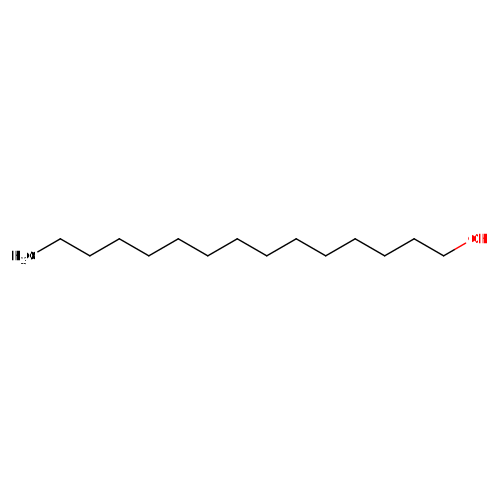
| Common Name | 1-Pentadecanol |
|---|
| Description | Pentadecanol, also known as neodol 5, belongs to the class of organic compounds known as long-chain fatty alcohols. These are fatty alcohols that have an aliphatic tail of 13 to 21 carbon atoms. Thus, pentadecanol is considered to be a fatty alcohol lipid molecule. Dependent pancreatic carboxyl esterase, releasing long chain alcohols and fatty acids that are absorbed in the gastrointestinal tract. Pentadecanol is a very hydrophobic molecule, practically insoluble (in water), and relatively neutral. Outside of the human body, Pentadecanol has been detected, but not quantified in, bitter gourds and soft-necked garlics. This could make pentadecanol a potential biomarker for the consumption of these foods. The metabolism of these compounds is impaired in several inherited human peroxisomal disorders, including adrenoleukodystrophy and Sjögren-Larsson syndrome. 20 Mg per day of mixed C24?. Very long chain fatty alcohols (VLCFA), obtained from plant waxes and beeswax have been reported to lower plasma cholesterol in humans. Studies of fatty alcohol metabolism in fibroblasts suggest that very long chain fatty alcohols, fatty aldehydes, and fatty acids are reversibly inter-converted in a fatty alcohol cycle. Reports suggest that 5–20 mg per day of mixed C24–C34 alcohols, including octacosanol and triacontanol, lower low-density lipoprotein (LDL) cholesterol by 21%–29% and raise high-density lipoprotein cholesterol by 8%–15%. 1-Pentadecanol is found in Ambrosia trifida, Angelica gigas, Breynia vitis-idaea, Cichorium endivia, Eucalyptus globulus, Glycyrrhiza glabra, Hamamelis virginiana, Morina persica and Pelargonium endlicherianum. 1-Pentadecanol was first documented in 2010 (PMID: 20491078). Wax esters are hydrolyzed by a bile salt-dependent pancreatic carboxyl esterase, releasing long chain alcohols and fatty acids that are absorbed in the gastrointestinal tract (PMID: 22260222). |
|---|
| Structure | InChI=1S/C15H32O/c1-2-3-4-5-6-7-8-9-10-11-12-13-14-15-16/h16H,2-15H2,1H3 |
|---|
| Synonyms | | Value | Source |
|---|
| 1-Pentadecanol | ChEBI | | N-1-Pentadecanol | ChEBI | | N-Pentadecanol | ChEBI | | Pentadecyl alcohol | ChEBI | | 1-Pentadecanol (acd/name 4.0) | HMDB | | N-Ppentadecanol | HMDB | | Neodol 5 | HMDB | | Pentadecan-1-ol | HMDB | | Pentadecanol-(1) | HMDB |
|
|---|
| Chemical Formula | C15H32O |
|---|
| Average Mass | 228.4140 Da |
|---|
| Monoisotopic Mass | 228.24532 Da |
|---|
| IUPAC Name | pentadecan-1-ol |
|---|
| Traditional Name | 1-pentadecanol |
|---|
| CAS Registry Number | 629-76-5 |
|---|
| SMILES | CCCCCCCCCCCCCCCO |
|---|
| InChI Identifier | InChI=1S/C15H32O/c1-2-3-4-5-6-7-8-9-10-11-12-13-14-15-16/h16H,2-15H2,1H3 |
|---|
| InChI Key | REIUXOLGHVXAEO-UHFFFAOYSA-N |
|---|
| Experimental Spectra |
|---|
|
| Not Available | | Predicted Spectra |
|---|
|
| Not Available | | Chemical Shift Submissions |
|---|
|
| Not Available | | Species |
|---|
| Species of Origin | |
|---|
| Chemical Taxonomy |
|---|
| Description | Belongs to the class of organic compounds known as long-chain fatty alcohols. These are fatty alcohols that have an aliphatic tail of 13 to 21 carbon atoms. |
|---|
| Kingdom | Organic compounds |
|---|
| Super Class | Lipids and lipid-like molecules |
|---|
| Class | Fatty Acyls |
|---|
| Sub Class | Fatty alcohols |
|---|
| Direct Parent | Long-chain fatty alcohols |
|---|
| Alternative Parents | |
|---|
| Substituents | - Long chain fatty alcohol
- Organic oxygen compound
- Hydrocarbon derivative
- Primary alcohol
- Organooxygen compound
- Alcohol
- Aliphatic acyclic compound
|
|---|
| Molecular Framework | Aliphatic acyclic compounds |
|---|
| External Descriptors | |
|---|
| Physical Properties |
|---|
| State | Not Available |
|---|
| Experimental Properties | | Property | Value | Reference |
|---|
| Melting Point | Not Available | Not Available | | Boiling Point | Not Available | Not Available | | Water Solubility | Not Available | Not Available | | LogP | Not Available | Not Available |
|
|---|
| Predicted Properties | |
|---|
| General References | - Jerkovic I, Marijanovic Z, Ljubicic I, Gugic M: Contribution of the bees and combs to honey volatiles: blank-trial probe for chemical profiling of honey biodiversity. Chem Biodivers. 2010 May;7(5):1217-30. doi: 10.1002/cbdv.200900100. [PubMed:20491078 ]
- Agnihotri S, Wakode S, Ali M: Essential oil of Myrica esculenta Buch. Ham.: composition, antimicrobial and topical anti-inflammatory activities. Nat Prod Res. 2012;26(23):2266-9. doi: 10.1080/14786419.2011.652959. Epub 2012 Jan 19. [PubMed:22260222 ]
|
|---|