| Record Information |
|---|
| Version | 2.0 |
|---|
| Created at | 2022-03-17 20:28:50 UTC |
|---|
| Updated at | 2022-03-17 20:28:50 UTC |
|---|
| NP-MRD ID | NP0046744 |
|---|
| Secondary Accession Numbers | None |
|---|
| Natural Product Identification |
|---|
| Common Name | Ciliaric acid |
|---|
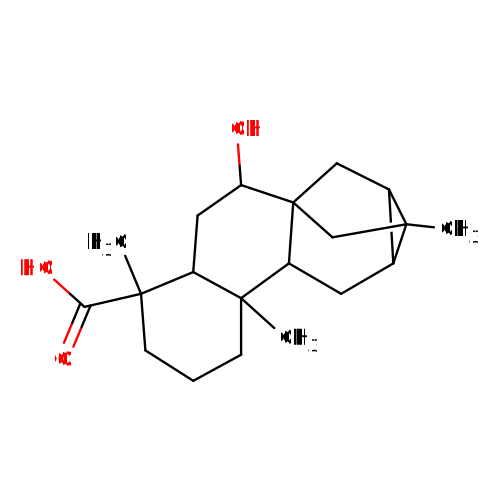
| Description | Ciliaric acid, also known as ciliarate, belongs to the class of organic compounds known as kaurane diterpenoids. These are diterpene alkaloids with a structure that is based on the kaurane skeleton. Kaurane is a tetracyclic compound that arises by cyclisation of a pimarane precursor followed by rearrangement. It possesses a [3,2,1]-bicyclic ring system with C15-C16 bridge connected to C13, forming the five-membered ring D. Ciliaric acid is found in Helianthus occidentalis, Helianthus petiolaris, Helianthus salicifolius, Psiadia punctulata and Xylopia aethiopica. Ciliaric acid is an extremely weak basic (essentially neutral) compound (based on its pKa). |
|---|
| Structure | CC12CC34CC1C2CC3C1(C)CCCC(C)(C1CC4O)C(O)=O InChI=1S/C20H30O3/c1-17-5-4-6-18(2,16(22)23)13(17)8-15(21)20-9-12-11(7-14(17)20)19(12,3)10-20/h11-15,21H,4-10H2,1-3H3,(H,22,23) |
|---|
| Synonyms | | Value | Source |
|---|
| Ciliarate | Generator |
|
|---|
| Chemical Formula | C20H30O3 |
|---|
| Average Mass | 318.4504 Da |
|---|
| Monoisotopic Mass | 318.21949 Da |
|---|
| IUPAC Name | 2-hydroxy-5,9,13-trimethylpentacyclo[11.2.1.0¹,¹⁰.0⁴,⁹.0¹²,¹⁴]hexadecane-5-carboxylic acid |
|---|
| Traditional Name | 2-hydroxy-5,9,13-trimethylpentacyclo[11.2.1.0¹,¹⁰.0⁴,⁹.0¹²,¹⁴]hexadecane-5-carboxylic acid |
|---|
| CAS Registry Number | Not Available |
|---|
| SMILES | CC12CC34CC1C2CC3C1(C)CCCC(C)(C1CC4O)C(O)=O |
|---|
| InChI Identifier | InChI=1S/C20H30O3/c1-17-5-4-6-18(2,16(22)23)13(17)8-15(21)20-9-12-11(7-14(17)20)19(12,3)10-20/h11-15,21H,4-10H2,1-3H3,(H,22,23) |
|---|
| InChI Key | REFPIPGRFRVTDA-UHFFFAOYSA-N |
|---|
| Experimental Spectra |
|---|
|
| Not Available | | Predicted Spectra |
|---|
|
| Not Available | | Chemical Shift Submissions |
|---|
|
| Not Available | | Species |
|---|
| Species of Origin | |
|---|
| Chemical Taxonomy |
|---|
| Description | Belongs to the class of organic compounds known as kaurane diterpenoids. These are diterpene alkaloids with a structure that is based on the kaurane skeleton. Kaurane is a tetracyclic compound that arises by cyclisation of a pimarane precursor followed by rearrangement. It possesses a [3,2,1]-bicyclic ring system with C15-C16 bridge connected to C13, forming the five-membered ring D. |
|---|
| Kingdom | Organic compounds |
|---|
| Super Class | Lipids and lipid-like molecules |
|---|
| Class | Prenol lipids |
|---|
| Sub Class | Diterpenoids |
|---|
| Direct Parent | Kaurane diterpenoids |
|---|
| Alternative Parents | |
|---|
| Substituents | - Atisane diterpenoid
- Kaurane diterpenoid
- Villanovane, atisane, trachylobane or helvifulvane diterpenoid
- Alkaloid or derivatives
- Cyclic alcohol
- Secondary alcohol
- Carboxylic acid derivative
- Carboxylic acid
- Monocarboxylic acid or derivatives
- Organic oxide
- Alcohol
- Carbonyl group
- Organic oxygen compound
- Organooxygen compound
- Hydrocarbon derivative
- Aliphatic homopolycyclic compound
|
|---|
| Molecular Framework | Aliphatic homopolycyclic compounds |
|---|
| External Descriptors | Not Available |
|---|
| Physical Properties |
|---|
| State | Not Available |
|---|
| Experimental Properties | | Property | Value | Reference |
|---|
| Melting Point | Not Available | Not Available | | Boiling Point | Not Available | Not Available | | Water Solubility | Not Available | Not Available | | LogP | Not Available | Not Available |
|
|---|
| Predicted Properties | |
|---|